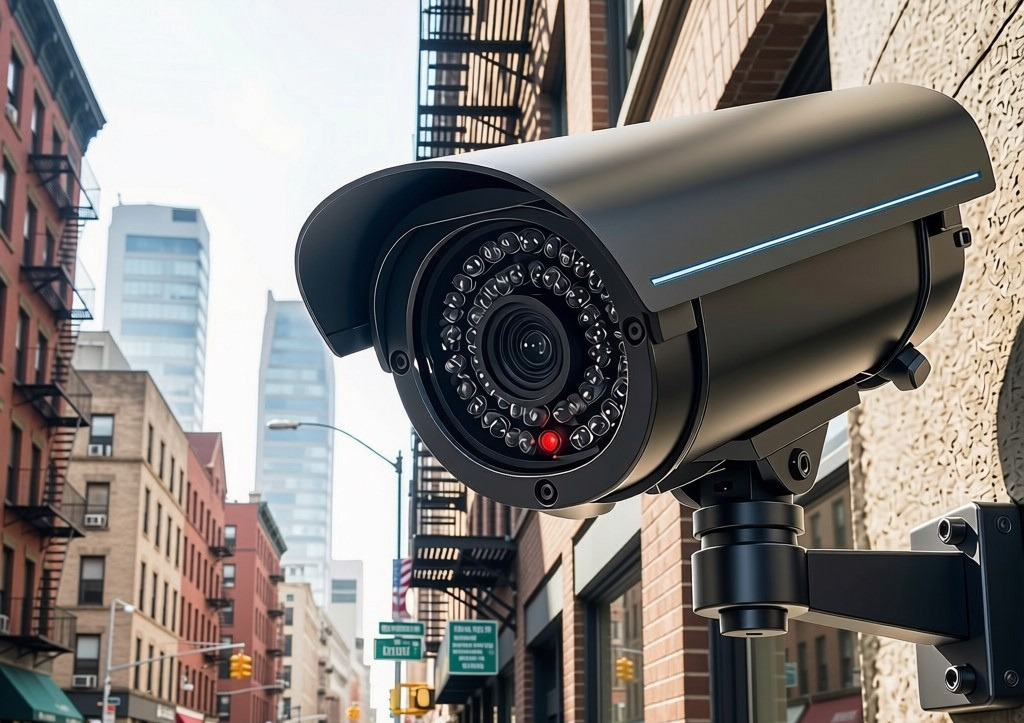
From facial recognition and license plate readers to public records and local oversight, an ACoM conversation with ethnic media examines how surveillance works—and what communities can do.
At about 5:30 a.m. on October 30, eight people were traveling to work in a white van in Woodburn, Oregon, when federal immigration agents surrounded the vehicle.
The agents did not know the identities of the people inside, according to immigration attorney Stephen Manning, who showed body-camera footage of the encounter during a September 10 conversation between American Community Media and ethnic media journalists.
What the agents did have, Manning said, was technology.
He said agents had used artificial intelligence and surveillance systems—including ELITE, which he described as built by Palantir and part of an Immigration OS platform, along with Mobile Fortify, Mobile Query and other data tools—to identify the van and surrounding area as a target. Manning said testimony in the case showed agents had earlier been scouting what was described as a “target-rich location” and conducting “live targeting.”
As the encounter unfolded, one woman in the van, identified in subsequent litigation by the initials MJMA, called 911. The occupants were eventually removed from the vehicle, handcuffed and lined up along the street, Manning said. Agents then used a cellphone to scan their faces in an effort to identify them.
The sequence raised a central question running through the American Community Media briefing: What happens when immigration enforcement does not have to begin with knowing who someone is?
American Community Media Executive Director Jaya Padmanabhan convened the discussion around two related subjects: artificial intelligence and surveillance in immigration enforcement, and community responses to the spread of those technologies. Ed Kissam, who helped structure the program, opened by arguing that the combination of AI-driven analytical tools and government access to growing amounts of personal data marked an “inflection point.”
The first conversation brought together Manning; Denise Bell, senior fellow at the Niskanen Center and co-author of the ACLU report Agents of Chaos and Cruelty; Steven Hubbard, senior data scientist at the American Immigration Council; and Saira Hussain, senior staff attorney at the Electronic Frontier Foundation.
A second panel featured former Flock Safety employee and immigrant-rights organizer Jonathan Paz; Brian Hofer, executive director of Secure Justice; Kimberly Woo, a community organizer with Services, Immigrant Rights and Education Network, or SIREN; Lena Graber of the Immigrant Legal Resource Center; and Abdi Soltani of the ACLU of Northern California.
Their perspectives differed, but a common issue emerged: the power of surveillance increasingly comes not from one camera or database, but from the ability to connect information collected across multiple systems.
Manning’s Woodburn case showed what that can mean on the ground.
Woodburn is about 45 minutes south of Portland in Oregon’s agricultural Willamette Valley. Manning described it as predominantly Latino, farmworker and immigrant. The case, MJMA v. DHS, began as a habeas petition and later became a class action.
Manning told journalists that his legal team had won a motion to compel that would allow broader discovery into Department of Homeland Security surveillance systems and how those systems contributed to the operation.
He described ELITE through the testimony of an agent as something like “Google Maps but for people”—a system in which people appear as points on a map and areas can be identified for enforcement activity. Manning used the image of a fishing dragnet to describe what he believes happened in Woodburn: technology identified an area and vehicle first, and agents determined who they had encountered afterward.
The case also showed the role community networks can play once an enforcement action begins.
After observers arrived at the Woodburn scene, calls went to Oregon’s rapid-response network, which alerted attorneys. Manning said he traveled in a small legal-services vehicle his organization calls the Justice Bus to reach the ICE processing facility in Portland.
Attorneys were given about three minutes with MJMA, he said, but that was enough to gather information and file a petition before she could be transferred out of Oregon.
MJMA remained in the state and became a class representative in the case. Manning said the other people in the van were deported and attorneys were denied access to them.
From there, the briefing widened from one enforcement action to a broader examination of what has been happening across communities.
Bell presented research covering more than 1,200 immigration enforcement incidents during 2025 in Arizona, California, Colorado, Florida, Illinois, Louisiana, Maryland and New Mexico.
She emphasized that researchers did not select only incidents already identified as civil-rights violations. They examined who was subjected to enforcement, where encounters happened and how they were carried out, then looked for recurring patterns.
Bell said the research documented 624 enforcement actions in everyday places and 252 incidents at locations including Home Depots, car washes, restaurants and rideshare lots. She also described patterns researchers classified as misconduct and racial profiling, including stops influenced by perceived race or ethnicity, language, accent, occupation or presence in particular locations.
The research, Bell said, also documented enforcement at courthouses and immigration check-ins.
For immigrant communities, that raises a practical issue beyond the technology itself: many ordinary interactions with government create records.
An address goes on an application. A person appears for an immigration appointment. Someone enters a courthouse because a hearing requires it. A family applies for a service for which it is eligible.
Those records may have been created for one purpose. The briefing focused on what can happen when that information moves across agencies or is combined with other sources.
Hubbard urged journalists not to become distracted by the term “artificial intelligence.”
“The more important story,” he said, is often the enormous amount of data government agencies can now “search, connect, and analyze.”
Hubbard, who leads data science, visualization and AI work related to immigration at the American Immigration Council, encouraged reporters to examine DHS AI inventories, privacy documents, agency policies, procurement records and Freedom of Information Act materials.
His advice was straightforward: “Follow the data, follow the connections.”
Hubbard also told the briefing that the DHS inventory showed a 36 percent increase in new AI systems within immigration enforcement over the previous six months. He cautioned against assuming that every development represented an expansion beyond its original mission, saying he did not have direct evidence to make that conclusion broadly.
Hussain brought the discussion back to data consolidation.
She said traditional immigration enforcement mechanisms have not disappeared. ICE can still encounter people through jails, immigration check-ins and courthouses. But alongside those longstanding pathways, she said, the federal government has been seeking to consolidate more information about individuals from different sources.
The result is an enforcement system in which established methods and newer technologies can operate together.
The afternoon discussion moved from how surveillance works to what communities and local governments can do about it.
Jonathan Paz offered an unusual perspective because he had once helped represent one of the companies now at the center of that debate.
Paz, a longtime union organizer, immigrant-rights activist and former Waltham, Massachusetts, city councilor, worked on the government affairs team at Flock Safety from 2024 to mid-2025. His job included representing the company before city councils, at public hearings and with elected officials.
Paz said he joined Flock believing in the public-safety case for its technology, including its potential to help find missing people.
He later left the company in protest, saying he had become concerned about surveillance and whether public and legal scrutiny could keep pace with the technology.
That tension—between public safety and privacy—became one of the most useful threads of the briefing.
Automated license plate readers can assist police investigations. But the same systems also collect information about vehicles moving through communities. Brian Hofer of Secure Justice argued that the concern grows when those records can be searched across networks or connected to other information.
The question, then, is not simply whether a camera can help solve a crime. It is who else can search the information, for what purpose and under what rules.
That distinction matters to Kimberly Woo, who told journalists that SIREN serves immigrant and refugee communities in California’s Bay Area and Central Valley.
Woo said immigrants have become concerned that information provided to access government programs or services could later be used for enforcement.
She offered one example: a community member who had injured a leg during war but was reluctant to apply for Medicaid because of concerns about how personal information might be tracked or used.
Whether those fears reflect how every particular dataset can legally be used is a separate policy question. Their effect on behavior is already significant, Woo argued: people can become reluctant to seek services for which they may be eligible.
Woo also described organizing across Bay Area communities to challenge surveillance contracts and push local governments to reconsider automated license plate reader programs.
Lena Graber of the Immigrant Legal Resource Center added an important distinction: technology is not responsible for all immigration arrests.
Graber, whose work focuses on sanctuary policies and cooperation between local law enforcement and ICE, noted that immigration enforcement continues through familiar channels—courthouses, immigration check-ins, workplace arrests and transfers from other law-enforcement agencies.
Her point was that surveillance technology should be understood as an additional layer on top of an enforcement system that already has multiple ways to locate people.
That also means local policy still matters.
Graber said sanctuary policies that limit how police and sheriffs cooperate with ICE can affect immigration enforcement outcomes.
Abdi Soltani of the ACLU of Northern California placed the debate in a broader civil-liberties frame. He argued that concerns about widespread tracking should not be treated solely as an immigrant issue because surveillance systems can collect information about everyone moving through a community.
At the same time, he said, aggregation of data can have a particularly direct impact on immigrants when it is used for detention and deportation.
When journalist Paul Kleyman asked how the public should weigh legitimate public-safety benefits against the civil-rights concerns raised during the briefing, Soltani drew a distinction between technologies closely tied to a particular behavior and systems that continuously collect information about people’s movements.
A speed camera, he said, is connected to the specific act of speeding. A system recording people’s movements across communities raises a different set of questions.
His argument was not that public safety should be dismissed, but that it should be pursued in ways that also protect civil liberties and civil rights.
That exchange resisted an easy conclusion.
Surveillance technologies can have public-safety uses. Communities also have legitimate questions about privacy, data sharing and government power. The policy challenge lies in determining what collection is necessary, what access should be permitted and what oversight should exist.
Ethnic media journalists pressed speakers on those boundaries.
Peter Schurmann, an editor with American Community Media, invoked the disclosures by Edward Snowden about U.S. government surveillance and asked what happens once surveillance infrastructure has already been built. How difficult is it to scale such systems back?
Manning’s answer was that once the infrastructure exists, it can be repurposed.
That concern extends the conversation beyond immigration.
A license plate reader does not collect information only from immigrants. A database does not contain records only about people without legal status. AI systems searching large government datasets may encounter information about citizens and noncitizens alike.
Soltani made that point explicitly, describing surveillance as an issue that affects everyone while acknowledging that its use for detention and deportation can have particular consequences for immigrants.
He also emphasized journalism’s role in bringing systems that may operate outside public view into public debate.
For ethnic media, that may be the most practical takeaway from the day.
Reporting on immigration surveillance cannot stop at saying that ICE uses artificial intelligence. The questions are more specific: What systems are being used? What data do they contain? Where did that information originate? Which agencies can access it? What did a local government authorize when it approved a surveillance contract? What restrictions exist? And who audits whether those restrictions are followed?
The speakers also identified places where communities still have agency.
Residents can ask local governments what surveillance technologies they have purchased and what policies govern their use. Journalists and community organizations can examine contracts, procurement records and public agency policies, and use public-records requests to investigate how information is collected and shared. Local debates over surveillance ordinances, data-sharing rules and cooperation with federal immigration authorities can determine what protections exist before a crisis occurs.
Rapid-response networks offer another form of community infrastructure. The Woodburn case showed how observers, organizers and attorneys can connect quickly when an enforcement action is underway. The response did not stop the operation, but according to Manning, it allowed one woman to reach legal counsel before she could be transferred out of Oregon.
The briefing’s message was not that any one of these measures can eliminate government surveillance. It was that understanding the system creates opportunities to question it, investigate it and participate in decisions about how it is used.
The Woodburn case shows why those opportunities matter.
At 5:30 in the morning, agents surrounded a van without knowing the identities of the eight people inside, according to Manning. The technology, he said, had helped identify the vehicle and area before agents identified the people.
Community observers then helped trigger another network—this one made up of residents and lawyers.
Those are two very different kinds of networks.
One gathers and connects information.
The other connects people.
As artificial intelligence makes it easier to search and connect information, the question for immigrant communities is no longer simply what technology government possesses. It is also what communities know about that technology, what rules govern it, and whether residents have a voice in deciding where its boundaries belong.
SEO Tags: Immigration Surveillance, AI and Immigration, ICE Enforcement, Immigrant Rights, Data Privacy, Civil Liberties, Flock Safety, Ethnic Media
Hashtags: #ImmigrantVoices #ImmigrantRights #AISurveillance #DataPrivacy #Immigration #CivilLiberties #EthnicMedia #CommunityPower #TheImmigrantMagazine
Social Snippets
1. AI surveillance is changing immigration enforcement—but communities are not without options. An ACoM conversation with ethnic media examines the technology, the data behind it and the tools communities can use to demand transparency and oversight.
2. “Follow the data, follow the connections.” From AI and facial recognition to license plate readers, experts explain how immigration surveillance works—and where communities still have power.
3. What surveillance technology has your city purchased? Who can access the data? How long is it stored? As AI reshapes immigration enforcement, those questions are becoming increasingly important for immigrant communities.
Image Suggestions
Primary image: An editorial photograph of an automated license plate reader or law-enforcement surveillance camera along a public roadway. Avoid generic AI graphics, which could make the reporting appear more speculative than the transcript supports.
Alt text: “A roadside surveillance camera monitors vehicles traveling on a public road.”
Suggested source: Wikimedia Commons or Unsplash, with the individual image license verified before publication.
Secondary image: A photograph from the American Community Media briefing showing speakers and ethnic media journalists in conversation, if ACoM has an image cleared for editorial use.
Alt text: “Speakers and ethnic media journalists discuss surveillance technology and immigration enforcement at an American Community Media briefing.”
Internal Linking Recommendations: Link immigration enforcement to recent The Immigrant Magazine coverage of ICE and deportation policy; immigrant rights to TIM’s Know Your Rights coverage; artificial intelligence to previous coverage of AI and immigrant communities; ethnic media to TIM reporting on community journalism; and data privacy to digital-security or privacy resources relevant to immigrant and mixed-status families.