
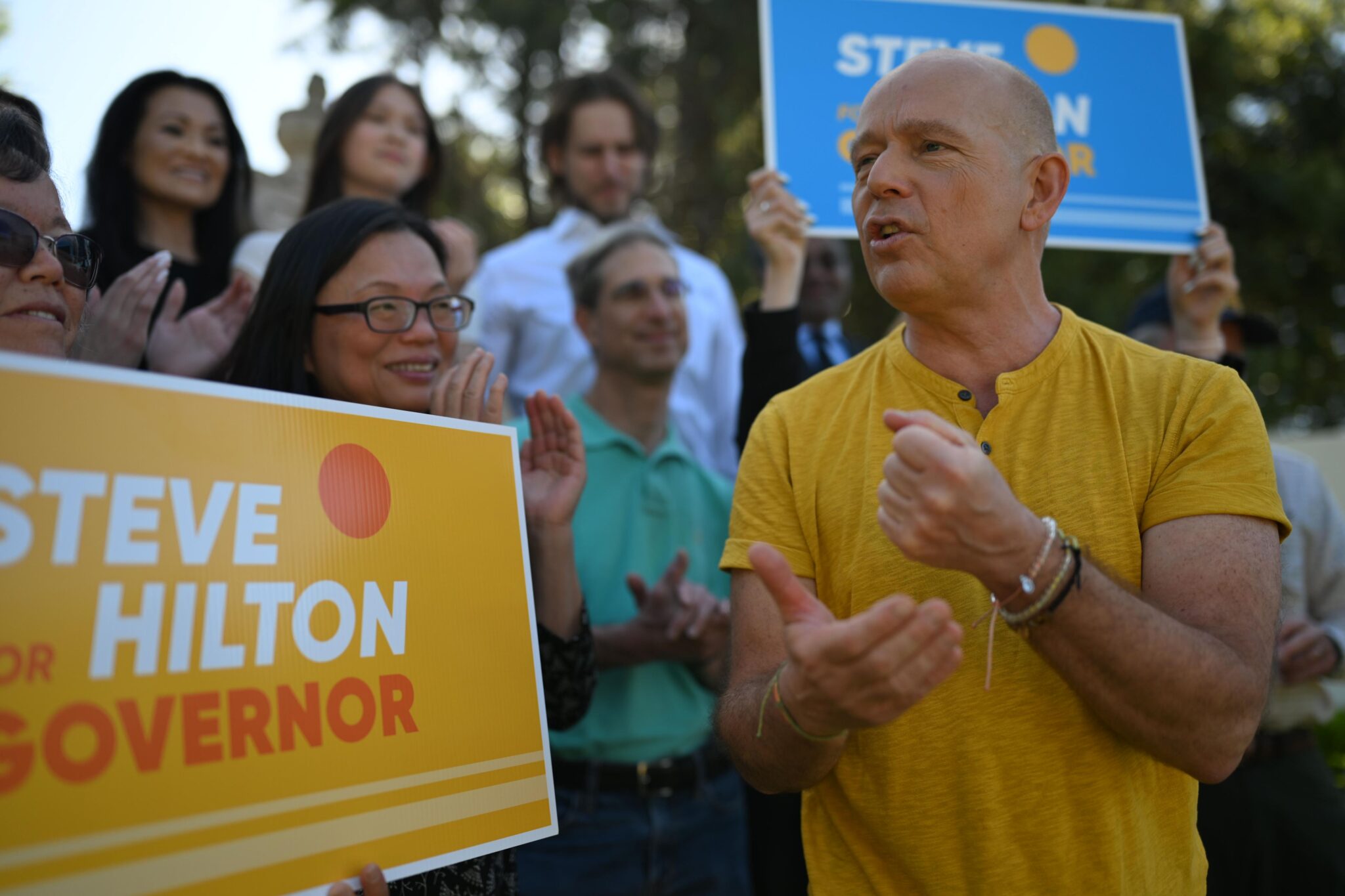
In an American Community Media briefing, the Republican gubernatorial candidate outlined his positions on legal immigration, affordability, healthcare, public safety, and the future of California opportunity.
Magazine, The Immigrant Experience
For generations, California has represented economic mobility for immigrant families seeking stability, opportunity, and a chance to build a better future.
That enduring promise was the backdrop to a recent American Community Media briefing featuring Steve Hilton, Republican candidate for governor.
Hosted by Pilar Marrero, associate editor of American Community Media (ACOM), the virtual conversation was part of ACOM’s California gubernatorial race series, which connects statewide candidates with ethnic media journalists serving Latino, Asian American, Black, African, and immigrant communities.
These briefings matter because ethnic media asks the questions that arise around kitchen tables and in community clinics, school parking lots, and small business storefronts.
Will our families be safe? Will healthcare remain within reach? Will our children have opportunities we did not? And who gets to belong in California’s future?
Hilton, an entrepreneur, political commentator, founder of Golden Together, and former senior adviser to British Prime Minister David Cameron, entered the briefing with a message calibrated for that audience.
He did not begin with party ideology.
He began with his own immigrant story.
“I’m a proud immigrant,” Hilton said.
His parents were Hungarian refugees who fled communism. He was raised in a working-class household in England before immigrating to California in 2012 with his wife and two sons. Since arriving, he said, he has taught at Stanford University, built a business, and become an American citizen.
“I’ve lived the California Dream,” he said.
The heart of his campaign, Hilton told reporters, is a belief that the same dream is slipping out of reach for millions of Californians.
A Conservative Case Framed Through an Immigrant Story
Hilton’s political message is rooted in a personal narrative that many immigrants understand instinctively.
His parents escaped authoritarianism. His family built a life through work. California rewarded initiative.
That journey gives Hilton a compelling biography and a political argument.
He presents himself as someone who believes deeply in immigration but insists that opportunity depends on lawful systems, fiscal discipline, and a government that functions.
Throughout the briefing, Hilton returned to one phrase: the ladder of opportunity.
Hilton used the phrase repeatedly to describe the economic progression many immigrant families pursue: steady employment, homeownership, small business ownership, and educational advancement for their children.
He argued that California’s rising costs and underperforming public institutions have made that progression more difficult.
Califordable: Hilton’s Economic Pitch
Hilton’s central campaign slogan is “Califordable,” a shorthand for his argument that government dysfunction has made everyday life unaffordable.
He cited high taxes, expensive housing, rising utility bills, and costly regulations as symptoms of a state that asks more from residents while delivering less.
To address those pressures, Hilton proposed:
- Eliminating state income tax on the first $100,000 earned.
- Ending California’s $800 annual tax on small businesses.
- Removing state taxes on tips.
- Reducing vehicle registration fees to a flat $71.
- Lowering gas and electricity costs by reversing current energy policies.
For families juggling rent, childcare, and grocery bills, Hilton’s affordability agenda is designed to offer immediate relief.
Whether voters believe those proposals are financially feasible will be central to the campaign.
But politically, the message is straightforward: California should once again reward work.
Immigration: Legal Pathways and State Cooperation
Pilar Marrero opened the discussion with immigration, asking how Hilton would approach cooperation with federal authorities, undocumented residents, and access to public services.
Hilton responded by emphasizing that immigration policy is primarily the responsibility of the federal government.
Still, he said that as governor he would not obstruct federal immigration enforcement.
“I’m a candidate of the legal immigrant community,” Hilton said.
He stressed that he supports immigration but believes it must occur through lawful channels.
His position reflects a sharp distinction between legal immigrants, whose stories he identifies with personally, and undocumented immigrants, whose status he argues places strain on state systems.
In California, where mixed-status households are common, distinctions between legal and undocumented immigration can affect entire families, including U.S. citizens, permanent residents, and undocumented relatives living under one roof.
Farmworkers and the Labor Question
Araceli Martínez-Ortega, a freelance journalist writing for Excélsior, raised one of the briefing’s most consequential questions.
If California agriculture relies heavily on undocumented workers, what happens if those workers are deported?
The question cut to the heart of a long-standing contradiction.
California’s economy depends on immigrant labor.
The strawberries in supermarket cartons, the grapes packed in the Central Valley, the produce that feeds the nation—all are tied to the work of people whose legal status is often precarious.
Hilton argued that an economy built on unauthorized labor is unsustainable.
He said California has millions of working-age adults who are not participating in the labor force and suggested welfare programs may discourage employment.
He also pointed to agricultural automation as a growing alternative.
His answer reflected a market-oriented view of labor and technology.
For farmworker families, the issue is tied directly to employment stability, legal protections, and the long-term sustainability of California agriculture.
Healthcare and the Cost of Inclusion
Asked about healthcare, Hilton said California hospitals face financial strain and staffing shortages.
He attributed those challenges to high operating costs, regulation, and increased demand.
He also stated that he opposes using state tax dollars to provide healthcare coverage for undocumented immigrants.
California has moved further than most states in extending Medi-Cal eligibility regardless of immigration status.
Supporters argue that preventive care lowers emergency costs and improves public health.
Critics, including Hilton, say scarce public resources should be prioritized for citizens and legal residents.
For low-income immigrant families, healthcare policy determines whether preventive care and treatment remain accessible and affordable.
Education, DEI, and Academic Outcomes
Néstor Fantini of Hispanic LA asked whether Hilton would follow national Republican efforts to eliminate diversity, equity, and inclusion programs.
Hilton said his priority would be ensuring taxpayer dollars are focused on academic fundamentals.
He pointed to poor reading and math outcomes among Latino and Black students as evidence that California’s schools are failing those who most need educational opportunity.
Hilton argued that parents want schools to emphasize core instruction over what he described as politicized initiatives.
The exchange highlighted one of the defining debates in public education.
Are equity programs essential tools for addressing historic barriers, or have schools drifted from their central mission?
For many immigrant families, educational opportunity remains one of the primary reasons they chose California.
Wildfires, Insurance, and the Price of Staying Put
A reporter from Chico Sol asked about climate change, wildfire prevention, and surging insurance rates.
Hilton argued that poor forest management, more than climate policy, has intensified California’s wildfire crisis.
He said overgrown forests and restrictive environmental rules have increased the risk of catastrophic fires.
On insurance, Hilton said excessive regulation and litigation have driven insurers out of California, leaving homeowners with fewer options and higher premiums.
For many first-generation homeowners, rising insurance costs threaten one of the most significant investments their families have made.
Hate Crimes and Public Safety
Nancy Tran asked how Hilton would respond to hate speech and hate crimes.
Hilton folded the issue into his broader public safety agenda, calling for stronger prosecution, greater support for law enforcement, and expanded rehabilitation programs.
He said California has not been sufficiently tough on hate crimes targeting Asian American and Jewish communities.
Tran pressed for preventive measures.
Hilton argued that reducing recidivism through rehabilitation is the most effective long-term strategy.
For immigrant communities, public safety includes both protection from crime and confidence that hate crimes will be investigated and prosecuted.
Immigration Reform and a Deliberate Silence
At the end of the briefing, Marrero asked whether Hilton supports federal immigration reform that would legalize long-term undocumented workers with families in the United States.
Hilton declined to take a position.
He reiterated that immigration reform is a federal issue and said his focus as governor would be to ensure state laws are peacefully enforced.
Hilton did not state whether he supports a pathway to legal status for long-term undocumented residents.
#SteveHilton #CaliforniaGovernor #ACOM #EthnicMedia #ImmigrationPolicy #CaliforniaDream #ImmigrantVoices #CaliforniaPolitics




1 Comment. Leave new
Loving the smooth betting experience on this platform. The interface feels super welcoming and the customer support team actually takes the time to help you out. It has quickly become my favorite spot for live markets. pawabetng