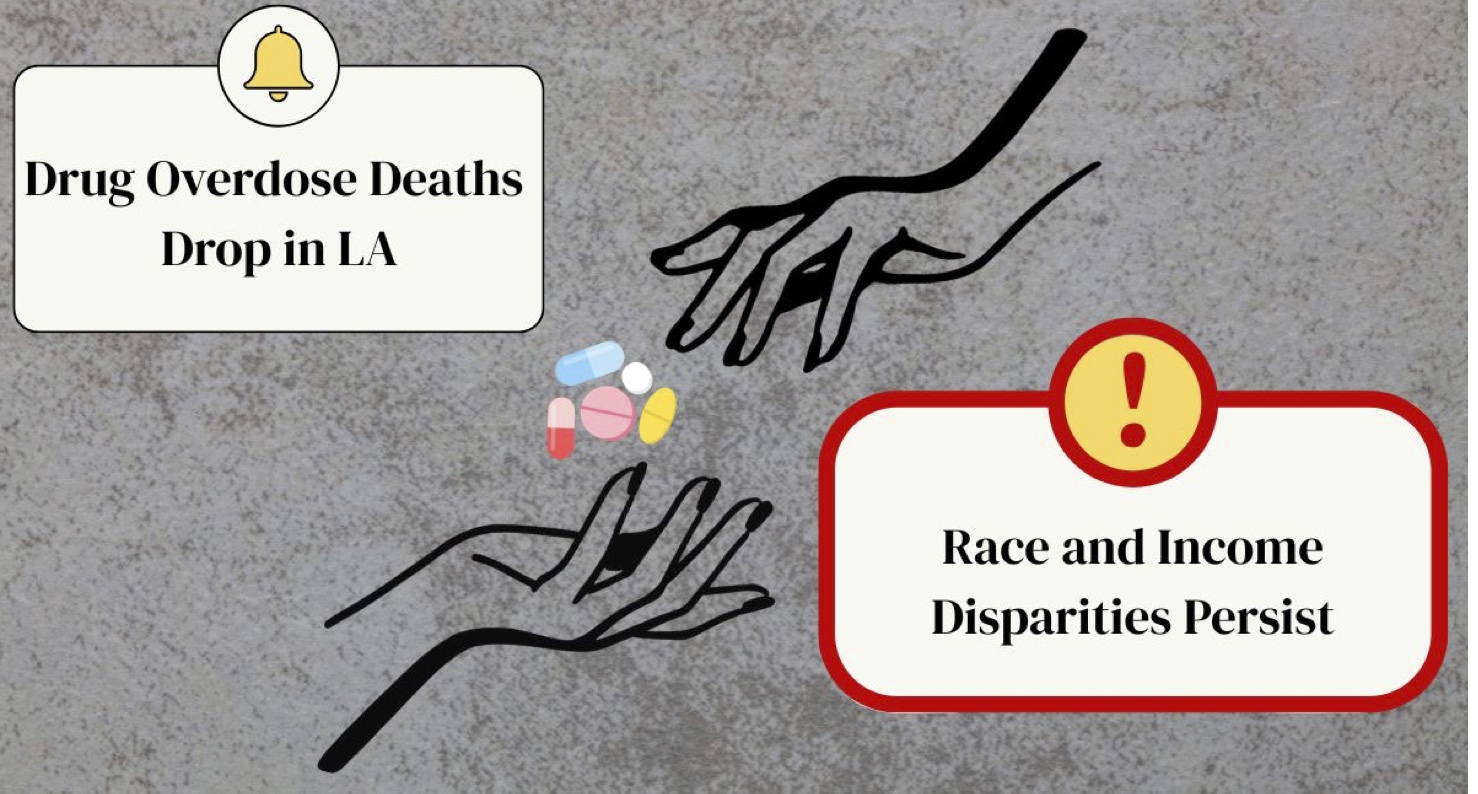
A 22% decline signals progress—but race, housing, and access still shape who is most at risk.
Overdose deaths are declining in Los Angeles County. But for Black, Latino, and immigrant communities, the conditions driving risk have not changed at the same pace.
That reality framed a recent ethnic media briefing hosted by American Community Media, where public health officials and frontline leaders presented new data alongside a more complex picture of who is benefiting from recent progress—and who is not.
The panel brought together four perspectives across the system: Dr. Brian Hurley, Medical Director of Substance Abuse Prevention and Control at the Los Angeles County Department of Public Health; Shoshana Scholar, Director of the Harm Reduction Division at the Los Angeles Department of Health Services; Kelvin Driscoll, Director of the Homeless Outreach Program Integrated Care System (HOPICS); and Aurora Morales, Associate Director of Community Initiatives at Homeless Health Care Los Angeles.
Each spoke from a different vantage point—data, systems, outreach, and lived experience—but their conclusions aligned.
The numbers are improving.
The inequities are not.
Hurley began with the data.
In 2024, Los Angeles County recorded a 22% decline in overdose deaths compared to the previous year. Fatalities involving fentanyl and methamphetamine—the primary drivers of overdose in the region—also decreased.
The trend reflects sustained investments in prevention, treatment, and harm reduction across multiple county systems.
But the same data highlights where those gains are not reaching.
Black residents continue to experience the highest overdose death rates in the county. Latino residents account for the largest number of deaths overall.
Among people experiencing homelessness, the risk is significantly higher—driven by isolation, unstable living conditions, and limited access to timely care.
“The decrease is not experienced equally across communities,” Hurley said.
He also emphasized the growing danger of fentanyl in the drug supply, where even small amounts can be lethal—particularly when individuals are unaware of what they are consuming.
Scholar outlined how the county is responding to those conditions through a four-part framework: prevention, harm reduction, treatment, and recovery.
In practice, much of the immediate impact is happening in harm reduction.
That includes widespread distribution of naloxone, now available over the counter; test strips that detect fentanyl and other substances; and outreach programs that engage individuals outside traditional healthcare settings.
These services are designed to operate without barriers.
They do not require abstinence.
They do not require enrollment.
They require access.
“Harm reduction services save lives and increase the likelihood that people eventually enter treatment,” Scholar said.
Los Angeles County has distributed millions of naloxone doses, with more than 50,000 reported overdose reversals since 2019—evidence that intervention is reaching people in real time.
But Scholar noted that access alone is not enough. Services must be delivered in ways that communities understand and trust.
That gap between availability and access becomes more visible at the community level.
Driscoll described how HOPICS operates in South Los Angeles, where overdose risk intersects with homelessness, poverty, and long-standing mistrust of institutional systems.
His teams conduct daily outreach in encampments, sidewalks, and drop-in centers—spaces designed to reduce barriers and create entry points for care.
Over the past year, HOPICS has distributed more than 48,000 doses of naloxone and documented nearly 600 overdose reversals.
But the effectiveness of that work depends on more than resources.
It depends on trust.
“Community-based providers reduce barriers to care,” Driscoll said.
Language, cultural familiarity, and concerns about interacting with formal systems often shape trust, especially for immigrant communities.
Organizations rooted in the community are often the first—and sometimes only—point of contact.
Morales described what that work looks like in practice.
Her teams operate in Skid Row and MacArthur Park, responding directly to overdoses with naloxone, oxygen, and other medical tools—often arriving before emergency services.
They also train community members to recognize and respond to overdoses, expanding the network of people who can intervene.
Because often, the first responder is not a clinician.
It is whoever is nearby.
Morales, who has experienced homelessness and substance use herself, emphasized that most overdoses are not intentional.
“People aren’t trying to die,” she said.
More often, overdoses occur at the intersection of potency and isolation—when someone is alone, and help is not immediately available.
That reality is particularly acute in communities where individuals are socially or economically isolated, including many immigrant populations.
For immigrant communities, the barriers discussed throughout the briefing take on additional layers.
Language remains a primary obstacle. While materials may be translated, they are not always accessible in practice—particularly when instructions around overdose response or treatment navigation rely on technical terminology.
Cultural stigma also plays a role.
In many households, substance use is not discussed openly. It is often associated with shame or moral failure, limiting awareness of available tools such as naloxone and delaying intervention until crisis.
Trust in public systems remains uneven.
Concerns about immigration status, surveillance, or past experiences with institutions can discourage individuals from seeking care—even when services are available.
Work and living conditions further compound risk.
Long hours, irregular schedules, and isolation reduce opportunities to access services and increase the likelihood that individuals use substances alone—one of the most significant risk factors in fatal overdose.
Public health efforts are beginning to address these gaps.
Bilingual outreach has expanded. Partnerships with community-based organizations are growing. Campaigns aimed at reducing stigma and reframing substance use as a health issue are gaining visibility.
But as the briefing made clear, progress in infrastructure does not automatically translate into equitable outcomes.
Access must be matched by understanding.
Services must be matched by trust.
Outreach must be matched by cultural relevance.
The broader trend reflects a national shift.
Overdose deaths are declining across the United States after years of increase. But disparities—across race, income, housing status, and access—remain consistent.
In Los Angeles County, those disparities are now the central challenge.
The systems to reduce deaths are in place.
The question is whether they are reaching the communities most at risk.
By the end of the briefing, the message was clear.
The decline in overdose deaths is real.
But progress that does not reach the most affected communities is incomplete.
The numbers are improving.
The inequities are not.
Until the conditions shaping risk change, the gap between progress and protection will remain.
#ImmigrantHealth #OverdosePrevention #HealthEquity #LatinoHealth #PublicHealth #HarmReduction #FentanylCrisis #CommunityHealth