With Two Minute Television, Namer looks beyond traditional TV to a mobile-first world where emerging creators can tell stories, find audiences, and build something of their own.
Long before television could fit inside a pocket, Larry Namer was working beneath the streets of Manhattan, splicing cable.
It was hardly a glamorous entrance into entertainment. The job was supposed to be temporary, and cable television itself was still unfamiliar enough that people wondered whether audiences would actually pay for television.
Namer stayed.
That temporary job became the beginning of a career spanning more than five decades—one that would eventually take him from the underground cables of New York to co-founding E! Entertainment Television.
Today, the screen commanding his attention is small enough to hold in one hand.
And this time, Namer is not only interested in what audiences are watching. He is interested in the moments when they are watching—and what those moments could mean for the people creating what they see.
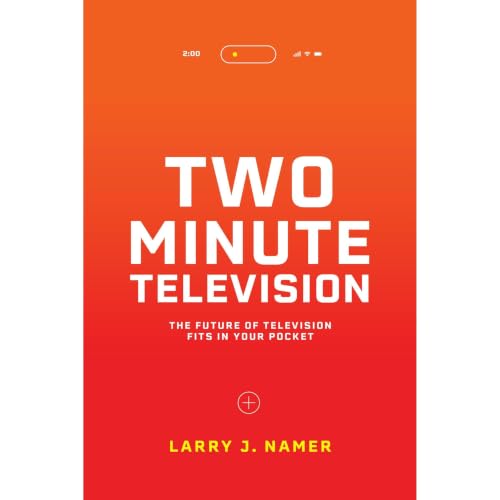
His new book, Two Minute Television: The Future of Television Fits in Your Pocket, explores microdramas: short, serialized stories created for the screen people carry everywhere.
But Namer is interested in more than the device.
He is paying attention to the minutes surrounding it.
The wait for coffee. The train ride home. Five minutes before the next meeting. The late-night scroll when sleep will not come.
These fragments of everyday life were never the natural territory of traditional television. Now they are becoming places where stories can live.
That is the world of the microdrama.
For Namer, its significance is larger than turning a screen sideways or shortening an episode.
The audience has moved.
So has the opportunity to reach it.
Two Minute Television moves from observation to instruction, examining how creators can develop a strong premise, capture attention quickly, build hooks and payoffs into short episodes, write visually for the 9:16 screen, and think differently about production, casting, platforms, and monetization.
Namer is not simply describing a new way to watch television.
He is asking creators to rethink how stories are made for moments television once overlooked—and what can be built from them.
An audience. A brand. A showcase for new talent. Perhaps the beginning of something larger.
For generations, getting a story onto television meant navigating an industry built around networks, studios, executives, schedules, and substantial production costs. Talent mattered, but so did proximity—to the right city, the right room, and the right introduction.
The smartphone does not erase those barriers.
But it changes the doorway.
A writer can imagine a destination beyond the television set. A filmmaker can create vertically from the beginning. A producer can test an idea and begin finding an audience without waiting for a network conference room.
The opportunity is not certainty.
It is access to the attempt.
And some of the stories waiting at that doorway have long lived beyond the traditional centers of entertainment—in family histories and neighborhood businesses, migration journeys and cultural collisions, and in lives unfolding between languages, countries, and generations.
The question has often been how those stories find an audience.
Increasingly, the answer may begin with something their creators already possess.
A phone.
Namer’s interest in this changing landscape fits a career spent watching the relationship between entertainment and its audience evolve.
His legacy is firmly tied to E! Entertainment Television, the network he co-founded and a brand that grew far beyond its American beginnings into an international entertainment presence.
That history alone could fill a book.
But Namer has chosen to write about what comes next.
Success has a curious way of turning people into monuments while they are still building. The athlete becomes the championship. The actor becomes the famous role. The entrepreneur becomes the company everyone remembers.
Larry Namer could easily become E!.
But that would leave out much of the story.
Across more than five decades in entertainment, Namer has had a close view of what happens when technology changes audience behavior.
Two Minute Television finds him studying another such moment.
Television once gathered families around a screen in the living room. Cable multiplied the choices. The internet broke down borders. Streaming loosened the schedule. The smartphone put the screen in the palm of the hand.
Microdrama goes one step further.
It changes television’s relationship with time.
A story no longer has to wait for the audience to sit down for an evening. It can meet people in the overlooked minutes of an ordinary day.
Perhaps the next change, then, is not simply where television is watched, but who gets to make it—and what they can build from it.
A phone, of course, is not a shortcut to a career. Technology can lower a barrier without doing the difficult work of storytelling. Audiences still have to care. Characters still have to hold attention. Stories still have to earn the next minute.
On a screen where the next distraction is one swipe away, that discipline may matter more than ever.
That is the opportunity Namer is examining—not television made smaller, but storytelling reconsidered for the audience holding it.
And the question of whose stories get seen extends naturally into another of Namer’s current projects.
He serves as executive producer of The Immigrant Podcast, hosted by The Immigrant Magazine founder Pamela Anchang. The series, which will be launched this fall, brings forward entrepreneurs, innovators, entertainers, athletes, business leaders, advocates, and everyday people whose journeys illuminate the contributions of immigrants.
Namer’s own story also carries an immigrant thread: his family has roots in Turkey. He has spoken about the importance of remembering how deeply immigrant contributions are woven into everyday life.
“One of the things that gets the strongest reaction is reminding people how many of the things we enjoy in everyday life exist because of the contributions of immigrants, both past and present,” Namer has said.
There is a natural connection between recognizing overlooked contributions and making room for overlooked stories.
And perhaps that is where Two Minute Television becomes most interesting.
Its promise is not that technology will make everyone successful. It is that the boundaries around who can attempt to tell a story, where that story can find an audience, and what a creator might build around it are shifting again.
More than five decades after Namer’s journey in television began, almost everything surrounding the medium has changed. The screens changed. The platforms changed. The audience moved.
The human appetite for stories remained.
Perhaps television was never really the box sitting in the living room. The box was simply where the stories happened to live at the time.
Now they live everywhere—in airports and waiting rooms, on trains, between meetings, and in those few quiet minutes at the end of a long day.
And increasingly, they live vertically.
Somewhere, there is a writer with a story who has never been inside a television studio.
A filmmaker whose hometown is nowhere near Hollywood.
An immigrant creator wondering whether an audience exists for a story told in an accent, neighborhood, or cultural language rarely seen on traditional television.
The screen is already in their hands.
The opportunity Namer sees is not simply to watch what comes next. It is to make it.
Discover Two Minute Television
Larry Namer’s Two Minute Television: The Future of Television Fits in Your Pocket explores microdrama, vertical storytelling, and the creative and business possibilities emerging as audiences increasingly turn to the screens they carry with them.
Discover Two Minute Television on Amazon
#LarryNamer #TwoMinuteTelevision #MicroDrama #VerticalDrama #ContentCreators #EmergingFilmmakers #MobileStorytelling #FutureOfTelevision #ImmigrantVoices