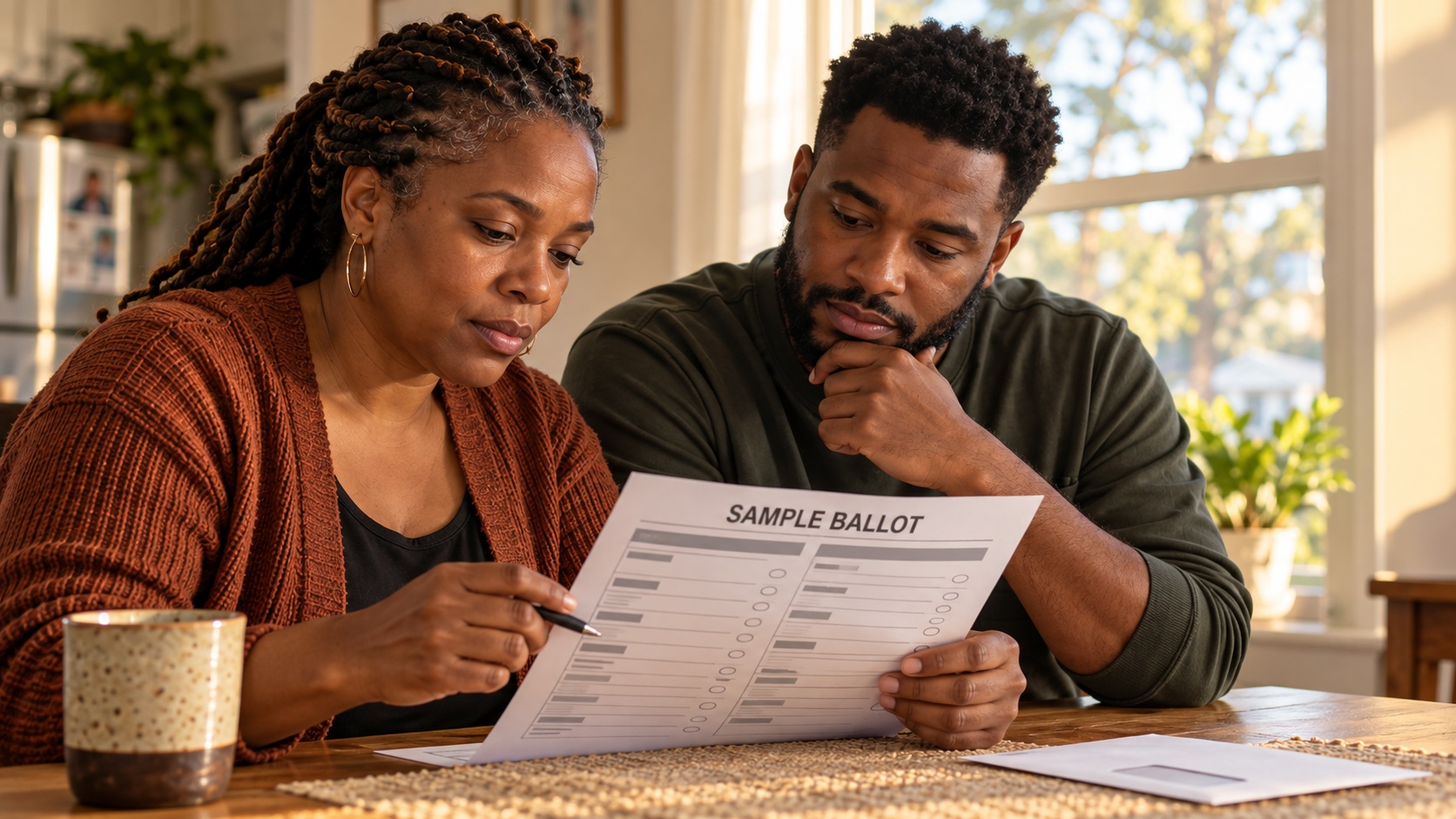
AI-generated editorial illustration
The rent. The day care bill. A parent’s health. A loved one waiting to come home. The people elected November 3 will make decisions that reach into these parts of family life. Here’s what to ask before you vote.
Magazine, The Immigrant Experience
The rent does not wait for an election. Neither does a child who needs a better school, a parent trying to find a doctor, nor the day care bill due at the end of the month.
Black immigrant voters know these pressures as well as their neighbors do. Some carry another worry alongside them. Their own citizenship may be settled, but a sibling abroad is waiting for a visa. A student in the family is trying to finish school. A neighbor is afraid of losing the right to work.
Not every family faces the same struggle. All of these concerns deserve to be heard by the people asking for their votes.
Election Day is November 3. If you are eligible to vote, check your registration now. Then look at everyone running on your ballot, including candidates for state and local office. Ask what they will do for the people and places you care about. www.eac.gov
A community with a voice of its own
An estimated 5.6 million Black immigrants lived in the United States in 2024, according to Pew Research Center. Jamaica, Haiti, and Nigeria were the three largest countries of birth, but Black immigrant communities reach across Africa, the Caribbean, and beyond. About 61% of Black immigrants were naturalized U.S. citizens. That does not tell us how many are registered to vote. It does remind us that Black immigrants are voters, parents, workers, and neighbors with their own views about the country’s future. www.pewresearch.org
The American Immigration Council estimates that 16 million registered voters who became U.S. citizens through naturalization live across 284 congressional districts it studied. In 126 of those districts, the number of immigrant voters was larger than the winning margin in the 2024 House race. Those voters come from many backgrounds, and numbers alone cannot tell us how November will turn out. They do tell candidates something: immigrant voters should not be overlooked. www.americanimmigrationcouncil.org
And immigrant voters have more to ask about than immigration.
The cost of keeping a household going
In Brooklyn, Judeth Douglas, an immigrant from Saint Vincent, spent months dealing with a lack of reliable heat in her apartment building. She and her neighbors kept calling the city for help. “There is no heat, and there are babies in the building,” she told Documented. “We are paying for the place.” documentedny.com
What Douglas wants is simple: a home her neighbors can live in and an answer from the officials responsible. New York City’s housing research found that first-generation immigrant households were more likely to struggle with rent across the racial and ethnic groups it studied, including Black New Yorkers. This is a New York finding, but the question travels: Who will make housing affordable, safe, and livable? wherewelive.cityofnewyork.us
For parents of young children, the cost of care can shape every other choice. Can they take a job? Can they keep studying? Child Care Aware of America’s 2026 research describes families having to weigh those opportunities against the price and availability of care. Candidates who say they stand with working families should be ready to talk about the day care bill. www.childcareaware.org
Health care matters from both sides of the door. A Migration Policy Institute analysis found that 24% of employed Black immigrants worked in health care during 2020–2024. They care for other families while managing their own needs as workers, patients, and parents. www.migrationpolicy.org
For four years, a Haitian caregiver named Tassy helped Richie Rosen, a man with a developmental disability, through the routines of daily life in New York. He made meals, drove Rosen places, and helped with tasks Rosen found difficult. Then Tassy lost his job after the end of Haiti’s Temporary Protected Status affected his permission to work. Rosen’s family had to help fill the gaps. The nonprofit that employed Tassy said it laid off nearly two dozen Haitian workers, many in jobs that were difficult to fill. www.reuters.com
Tassy lost his work. Rosen lost someone he had come to rely on. When candidates talk about health care, voters can ask whether their plans account for both the people who give care and those who need it.
In Minneapolis, some Somali-owned businesses felt another kind of loss. The Associated Press reported that fear during an immigration crackdown kept owners from opening shops and customers from coming in. Sales fell, and paying rent became harder. That fear reached people who were citizens, too. apnews.com
A family’s livelihood depends on more than whether its doors are open. People have to feel safe enough to walk through them.
The distance between family members
Some families are trying to make ends meet here while someone they love is still abroad. A student is waiting to begin a degree. A spouse, child, or parent is waiting to join the rest of the family.
Since January, U.S. rules have limited new student visas for people from countries including Nigeria and Senegal. Broader restrictions cover Haiti and Somalia, among others. The State Department explains which countries and visas are affected. There are limited exceptions. Visas issued before the rules took effect were not revoked by this proclamation. travel.state.gov
The rules also took away a previous broad exception that had allowed certain close relatives to seek immigrant visas despite earlier restrictions. For some spouses, children, and parents, joining family in the United States has become harder. The answer depends on the person’s circumstances, and individual exceptions may still be possible. travel.state.gov
Students already here face their own questions about tuition, housing, and whether they can work while studying. A new rule would have required many international students to seek permission to remain after a fixed period, even if they were continuing their studies. A federal judge blocked that rule before it took effect in September. The previous rules still apply while the court case continues. ois.usc.edu
For a family waiting to live together, these rules are more than paperwork. Voters can ask candidates what they will do when policy keeps loved ones apart and what they will do to protect students’ chance to finish what they started.
When protection ends at home
Temporary Protected Status, or TPS, has allowed eligible people from countries facing serious crises to live and work in the United States for a limited time. It has never been a promise of permanent residence. But families have built their lives while relying on it.
Cameroon’s TPS designation ended in August 2025. Haiti’s ended in July 2026, and Somalia’s in August 2026. Not everyone from those countries held TPS, and some people have another legal basis to stay or work. For those whose jobs depended on it, the loss of protection can mean the loss of income their household counts on. www.govinfo.gov
In Springfield, Ohio, WYSO reporter Kathryn Mobley documented what followed the end of Haiti’s TPS designation on July 27. Residents were arrested or told to report to ICE offices. Some returned home wearing ankle monitors. Some became afraid to leave home, and churches and neighbors brought them food. Faith leaders and others began an “Unshackle Springfield” campaign. www.wyso.org
Truthout reported on “Layla,” a Somali immigrant identified by a pseudonym who had lived in the United States for more than two decades. After Somalia’s TPS designation ended, she worried about who would care for her children if she were deported. She said she was afraid even to walk to her mailbox. truthout.org
No one family can speak for an entire community. These accounts show what can happen after a policy announcement fades: someone misses work, a child worries about a parent, or a neighbor brings food because leaving home feels too frightening.
What can a vote change?
The president’s administration makes many decisions about visas, TPS, and immigration enforcement. The people elected in November have powers of their own—and voters can ask how they will use them.
Members of Congress write laws, decide federal spending, and can investigate how agencies treat people. Congress can change immigration and family visa laws, although an individual member cannot grant someone a visa or work permit.
Governors and state lawmakers decide how to fund schools, colleges, health programs, and child care. State laws can also shape cooperation with federal immigration enforcement.
Sheriffs and other local officials, where they appear on the ballot, make choices closer to home. Some law enforcement agencies work with ICE through agreements known as 287(g). A sheriff cannot decide TPS, but local practices can affect what happens when someone encounters law enforcement. www.aclu.org
Candidates should answer for what their offices can do. Ask them:
- What will you do to make housing and child care affordable?
- How will you respond when residents report unsafe housing?
- How will your health care plans affect patients and caregivers?
- What will you do for local schools and students trying to afford college?
- What changes would you support when immigration rules keep close relatives apart?
- What limits would you place on detention and ankle monitors?
- If you seek a local law enforcement office, under what rules would your agency work with ICE?
Listen for a specific action. Ask how you will know whether they followed through.
Bring your community’s questions to the ballot
Only eligible U.S. citizens can vote in federal elections. Naturalized citizens can vote; having a green card, TPS, or a student visa does not by itself give someone that right. Registration deadlines and voting options differ by state. The U.S. Election Assistance Commission can help you find your state’s information. www.usa.gov
If you are eligible, check your registration, find your sample ballot, and decide when and how you will vote. Talk with relatives and neighbors, including those who cannot vote, about what they want candidates to answer. They can attend forums, tell their stories, and contact elected officials, too.
For help preparing, see The Immigrant Magazine’s 2026 midterm voting guide and mail-in voting explainer.
A vote cannot pay next month’s rent or bring a separated family together overnight. It can help choose the people who write laws, approve budgets, and demand answers. Find out who is on your ballot. Ask what they will do for your family and your neighbors. Then, if you can vote, make sure your community’s concerns are heard.
#2026Midterms #BlackImmigrantVoters #BlackImmigrantFamilies #FamilyReunification #ChildCare #ImmigrantVoices #YourVoteMatters