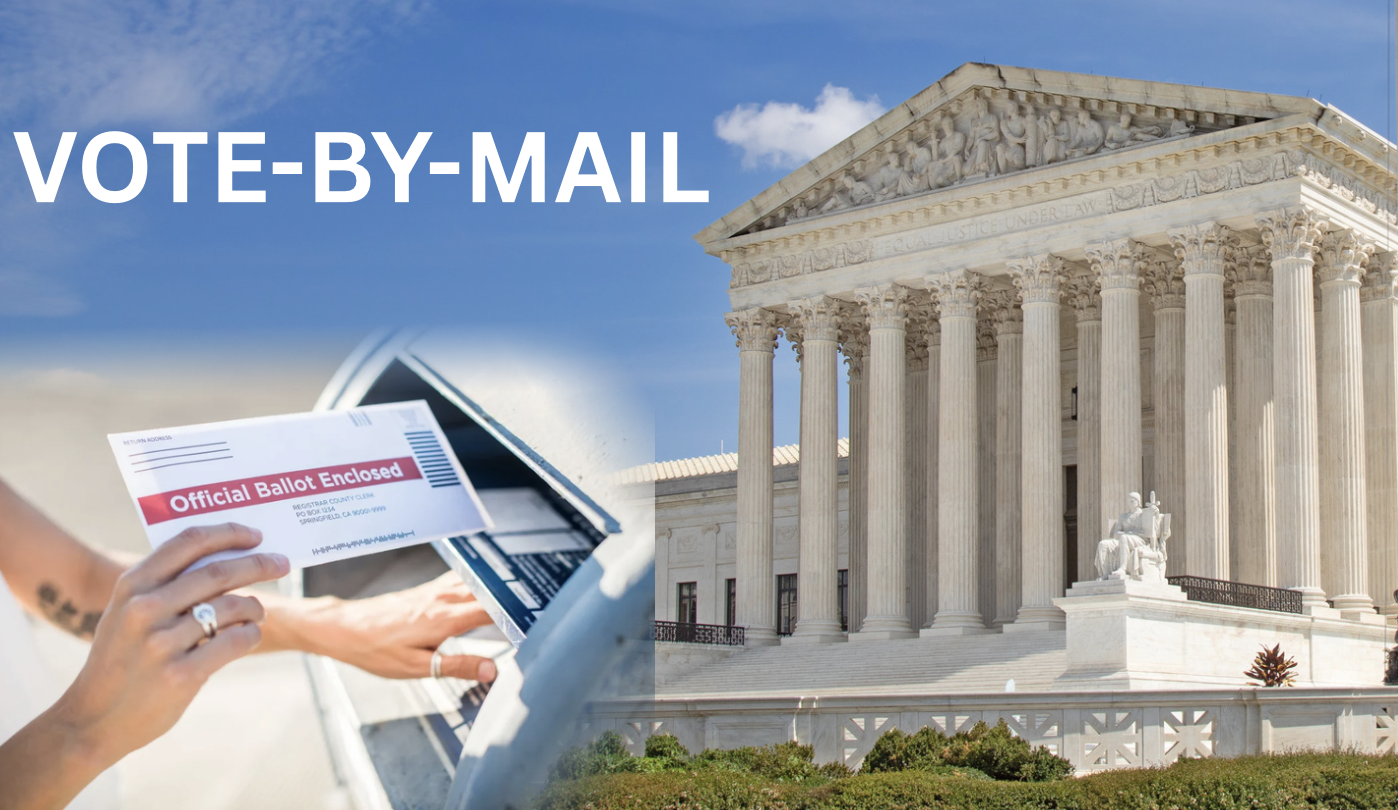
After the Supreme Court left new USPS ballot requirements blocked for the midterms, voting-rights attorneys joined ACOM and ethnic media to explain what changed—and what voters need to do now.
Magazine, The Immigrant Experience
There is something deeply personal about a ballot arriving in the mail.
For an elderly voter who no longer drives, it can mean participating without a difficult journey. For a college student hundreds of miles from home, it is a connection to the community that still claims them. For a voter with a disability, a caregiver who cannot easily leave home, a rural resident far from a polling place, or an American living overseas, it can be the bridge between having the right to vote and being able to exercise it.
And in many immigrant and multilingual households, voting from home offers something else: time.
Time to read. Time to understand the instructions. Time to seek language assistance. Time to participate without the pressure that can accompany an unfamiliar institution.
That human reality framed a recent conversation between American Community Media (ACOM), ethnic media journalists, and four voting-rights attorneys following a consequential September 14 Supreme Court order involving mail-in voting and the U.S. Postal Service ahead of the 2026 midterm elections.
Moderated by Sunita Sohrabji, ACOM health editor, and held in collaboration with Asian Americans Advancing Justice–AAJC, the briefing brought together Niyati Shah, Senior Director of Litigation at Asian Americans Advancing Justice–AAJC; John Cusick, Assistant Counsel at the Legal Defense Fund; Ethan Herenstein, Staff Attorney with the ACLU Voting Rights Project; and Justin Lam, Counsel for Democracy at the Brennan Center for Justice.
Each came to the conversation with a different part of the story.
Shah explained why the case matters to voters, particularly communities that rely on voting by mail. Cusick unpacked what the new Postal Service requirements would have demanded from election officials. Herenstein walked ethnic media through the legal fight from the presidential executive order to the Supreme Court. And Lam brought the conversation back to the practical question millions of voters may be asking:
What should I do now?
The immediate answer from the briefing was clear.
For the November 2026 midterms, the challenged new USPS mail-ballot requirements remain blocked. Eligible voters can continue using the mail-voting processes available under their state laws.
But getting to that simple answer required months of litigation—and revealed how quickly uncertainty in Washington can travel into communities already navigating complicated government systems.
The dispute began on March 31, 2026, when President Donald Trump issued an executive order called Ensuring Citizen Verification and Integrity in Federal Elections. According to the briefing, the order included directives involving federal elections and instructed USPS to develop new requirements affecting mail ballots.
Voting-rights organizations challenged those actions, arguing that the executive branch and Postal Service were exceeding their legal authority and interfering with election administration powers assigned under the Constitution and federal law to states and Congress.
Shah described the executive order from the challengers’ perspective as an unlawful attempt to exercise control over federal election administration.
The controversy intensified when USPS issued a rule containing new requirements affecting federal mail ballots.
According to the attorneys, the rule would have imposed new conditions on election officials and mail ballots only weeks before Election Day.
For Shah, however, the significance of the legal fight went beyond envelopes, barcodes, and federal authority.
“This is an important win for all voters,” she told ethnic media following the Supreme Court action.
Then she named some of the Americans for whom voting by mail can be particularly important: older voters, people with disabilities, rural residents, students away at college, and voters who need language assistance.
These are not abstract categories.
They are the grandmother studying her ballot at the kitchen table. The first-generation college student is voting from a dormitory in another state. The naturalized citizen carefully reads the instructions before making a choice. The caregiver who cannot easily leave home.
And they include citizens living in families where immigration status does not fit neatly into one box.
That became one of the briefing’s most revealing conversations.
Sohrabji asked Shah about a reality familiar to many of the communities served by ethnic media: mixed-status families.
Could eligible citizens become reluctant to vote because they fear that participating in the voting process or submitting information could somehow affect relatives with different immigration statuses?
Shah returned to one of the practical benefits of mail voting.
It allows an eligible voter, she said, to submit a ballot “on your own terms, in your own time.” Someone who needs language assistance has time to obtain it. Someone uncomfortable going to the polls has another way to participate.
It was a moment when the briefing moved from constitutional law to the kitchen table.
Because for many Americans, democracy is not experienced as a court opinion.
It is experienced as a series of questions:
Do I understand the instructions?
Do I feel comfortable participating?
Will my ballot get there?
Will my vote count?
For families already navigating immigration agencies, citizenship applications, employment rules, and other government systems, uncertainty surrounding elections can become one more reason to hesitate.
That is why the technical details of the challenged USPS rule mattered.
Cusick told the ACOM and ethnic media audience that the rule contained three major requirements.
Election officials would have faced new standards for ballot envelopes. They would have been required to upload the names, addresses, and barcode information of mail voters into a new USPS ballot-mail portal. And information associated with the mailed ballot would have needed to match information contained in that system.
“Weeks before a national election, the Postal Service tried to make itself the gatekeeper of every ballot in the country,” Cusick said, describing the challengers’ view of the rule.
The timeline was crucial.
According to Cusick, the rule was published fewer than 70 days before Election Day.
By then, election administration was not something waiting to begin.
It was already happening.
Election officials had designed, ordered, or printed ballot envelopes. States and counties were preparing systems. Workers needed training. Community organizations were preparing voter education. And some state laws contained their own ballot-design requirements.
Cusick told reporters that at a September 3 hearing, the portal election officials were expected to use, which was not yet operational in working form, and election officials had not been trained on it.
The word he said he heard repeatedly from those confronting the timetable was blunt:
“Impossible.”
Cusick also discussed an anonymous federal whistleblower report concerning the USPS system. He told reporters that the report reinforced concerns that election officials and organizations had already raised publicly about the system and the speed of its implementation.
For voters, the underlying concern was much easier to understand.
What would happen if an otherwise lawful ballot failed to satisfy the new federal requirements?
The challengers argued that the system could have resulted in lawful ballots not being delivered.
And when an election is already underway, uncertainty over whether a ballot will move through the mail can itself become a barrier to participation.
Herenstein then took ethnic media through the legal journey.
His organization and its partners filed suit after the March executive order on behalf of a coalition of civic organizations whose members participate in elections and use voting by mail.
The challengers made two central arguments.
First, Herenstein explained, they argued that the Constitution gives states primary responsibility for administering federal elections, subject to Congress’ authority to alter those rules. In their view, the president did not have authority to override the way states conduct elections.
Second, they argued that the Postal Service must deliver mail unless Congress has authorized an exception—and that Congress had not authorized USPS to refuse otherwise valid election mail based on requirements created by the Postal Service itself.
The litigation evolved as USPS moved from the executive order to a final rule.
On September 4, according to Herenstein, a federal district court issued a preliminary injunction blocking implementation of the challenged rule for the midterm elections.
The Postal Service then asked the U.S. Supreme Court to lift that injunction.
On September 14, the Supreme Court declined to do so.
The result: the injunction stayed in place, and the new requirements remained blocked for the 2026 midterms.
Justices Samuel Alito and Clarence Thomas dissented. Justice Brett Kavanaugh joined the majority but separately indicated that election officials did not have sufficient time to reasonably implement the rule before the election.
The distinction matters.
The Supreme Court’s action did not permanently resolve every underlying legal question surrounding the rule. The litigation can continue, and questions concerning presidential and Postal Service authority may remain before the courts.
But the election calendar will not wait for the final chapter of a lawsuit.
November is approaching.
That was where Lam turned the ACOM conversation from litigation to action.
His message was practical: make a plan to vote and act early when possible.
Mail voting remains available under existing state rules, he told reporters. Voters should choose the voting method that best serves them—whether returning a ballot through the mail, using a drop box where available, returning it in person where permitted, or using another method allowed by state law.
For ethnic media audiences, that may be the most important takeaway from an otherwise complicated constitutional battle.
What Mail Voters Should Do Now
Check the rules where you live. Mail-voting eligibility, procedures, and deadlines vary by state. Use information from your state or local election officials rather than assuming rules you hear about elsewhere apply to you.
Know whether you need to request a ballot. States do not all administer mail voting in the same way. Find out what your state requires and when.
Make your voting plan early. Know when your ballot should arrive and the deadline for returning it.
Read the ballot instructions carefully. Follow your state and local requirements for completing and returning the ballot.
Return your ballot early when possible. The attorneys repeatedly encouraged voters not to wait until the last moment.
Use trusted information. Election misinformation can travel quickly through social media and private messaging groups. When something sounds alarming or confusing, verify it with official state or local election information or established nonpartisan voter resources.
And perhaps most importantly:
Do not assume that voting by mail has disappeared because of this court fight.
According to the attorneys at the ACOM briefing, the challenged new USPS requirements are blocked for the 2026 midterms. Eligible voters can continue following the existing mail-voting rules in their states.
That reassurance carries particular importance for ethnic media.
These outlets have always done more than translate words.
At their best, ethnic media translate institutions.
They explain what a Supreme Court order means to the grandmother listening to Korean-language radio on her way to the market. They turn a federal regulation into something a Spanish-speaking family can discuss around the dinner table. They help a newly naturalized citizen distinguish official election information from a viral rumor.
They reach the voter who may never read a federal court opinion but urgently needs to understand what that opinion means for them.
During the reporter Q&A, Jorge Luis Macias, editor of Latino Sentinel, pushed the discussion toward whether particular communities or political constituencies were being targeted by the administration’s actions.
Herenstein did not speculate about partisan motivations.
Instead, he emphasized the breadth of the rule’s potential impact.
Whatever the administration’s motivation, he said, voters from different political affiliations could have been affected—including people with disabilities, students, overseas military personnel, rural voters, and others who depend on mail voting because getting to a polling place may be difficult.
His response illuminated a larger truth running beneath the briefing.
Voting access is rarely the story of only one community.
A barrier affecting an immigrant voter may also touch a veteran. A rule affecting an Asian American grandmother may affect a rural farmer. A confusing process for a newly naturalized citizen can also confuse an 18-year-old casting a first ballot.
Different American lives can meet at the same mailbox.
For immigrant communities, however, clarity can carry unusual weight.
These are communities that may already be navigating multiple institutions—immigration, citizenship, education, health care and employment—each carrying its own paperwork, language, and consequences.
Add uncertainty about voting, and civic participation itself can begin to feel risky.
That is why the conversation between ACOM, ethnic media, and the four voting-rights attorneys mattered.
The legal battle may continue. The preliminary injunction does not necessarily represent the final word on every legal question surrounding the USPS rule.
But voters do not need to wait for the final lawsuit to begin making their November plans.
Learn the rules where you live.
Know your deadlines.
Use trusted information.
Make your voting plan early.
And if voting by mail is the method that works for you, the immediate message from the briefing is clear: mail voting remains available for the 2026 midterms under existing state rules.
Soon, millions of ballots will make their quiet journeys.
From election offices to postal facilities. From mail carriers to doorsteps. From envelopes to kitchen tables, where perhaps English is only one of several languages spoken.
There, far from the arguments of Washington and the language of courtrooms, an American will make a choice.
Democracy can look enormous from a distance—courts, presidents, constitutions, and institutions.
Up close, sometimes it looks like an envelope.
#MailInVoting #VoteByMail #Election2026 #VotingRights #ImmigrantVoices #EthnicMedia #CivicEngagement #AAPICommunity #YourVoteMatters