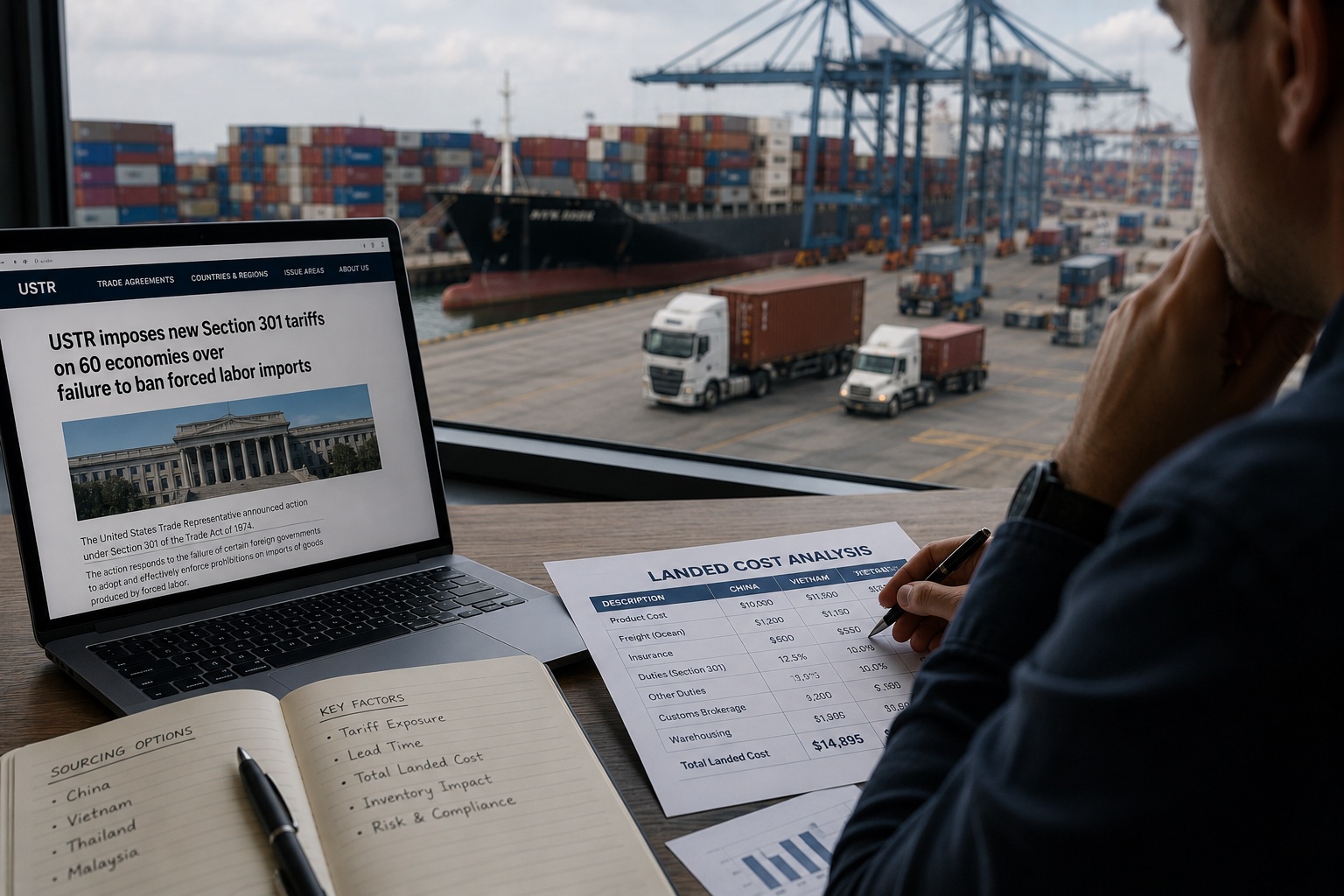
New Section 301 tariffs of 10% and 12.5% could change the true landed cost of sourcing from China and Southeast Asia—making tariff, logistics, and margin analysis essential before the next purchase order.
A sourcing decision that looked profitable last month may not produce the same margin today.
USTR has imposed new Section 301 tariffs of 10% or 12.5% on 60 trading partners representing 99.4% of U.S. imports, tied to whether those economies have adopted and effectively enforced prohibitions on imports made with forced labor. The tariffs apply to most imports, subject to specific exemptions.
For CEOs, procurement leaders, import managers, and supply chain directors sourcing from China and Southeast Asia, this is more than another trade-policy update.
It changes the economics of where you source, how you price, and how much margin you can protect.
On a $250,000 shipment, a 12.5% additional tariff can represent $31,250 in added duty exposure before freight, warehousing, brokerage, and other landed-cost expenses are considered.
That is why the right time to review the impact is before the next purchase order is committed.
Moving a PO May Not Produce the Savings You Expect
For years, many companies reduced China exposure by shifting production to Vietnam, Thailand, Malaysia, Cambodia, and other Asian markets.
That strategy may still make sense.
But the tariff advantage between sourcing countries may now be smaller than many importers expect.
USTR says trading partners that committed to adopting and effectively enforcing forced-labor import prohibitions are subject to a 10% tariff, while countries that failed to adopt such prohibitions are subject to a 12.5% rate.
The practical implication is important:
Moving production out of China should no longer be treated as an automatic tariff-saving strategy.
A lower factory price is only one part of the equation.
Importers now need to compare the following:
- country of origin;
- HTS classification;
- Section 301 exposure;
- existing duties and other tariff programs;
- applicable exemptions;
- freight and routing;
- lead time;
- inventory carrying cost; and
- final landed margin.
The right question is not
“Which country has the lowest tariff?”
It is:
“Which sourcing option gives us the strongest landed-cost outcome after tariffs, freight, inventory, and operational risk are included?”
Exemptions Can Change the Economics
The new tariffs do not apply uniformly to every product.
USTR excludes certain categories, including articles and parts already subject to Section 232 tariffs, along with designated products where additional tariffs could create supply shortages, broader economic disruption, or other unintended effects.
That makes product-level review essential.
Two importers buying from the same country can face very different outcomes depending on HTS classification, product eligibility, and how other tariff programs apply.
For high-volume importers, that difference can affect far more than customs cost. It can influence:
- gross margin;
- customer pricing;
- supplier negotiations;
- purchasing volume;
- inventory strategy; and
- working capital.
Tariff planning should therefore happen at the SKU and shipment level—not through a broad assumption about an entire sourcing country.
The Headline Rate Is Not Always the Final Cost
The new Section 301 tariff may be only one part of the duty picture.
Depending on the product, importers may also need to consider existing customs duties and other applicable trade programs.
That means a 10% or 12.5% headline rate does not necessarily tell management what the shipment will ultimately cost.
Before changing suppliers, accepting a new quote, or repricing a product, companies should understand the complete tariff exposure attached to the actual SKU being imported.
A sourcing decision based on incomplete duty assumptions can quickly erase the savings procurement expected to achieve.
What Importers Should Do Before the Next PO
Before committing the next major Asia purchase order:
- Verify HTS classification and country of origin.
Make sure the assumptions driving your landed-cost model are correct. - Check whether the product qualifies for an exemption.
Do not assume every product from a covered country receives the same treatment. - Calculate the full tariff stack.
Look beyond the new headline rate and account for other applicable duties. - Compare sourcing countries using true landed cost.
Factory price alone is not enough. - Review logistics before production begins.
Freight, routing, lead time, warehousing, and inventory requirements can change the economics of a sourcing move.
The objective is not simply to find the cheapest supplier.
It is to identify the sourcing decision that leaves the business with the strongest margin after the entire supply chain is accounted for.
And this is where many importers benefit from looking at the decision from end to end.
A sourcing change touches more than procurement. It affects freight, customs, routing, warehouse capacity, inventory timing, and ultimately the margin that remains once the product reaches the customer.
Anton Tombu, Business Development Director at XCT Logistics, works with U.S. importers navigating those decisions across China and Asia. The value is not in simply moving the freight. It is in helping companies see the logistics and landed-cost implications before the decision becomes expensive to reverse.
If you are comparing China, Vietnam, Thailand, Cambodia, Malaysia, Taiwan, or another Asian sourcing market, model the economics before production starts.
Once production begins—and especially once the container is moving—the room to adjust becomes much smaller.
If you are evaluating where to place an upcoming Asia purchase order, schedule a confidential supply chain review with Anton Tombu, Business Development Director at XCT Logistics, before production is committed.
A different sourcing country does not automatically mean a lower cost.
The better decision is the one that improves your true landed margin.
Source
Official U.S. Trade Representative Fact Sheet
#Section301 #USTR #SupplyChain #GlobalTrade #USImporters #ChinaSourcing #SoutheastAsia #Procurement #Logistics #LandedCost