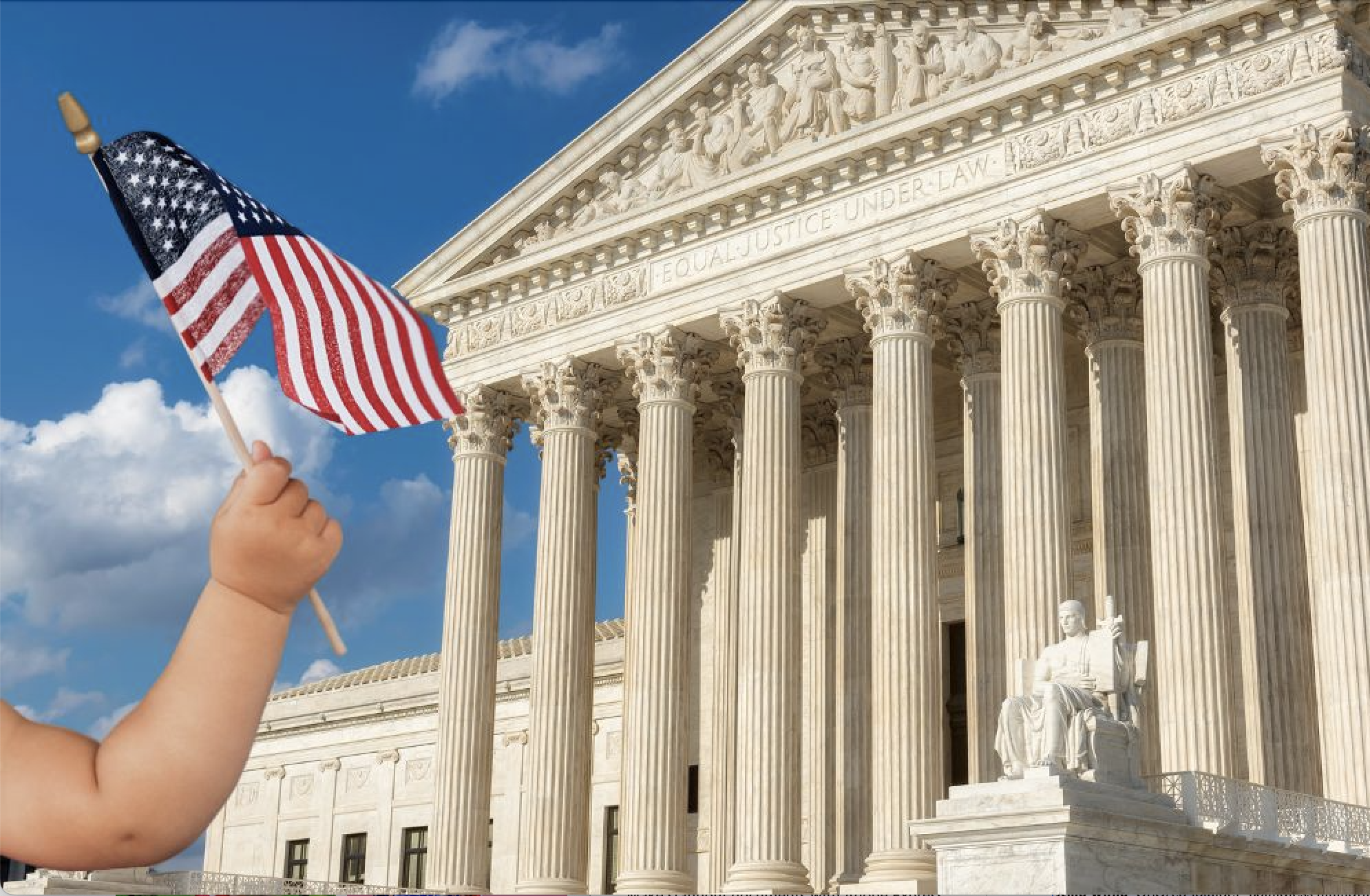
What a proposed birthright citizenship ban could mean for immigrant families, the U.S. economy, and the future of belonging in America.
The future of birthright citizenship—and what it means to belong in America—is no longer theoretical. It is now before the courts, carrying consequences that could reshape the country for generations.
Four leading experts in law, economics, and immigration policy—Professor Hiroshi Motomura of UCLA School of Law, Philip Connor of Princeton University, Julia Gelatt of the Migration Policy Institute, and Xiao Wang of Boundless Immigration—came together to examine what is at stake as the U.S. Supreme Court prepares to weigh the legality of an executive order issued by Donald Trump seeking to restrict citizenship under the 14th Amendment.
Their analysis unfolded during a briefing hosted by American Community Media, where ethnic media journalists pressed for clarity on the legal, economic, and human consequences of redefining citizenship in the United States.
What emerged was not just a policy debate—but a portrait of a nation at a crossroads.
Professor Motomura grounded the conversation in history, reminding listeners that birthright citizenship is not an accidental feature of American law. It is a deliberate response to exclusion.
In the wake of the Dred Scott decision, which denied Black Americans citizenship, the 14th Amendment established a new national principle: anyone born on U.S. soil is a citizen. It rejected the idea that belonging should be inherited through bloodlines and instead rooted it in presence, participation, and shared future.
To revisit that principle now, Motomura suggested, is to revisit the country’s identity itself.
The question is no longer just legal—it is existential.
If the law defines belonging, the economy reveals its value.
Philip Connor’s analysis placed a measurable weight on what birthright citizenship has produced. Drawing from decades of Census data, his research identified at least 4 million individuals who have benefited from being born in the United States to undocumented or temporary immigrant parents.
Their contribution to the economy over time is immense: $7.7 trillion across a century.
These are not marginal gains. They reflect the steady integration of individuals into the workforce—many of whom move into professions requiring higher education, from healthcare to education to administrative leadership.
Without birthright citizenship, Connor warned, that pipeline narrows. The country risks losing over $1 trillion in future economic contributions, alongside hundreds of thousands of workers who would otherwise fill critical roles.
In a nation already grappling with labor shortages, those losses carry long-term consequences.
Julia Gelatt extended the conversation beyond economics into population and policy realities.
Her findings challenge one of the central assumptions behind restricting birthright citizenship—that it would reduce unauthorized immigration.
Instead, it would likely do the opposite.
By her estimates, the policy would lead to an additional 2.7 million undocumented individuals within 20 years, growing to 5.4 million over 50 years. Each year, roughly 255,000 children would be born in the United States without legal status—children who would grow up American in every way except on paper.
They would face limited access to public benefits, barriers to higher education, and restrictions on legal employment.
Over time, this creates something the United States has largely avoided: a multi-generational underclass.
Gelatt pointed to the success of DACA as a counterexample. When young people are given even limited access to legal work and stability, they pursue education, build careers, and contribute economically.
Remove that access, and the trajectory shifts.
The effects would not stop at individuals—they would reshape families.
Today, many immigrant households rely on U.S.-born children as anchors of stability. These children often help families navigate institutions—schools, hospitals, government systems—serving as bridges between communities and the structures that govern them.
Without birthright citizenship, that bridge disappears.
Families would face deeper uncertainty, fewer protections, and reduced access to opportunity. In some cases, children within the same household could experience entirely different legal realities, complicating not just logistics but identity itself.
The quiet stability that citizenship provides would give way to constant negotiation.
Xiao Wang widened the lens further, pointing to the global implications of this shift.
For decades, the United States has stood apart as a destination not only for opportunity but also for certainty. Birthright citizenship has offered a simple, powerful guarantee: if your child is born here, they belong here.
That clarity has shaped decisions made in classrooms, clinics, and corporate boardrooms around the world.
Take it away, Wang argued, and the message changes.
Highly skilled workers—doctors, engineers, researchers—do not choose destinations based solely on salary. They choose based on where their families can build stable lives. If the United States cannot provide that assurance, other countries are ready to step in.
Nations like Canada, the United Kingdom, Australia, and New Zealand are already expanding pathways to attract global talent.
The consequences would be felt most sharply in places already underserved. Rural communities—where immigrant professionals make up a disproportionate share of healthcare providers—could see worsening shortages, longer wait times, and reduced care access.
What begins as a legal shift could quickly become a public health challenge.
Across the briefing, one truth surfaced repeatedly.
Birthright citizenship has never been just a legal technicality. It has been a mechanism of integration—a quiet but powerful force that allows each new generation to step fully into the American story.
Even if the U.S. Supreme Court ultimately rejects the executive order, the debate itself has already introduced uncertainty. It has forced immigrant families to question stability, belonging, and the future.
And it has placed a deeper question before the nation:
Who gets to belong?
#ImmigrantVoices #BirthrightCitizenship #ACOM #ImmigrationPolicy #Belonging #EthnicMedia #DiasporaLeadership #CivicEngagement