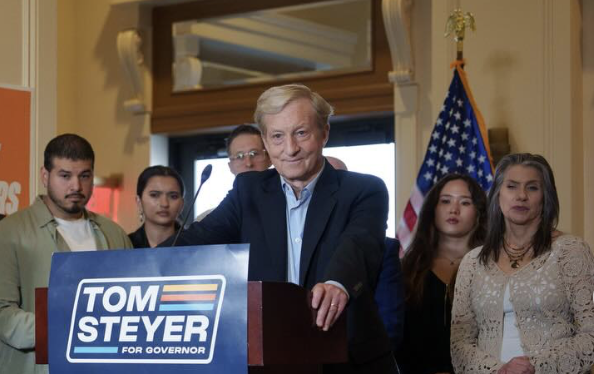
In a candid ethnic media briefing on immigration, housing, healthcare, and corporate power, Tom Steyer argued that California’s affordability crisis is no longer about scarcity—it is about who the state has chosen to protect.
Magazine, The Immigrant Experience
California still introduces itself to the world as possibility.
It is the state families cross oceans for. The state where immigrants arrive carrying degrees that are ignored, accents that are mocked, and hopes too expensive to abandon. The state where parents work double shifts believing their children might eventually inherit something steadier than sacrifice.
But increasingly, California feels like a state asking working people how much instability they are willing to tolerate just to remain inside it.
Rent climbs faster than wages. Utility bills arrive with the force of second rents. Small businesses survive on thinner margins each year. Young families postpone homeownership indefinitely. Immigrant workers who power entire industries commute farther, sleep less, and pay more simply to stay employed in the regions their labor sustains.
California is still producing wealth at extraordinary levels.
The question now is who that wealth is actually stabilizing.
That question sat underneath nearly every answer Tom Steyer gave during a statewide briefing with ethnic media journalists this week, where the businessman and climate activist presented one of the clearest ideological arguments yet in the governor’s race: California’s affordability crisis is not an unfortunate side effect of growth. It is the predictable outcome of political systems that have protected concentrated corporate power while asking ordinary residents to absorb the consequences.
“The corporations want nothing to change,” Steyer said. “I am the change candidate.”
Candidates often say versions of this during campaigns. What made Steyer’s comments stand out was not the slogan itself, but the consistency of the framework behind it.
Again and again, he returned to the same core argument: California’s housing crisis, healthcare instability, utility costs, environmental burdens, and immigrant vulnerability are not separate emergencies unfolding side by side. They are connected expressions of the same imbalance — a state where economic power has become increasingly insulated while working people live closer and closer to precarity.
For immigrant communities, that precarity rarely arrives in dramatic form all at once.
It accumulates quietly.
In overcrowded apartments where multiple incomes are required to hold one lease together.
In unopened medical bills left on kitchen counters for weeks.
In long commutes that turn parents into visitors inside their own homes.
Small businesses are one bad month away from closure.
In the silence children notice when adults discuss immigration status in lowered voices.
Steyer’s briefing resonated because he attempted to speak to that accumulation directly rather than reducing California’s problems to campaign shorthand.
On immigration, he delivered perhaps the most confrontational comments of the discussion, describing ICE as “a criminal organization” and accusing federal immigration enforcement agencies of racial profiling and violence against Californians.
At a moment when many Democratic politicians choose cautious language around immigration enforcement, Steyer spoke with unusual bluntness. But more significant than the rhetoric itself was the broader argument underneath it.
He framed immigration enforcement not simply as a federal issue but as a destabilizing force inside California communities.
A workplace issue.
A family issue.
A civil rights issue.
A question of whether people who sustain the state are allowed to feel safe inside it.
“Immigrants build California,” Steyer said. “Immigrants make California run today.”
He proposed prosecuting ICE agents who violate California law, expanding legal defense support for immigrants facing deportation proceedings, and increasing oversight of detention facilities operating inside the state.
For mixed-status families, those proposals are not abstract ideological signals. They touch daily realities.
A detention hearing can collapse household income overnight.
A deportation threat can force families to reorganize childcare, housing, transportation, and work schedules simultaneously.
Fear changes how communities interact with schools, hospitals, law enforcement, and public institutions altogether.
And increasingly, that fear intersects with another pressure Californians discuss constantly but still experience unevenly: affordability.
Steyer repeatedly argued that housing has become the clearest measure of California’s widening inequality. He pledged to build one million affordable homes and accused entrenched political and corporate interests of obstructing the scale of development needed to stabilize working families.
For immigrant communities, housing pressure often reshapes family life itself.
Three generations share small apartments not because of cultural preference, but because the math no longer works otherwise.
Workers leave before sunrise to commute from distant suburbs after being priced out of the cities where they work.
Adult children postpone independence because surviving separately has become financially unrealistic.
The state built by immigrant labor is becoming increasingly difficult for immigrant labor to inhabit.
Healthcare, Steyer argued, reflects the same deeper imbalance.
He endorsed single-payer healthcare and described California’s current healthcare system as economically unsustainable for families, businesses, and the state budget alike. But unlike candidates who discuss universal healthcare mainly as aspiration, Steyer emphasized the arithmetic beneath the crisis — rising Medi-Cal pressures, escalating pharmaceutical costs, and shrinking affordability across the healthcare system itself.
“If healthcare is going to be a right, we’re going to have to deliver it,” he said.
For immigrant families, healthcare policy is often experienced less through ideology than through hesitation.
Whether to schedule an appointment.
Whether to miss work.
Whether symptoms are serious enough to justify the bill that may follow.
Whether undocumented relatives can safely seek treatment without fear.
Steyer also sharply criticized pharmaceutical companies, accusing them of protecting inflated drug prices through political influence while ordinary Californians absorb the cost.
That same anti-corporate argument shaped his climate and energy comments.
Though nationally known for climate activism, Steyer spent little time discussing climate in symbolic terms. Instead, he spoke about utility monopolies, electricity prices, gasoline costs, and the economic burden carried by working households. He argued that Californians are paying disproportionately high energy costs while large corporations continue benefiting from concentrated market power.
His proposed solutions included restructuring utility regulation, increasing competition, lowering electricity costs, and taxing oil company windfall profits.
Importantly, he tied environmental policy directly to racial and economic inequity, arguing that Black, Latino, immigrant, and low-income communities disproportionately bear the consequences of pollution and environmental neglect.
That connection matters because California’s affordability crisis and environmental crisis increasingly overlap geographically. The neighborhoods facing the highest housing instability are often the same neighborhoods living closest to industrial pollution, extreme heat exposure, overcrowded infrastructure, and environmental risk.
Steyer’s broader political strategy appears rooted in connecting those experiences into one coherent explanation for why so many Californians feel economically cornered despite living inside one of the richest states in the world.
Still, the defining contradiction of his candidacy remained present throughout the briefing.
Tom Steyer is a billionaire running against concentrated wealth and corporate influence.
Ethnic media journalists challenged him directly on his campaign spending and past investments tied to fossil fuel industries and private prison companies.
Steyer acknowledged those investments as mistakes and pointed toward years of subsequent work on climate advocacy, criminal justice reform, and rehabilitation-focused policy efforts.
Whether Californians believe Tom Steyer can meaningfully confront that reality remains uncertain.
He is still asking voters to trust a billionaire arguing against concentrated wealth. He is still campaigning in a state where residents have grown deeply skeptical of political promises untethered from material change. And he is still competing in a gubernatorial race that may ultimately hinge on one defining question: whether Californians believe the current system can still repair itself from within.
But what made Steyer’s appearance before ethnic media journalists significant was not simply the policy platform itself. It was the clarity of the argument underneath it.
That California’s affordability crisis is no longer just economic.
It is civic.
It is moral.
It is about who gets protected, who gets displaced, and who is still allowed to build a stable life in one of the richest states in the country.
And as California’s governor’s race accelerates, immigrant and working-class communities may ultimately decide whether voters want cautious management of the current system—or a direct confrontation with the forces reshaping daily life across the state.
Because the deeper question hanging over this election is no longer whether California remains wealthy.
It is whether the people sustaining that wealth can still afford to belong here at all.
#TomSteyer #CaliforniaPolitics #WorkingFamilies #ImmigrantVoices #HousingJustice #HealthcareForAll #ClimateJustice #CaliforniaGovernor #EthnicMedia #ImmigrantMagazine