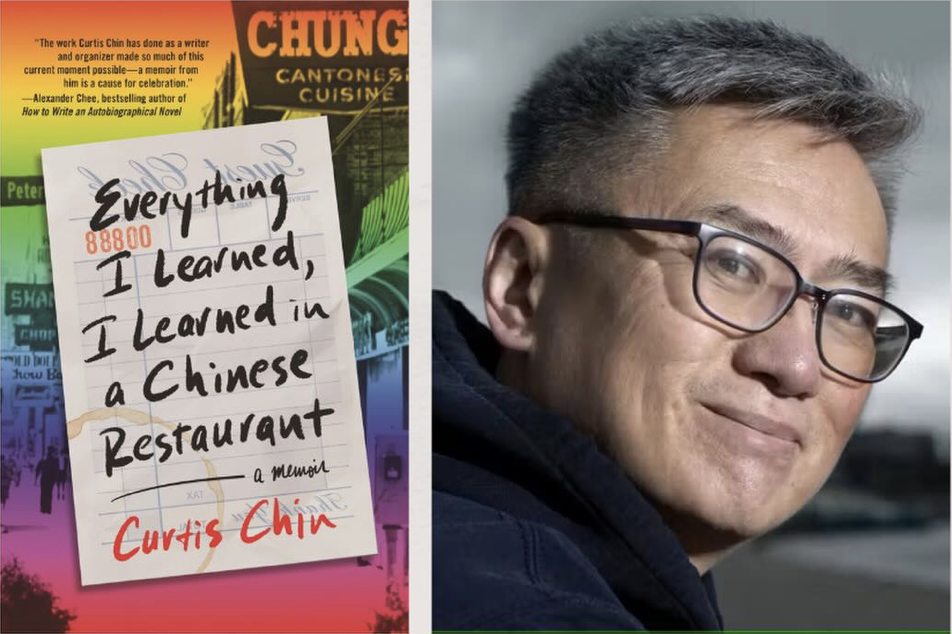
From a Detroit Chinese restaurant to a national conversation on belonging, Chin reflects on immigration, race, labor, and the Americans still treated like outsiders in the country they helped build
Magazine, The Immigrant Experience
The first thing Curtis Chin wants people to understand is that his family did not arrive late to America’s story.
They were already in Detroit before Ford Motor Company. Before Motown. Before the city became shorthand for both industrial power and industrial collapse.
His great-great-grandfather came from Guangdong province in the late 1800s, carrying the same fragile hope that has carried generations of immigrants across oceans: that somewhere else might offer dignity, work, and survival. He first landed in Canton, Ohio, mistakenly believing Chinese immigrants lived there. They did not. Eventually he made his way north to Detroit, where anti-Chinese discrimination blocked him from factory jobs and pushed him into laundry work instead.
That pattern—exclusion followed by reinvention—became the family’s American inheritance.
The laundry became a laundromat. The laundromat became a grocery store. The grocery store became Chung’s Cantonese Cuisine, the restaurant that would anchor the Chin family in Detroit for decades while quietly teaching Curtis Chin how race, labor, identity, and belonging actually work in America.
By the time Chin was born, Detroit itself was coming apart.
The auto industry was collapsing. Anti-Asian resentment simmered alongside fears over Japanese car manufacturers. Crack cocaine and violence hollowed out neighborhoods already struggling under economic abandonment. AIDS devastated communities. Tanks once rolled through Detroit streets after the 1967 uprising. Chin often jokes that he became a “riot baby” because he was conceived during the five days the city shut down after the unrest.
But inside the restaurant, another America existed.
There were almond cookies cooling in the kitchen. Egg rolls folded by hand. Relatives shouting orders beneath fluorescent lights. Black families, white factory workers, churchgoers, businessmen, immigrants, politicians, and exhausted night-shift workers all passing through the same dining room.
Long before diversity became corporate language, places like Chinese restaurants were already forcing America into proximity with itself.
That became one of the defining themes during Chin’s recent conversation with journalists gathered through American Community Media, where ethnic media reporters pressed him not simply about his memoir, Everything I Learned, I Learned in a Chinese Restaurant, but about the deeper question underneath it: Why does America still struggle to recognize immigrants and people of color as fully American?
For Chin, the answer begins with memory.
America, he suggested, repeatedly forgets who helped build it.
Asian Americans are still treated as perpetual outsiders even when their families have lived in the country for generations. The accusations directed toward immigrants today — foreigners, job stealers, people who cannot assimilate — echo the same rhetoric aimed at Chinese immigrants more than a century ago during the era of the Chinese Exclusion Act.
The stereotypes survived. The targets simply changed names.
Detroit taught Chin how quickly economic fear can turn into racial blame.
Growing up during the decline of American manufacturing, he watched entire communities searching for someone to hold responsible. Japanese automakers became symbols of economic loss. Asian faces became stand-ins for disappearing jobs and collapsing industries.
The consequences turned deadly in 1982 when Vincent Chin, a Chinese American draftsman in Detroit, was beaten to death by two white autoworkers who blamed Asians for the collapse of the U.S. auto industry. The men never served prison time.
For many Asian Americans, the murder became a defining civil rights moment.
But Chin resists telling the story solely through tragedy.
Long before Vincent Chin’s death galvanized national attention, Detroit’s Asian communities had already been building coalitions through churches, restaurants, businesses, festivals, and neighborhood organizing. Chinese, Filipino, Indian, and other Asian immigrant communities regularly collaborated through events like Detroit’s Far East Food Festival in Hart Plaza.
When violence forced communities to mobilize politically, the relationships were already there.
“You can’t mobilize people politically if they don’t feel part of a community,” Chin said during the conversation.
That belief shapes how he understands storytelling itself.
For Chin, writers, artists, journalists, and academics are not separate from political life. They help communities recognize themselves. They create language around identity before policy ever changes. That is why, he argued, attacks against books, education, journalists, and diversity initiatives matter so deeply. Cultural erasure weakens solidarity long before legal rights disappear.
His memoir pushes directly against that erasure.
Rather than presenting Asian Americans as newcomers struggling to assimilate, Chin roots his family firmly inside the American story itself. His parents were politically engaged. They followed racial politics closely while running a restaurant in Detroit’s inner city. They navigated Black neighborhoods, white suburbs, immigrant communities, and the tensions between them.
That environment shaped Chin’s understanding of identity differently from many immigrant narratives.
“I fully accepted the term Asian American,” he explained.
The harder question was never whether he was American enough. The harder question was how Asian Americans fit inside a country historically organized around a Black-white racial framework while simultaneously experiencing privilege and discrimination in different ways.
The restaurant became a laboratory for those contradictions.
Customers from every political persuasion and racial background sat under the same fluorescent lights eating from the same menu. Rich and poor. Conservative and liberal. Native-born and immigrant. People who might never enter each other’s homes still shared public space around food.
That, Chin suggested, may be one of the few genuinely democratic spaces America still has left.
“If we could just lean across the table and ask somebody, ‘What are you eating?’” he said, “those are the conversations America needs.”
The line lingered because it carried something larger beneath it.
The memoir is not really about Chinese restaurants. It is about whether Americans still believe coexistence is possible.
Throughout the ethnic media discussion, journalists repeatedly raised concerns about rising white nationalism, attacks on immigrants, anti-DEI backlash, and efforts to narrow the definition of who belongs in America. Chin did not avoid the politics. He criticized attempts to end birthright citizenship and warned against movements seeking to roll back the country’s demographic and cultural diversity.
But he also argued that racial division is often manipulated through economic fear.
As wealth inequality deepens, race and immigration become convenient tools for redirecting public anger sideways instead of upward. Working-class communities are encouraged to blame one another rather than interrogate the systems making life more unstable for everyone.
That analysis carries particular weight coming from someone raised inside a working-class immigrant business.
The restaurant existed because of labor. Physical labor. Intergenerational labor. Emotional labor. The kind of labor immigrant families often perform invisibly while simultaneously being told they do not truly belong.
And even success does not fully protect against erasure.
Chin spoke candidly about how attacks on diversity and humanities funding are already shrinking opportunities for immigrant artists and storytellers. Book initiatives have lost funding. Documentary projects focused on immigrant communities have collapsed as corporate diversity commitments disappear under political pressure.
The consequences stretch far beyond publishing.
When immigrant stories disappear from classrooms, libraries, films, and media spaces, communities lose historical memory. Young people lose mirrors. The country loses the ability to recognize itself honestly.
That may explain why Chin’s memoir resonates so deeply right now.
Not because it romanticizes immigration, but because it insists immigrant stories are inseparable from American history itself. His family did not stand outside the American experiment observing it from a distance. They cooked inside it. Worked inside it. Argued inside it. Survived inside it.
And like millions of immigrant families before them, they kept building lives even while the country debated whether they truly belonged.
Near the end of the conversation, Chin reflected on Qingming, the Chinese tomb-sweeping festival where families honor ancestors at burial sites. Thinking about anti-immigrant rhetoric and generations of sacrifice, he arrived at a conclusion simple enough to fit inside one sentence.
“Yes,” he said, “my family succeeded because of America. But America also succeeded because of my family.”
Somewhere in America tonight, under fluorescent restaurant lights, that argument is probably still happening — between bites of food prepared by hands the country still struggles to fully recognize as its own.
#CurtisChin #ImmigrantVoices #AsianAmerican #Belonging #ImmigrationMatters #VincentChin #EthnicMedia #TheImmigrantMagazine #AmericanIdentity