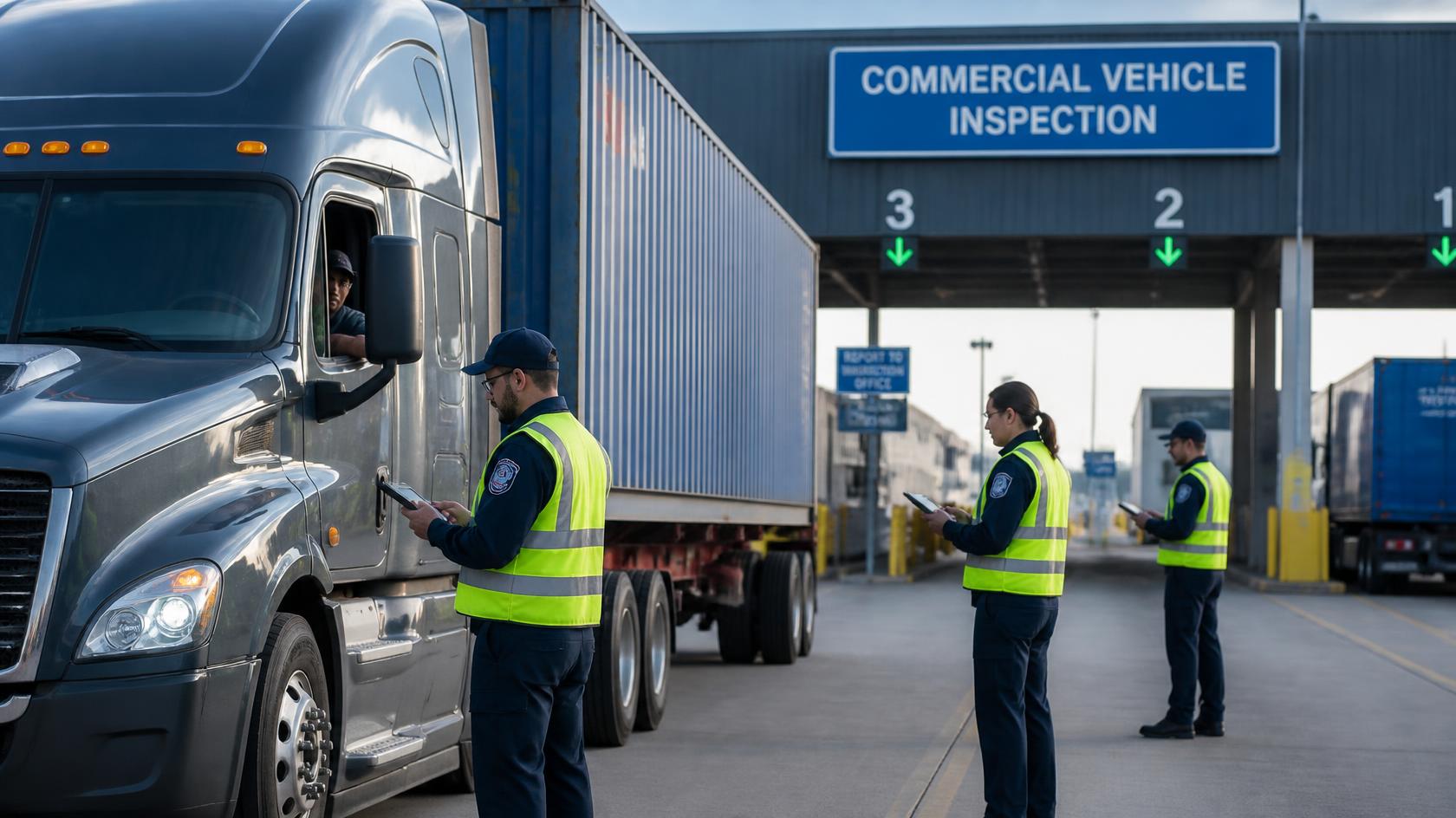
Commercial-vehicle authorities across North America are increasing scrutiny of unsafe trucks, unqualified drivers, manipulated electronic logs, and cargo-securement failures.
During the Commercial Vehicle Safety Alliance’s May 2026 International Roadcheck, inspectors across the United States, Canada, and Mexico used common North American inspection standards. The operation placed special emphasis on electronic logging device tampering and cargo securement.
State and provincial authorities have continued conducting targeted commercial-vehicle inspections outside the three-day campaign.
In July, Nebraska State Patrol officers inspected 41 commercial vehicles, identified 155 federal and state violations, and placed 13 vehicles and two drivers out of service.
For U.S. importers sourcing from China and Asia, the message is simple:
A low trucking rate can become expensive when the truck cannot complete the move.
What This Means for Importers
Stronger enforcement can affect three parts of the supply chain.
Dependable capacity may tighten
A truck may be available but still be unsuitable for a critical shipment because of weak driver controls, poor equipment condition, or an unreliable operating history.
The number of trucks may not change immediately.
The number an importer can confidently use may shrink.
Transit times may become less predictable
An inspection can delay a shipment even when no serious violation is found.
If a driver or vehicle is placed out of service, the importer may need replacement equipment, a new delivery appointment, or a cargo transfer.
That disruption can trigger storage, detention, additional chassis time, warehouse rescheduling, and customer-service problems.
Compliant carriers may become more valuable
Carriers that invest in qualified drivers, maintained equipment, credible electronic records, insurance, and subcontractor oversight carry real operating costs.
If enforcement removes poorly controlled capacity from certain lanes, dependable carriers may gain pricing leverage.
That does not mean every trucking rate will rise.
It means compliance is becoming a more important part of carrier selection.
The Question Behind the Rate
Consider two inland transportation quotes:
- Carrier A: $1,450
- Carrier B: $1,625
Carrier A appears to save $175.
But if Carrier A relies on poorly maintained equipment or an unvetted subcontractor, one out-of-service event could erase the savings from many successful shipments.
A more useful calculation is:
Reliable transportation cost = quoted rate + disruption exposure + inventory impact + recovery cost
When a trucking rate appears unusually low, importers should ask:
What operating advantage makes this price possible?
There may be a strong answer, such as balanced freight, contracted volume, efficient routing, or equipment already positioned near the pickup point.
When there is no clear explanation, the lower price may reflect a risk that has not yet appeared on the invoice.
Three Actions Importers Should Take
1. Confirm who will actually move the freight
The company accepting the booking may not be the motor carrier operating the truck.
Ask whether the shipment will move through:
- The provider’s own fleet
- A dedicated carrier
- A prequalified carrier network
- A spot-market operator
- Another subcontractor
Subcontracting is not inherently problematic.
Uncontrolled subcontracting is.
2. Review the carrier beyond price
Importers should consider the following:
- Operating authority
- Insurance status
- Driver qualification controls
- Inspection history
- Equipment maintenance
- ELD and hours-of-service practices
- Subcontractor oversight
- Exception-management capability
No single metric provides the full answer.
The goal is to determine whether the carrier has credible operating controls and a realistic recovery plan.
3. Decide what happens if the truck cannot continue
The recovery process should be established before dispatch.
Importers should know the following:
- Who secures replacement capacity
- Who contacts the terminal or warehouse
- Who reschedules delivery
- How quickly the importer will be notified
- Who approves additional charges
- What happens if terminal free time is expiring
A trucking exception rarely remains a trucking-only problem.
It can quickly affect customs timing, port release, warehousing, fulfillment, inventory availability, and customer delivery.
This is where coordinated logistics support matters most: connecting carrier selection, customs coordination, inland planning, warehouse readiness, shipment visibility, and recovery decisions before one weak handoff disrupts the entire move.
Basic tracking tells an importer where the truck is.
Decision-ready visibility explains that the driver has been placed out of service, the delivery appointment is at risk, and replacement capacity is being arranged.
The Bottom Line
North American authorities are increasing scrutiny of driver qualifications, electronic logs, equipment safety, and cargo securement.
This does not prove that every freight rate will rise or that every shipment will be delayed.
It does mean that carrier compliance is becoming a more important part of transportation’s true cost.
Before critical freight leaves China or Asia, importers should know:
- Who will operate the truck
- How that carrier was evaluated
- What happens if the driver or vehicle cannot continue
The cheapest carrier is not automatically the riskiest.
But the lowest rate should always have a credible operational explanation.
Importers seeking a confidential review of carrier risk, inland timing, and recovery options can speak with Anton Tombu, Business Development Director at XCT Logistics.
#SupplyChain #CarrierCompliance #CrossBorderLogistics #TruckingCompliance #USImporters #ChinaSourcing #LandedCost