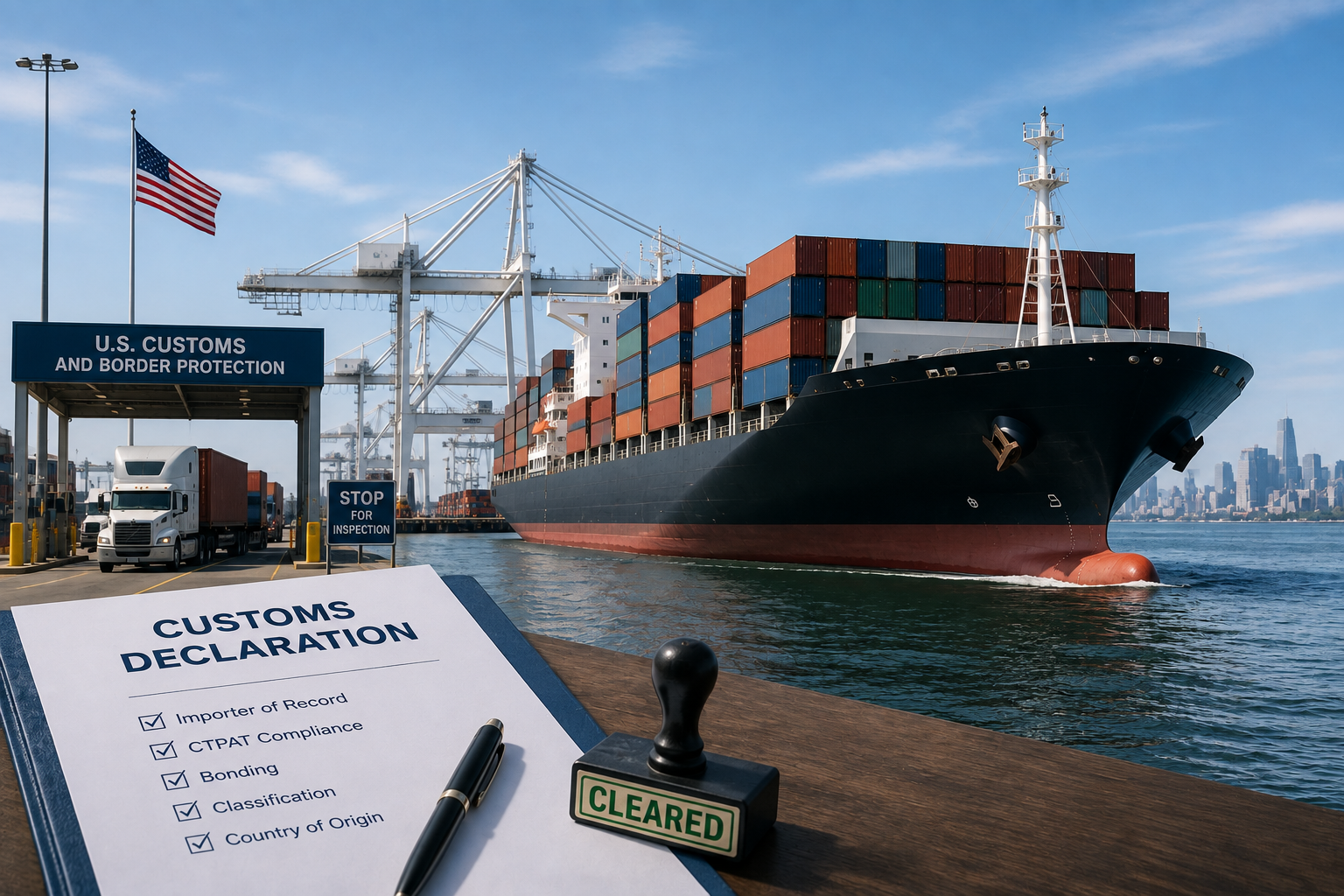
A container can leave China on time, cross the Pacific without disruption, arrive at a U.S. port exactly as scheduled—and still become a costly business problem.
The reason may have nothing to do with freight.
It could be the importer behind the shipment.
On June 3, 2026, President Donald Trump signed Executive Order 14411, “Strengthening Customs Enforcement”, directing the Department of Homeland Security and U.S. Customs and Border Protection to strengthen importer eligibility, foreign Importer of Record requirements, bonding, disclosure, broker oversight, enforcement, and importer accountability.
For companies sourcing from China and Asia, the deeper issue is not simply more customs paperwork.
It is whether the entity, broker, financial structure, and documentation supporting an import can withstand a more demanding compliance environment.
That makes EO 14411 a supply-chain continuity, working-capital, and customer-service issue—not merely a customs issue.
What Does Executive Order 14411 Mean for U.S. Importers?
Imagine a distributor preparing fourth-quarter inventory.
Purchase orders are committed to factories in Shenzhen. Production slots are locked. Retail customers are expecting delivery.
Then the company discovers that the entity being used as Importer of Record no longer fits the structure the business assumed it could continue using.
The merchandise still exists. The capital is already committed. The customer still wants the product.
But compliance has become the constraint.
EO 14411 directs DHS, within 180 days, to take steps to revise importer-eligibility regulations, guidance, and policies. Those revisions are to include requiring Importers of Record, or IORs, to maintain a CBP-determined minimum level of tangible domestic assets, bonding, or both, along with increased minimum bond coverage.
The order also calls for additional importer information, including anticipated import volumes, year organized, ownership and beneficial ownership, business affiliations, and domestic assets.
CBP is also directed to update the IOR registry, remove inactive importers, confirm compliance among active importers, and create risk-based tiers using factors such as compliance history, enforcement actions, and audit results.
The strategic message is simple:
Who is importing is becoming nearly as important as what is being imported.
Why Foreign Importers of Record Face a Bigger Change
The foreign-IOR provisions deserve particular attention from companies sourcing in Asia.
EO 14411 directs DHS to promptly revise applicable rules, policies, or guidance so that a foreign IOR making formal entry generally cannot rely on a continuous bond unless CBP permits it after determining that U.S. revenue is protected and compliance is assured.
More significantly, a foreign IOR making formal entry is to be validated in CTPAT, if CBP determines it eligible, or use a CTPAT-validated and licensed customs broker to file entries with CBP.
The order also directs DHS to prohibit foreign IORs from filing informal entries.
For Chinese manufacturers, Asian exporters, overseas e-commerce businesses, and multinationals using foreign-IOR structures, that could materially change how goods enter the United States.
Foreign importers should determine whether they may qualify for CTPAT validation themselves or whether they will need a CTPAT-validated broker.
Companies purchasing on Delivered Duty Paid, or DDP, terms should also confirm who is actually acting as IOR. Do not assume the supplier, marketplace, or logistics provider has structured the customs relationship the way your company expects.
The broker decision may become less about the lowest clearance fee and more about a fundamental question:
Is the broker qualified—and willing—to represent this importer?
Customs Brokers Are Becoming Compliance Gatekeepers
That question matters because EO 14411 changes the broker’s risk equation too.
The order directs stronger customs enforcement and specifically identifies maximum penalties for brokers that, for example, fail to conduct due diligence, repeatedly represent noncompliant clients, or fail to cooperate promptly with CBP information requests.
A broker therefore has strong reasons to scrutinize prospective clients more carefully.
Historically, the brokerage relationship could feel transactional:
Here is the commercial invoice. Here is the packing list. Please clear the shipment.
The emerging conversation may be closer to:
Who owns the importer? Who are its affiliates? Who manufactured the goods? How were they valued and classified? Can origin be supported? Can the importer meet its customs obligations?
That changes when compliance work needs to begin.
Broker readiness should be confirmed before cargo leaves Asia.
The expensive time to discover that a broker needs more documentation—or will not support an import structure—is after production is complete and inventory is already moving.
“Good Standing” Could Become a Gatekeeper to Importing
EO 14411 also directs DHS, within 180 days, to require all IORs to maintain good standing with CBP.
CBP is directed to define good standing using factors including the importer’s and its affiliates’ history of compliance with U.S. customs and trade laws and payment of required customs liabilities.
The order states that IORs not in good standing shall not be allowed to import or conduct certain activities directly related to importing, including designating a customs broker to act as IOR on their behalf.
That elevates customs compliance from an operational task to an enterprise-risk concern.
The bigger issue is not necessarily one isolated classification disagreement. It is whether recurring errors, unpaid liabilities, weak controls, valuation problems, ownership opacity, or poor recordkeeping create a pattern that affects the importer’s standing.
Executives should think about customs standing much like creditworthiness.
You do not wait until a bank freezes a credit facility to examine the balance sheet.
An importer should not wait for a serious customs problem to discover weaknesses in its controls.
Why Errors Could Become More Expensive
EO 14411 also directs DHS to take steps to revise customs penalty-mitigation standards.
Those revisions are to include a minimum mitigation floor of not less than 50% of an assessed penalty, absent specified exceptional circumstances, a minimum liquidated-damages floor, and elimination of mitigation for repeat offenders.
This does not mean every declaration error automatically creates a penalty equal to 50% of the merchandise value.
The provision concerns mitigation of assessed penalties, and implementation remains subject to agency action and applicable law.
But the policy direction is clear:
Repeated noncompliance is intended to become more costly.
That increases the importance of HTS classification, customs valuation, country of origin, related-party transactions, forced-labor exposure, antidumping and countervailing duties, broker instructions, and record retention.
For a high-volume importer, a small weakness repeated across hundreds of entries can become a material financial problem.
Why China and Asia Sourcing Deserves Special Attention
EO 14411 specifically prioritizes enforcement involving forced labor, misclassification, undervaluation, and illegal transshipment. It also emphasizes compliance with rules governing origin, revenue collection, product safety, and other federal requirements.
For procurement teams, that changes how “lowest cost” should be evaluated.
A supplier may offer a 12% unit-cost reduction. But if classifications are wrong, customs value cannot be supported, key sourcing information is missing, or country of origin cannot be substantiated, that apparent saving can disappear quickly.
The cheaper purchase order can become the more expensive supply chain.
The traditional landed-cost formula is:
Factory price + freight + duty + delivery.
Management increasingly needs to consider:
Factory price + freight + duty + compliance cost + delay exposure + enforcement risk + inventory disruption.
That is the calculation that ultimately affects profitability.
Is December 2026 the Effective Date?
Not exactly.
EO 14411 contains different instructions and implementation timelines.
Some foreign-IOR actions are directed to occur promptly. Certain disclosure, penalty-mitigation, disposal, and transparency actions carry 90-day directives. Importer eligibility, good standing, registry changes, and enhanced vetting carry 180-day directives from June 3. The order also states that implementation must be consistent with applicable law, including the Administrative Procedure Act.
Importers should therefore not view December as a single date on which every provision suddenly becomes operative.
The better approach is to treat the remainder of 2026 as a compliance-transition period—and prepare now.
A Five-Point EO 14411 Readiness Review
1. Confirm Your Importer of Record
Map the IOR structure shipment by shipment.
Who is legally importing? Who holds the bond? Who carries customs liability? Is the importer domestic or foreign? Does the commercial agreement match the customs structure?
Companies using DDP terms, foreign sellers, marketplaces, or related entities should pay particular attention.
2. Review Your Customs Broker Now
If a foreign IOR is involved, confirm the broker’s CTPAT status and ask how its requirements are changing.
Ask what documents will be required, whether existing foreign-IOR arrangements will continue to be supported, and how much lead time future reviews may require.
Anton Tombu, Business Development Director at XCT Logistics, encourages importers to treat broker readiness as part of shipment planning—not as an administrative detail that begins when cargo approaches the United States.
3. Build a Defensible Importer File
Organize records covering ownership, business affiliations, bonds, suppliers and manufacturers, HTS classification support, valuation methodology, origin documentation, related-party arrangements, duty-payment history, and previous CBP inquiries.
Good documentation reduces the time spent reconstructing transactions under pressure.
4. Audit Classification, Valuation, and Origin
Ask three questions:
Are our products classified correctly?
Can we explain how customs value was determined?
Can we substantiate country of origin?
An importer should be able to explain not only what appears on an entry, but why it is correct.
5. Connect Compliance to Inventory Planning
If review delays clearance, what happens to customer commitments?
If a foreign-IOR structure becomes impractical, which entity will import?
If the broker needs factory records, who obtains them in Asia?
If duty exposure changes, does pricing need to change?
These are operating questions—not simply customs questions.
The Best Time to Discover a Weakness Is Before the Container Moves
Companies do not need to wait for every implementation detail to improve their position.
Confirm the IOR. Verify broker status. Review bonds. Audit classifications. Test valuation methodology. Document suppliers. Review origin evidence. Reconcile customs arrangements with corporate structure.
As Anton Tombu, Business Development Director at XCT Logistics, advises importers evaluating China- and Asia-to-U.S. supply chains, the best time to identify a documentation, brokerage, or importer-structure weakness is before cargo is committed—not after the container is already moving.
The vessel may be on schedule. The inventory may be sold. The customer may be waiting.
But if the importer structure, broker relationship, or documentation cannot withstand scrutiny, none of that guarantees a smooth arrival.
The worst time to discover that weakness is when the container is already halfway across the Pacific.
Before your next major shipment leaves Asia, consider reviewing your importer structure, brokerage relationships, supplier documentation, customs coordination, and logistics workflow with Anton Tombu, Business Development Director at XCT Logistics.
Schedule a confidential consultation with Anton Tombu, Business Development Director at XCT Logistics, to review your China- and Asia-to-U.S. import strategy before evolving customs requirements become an inventory problem.