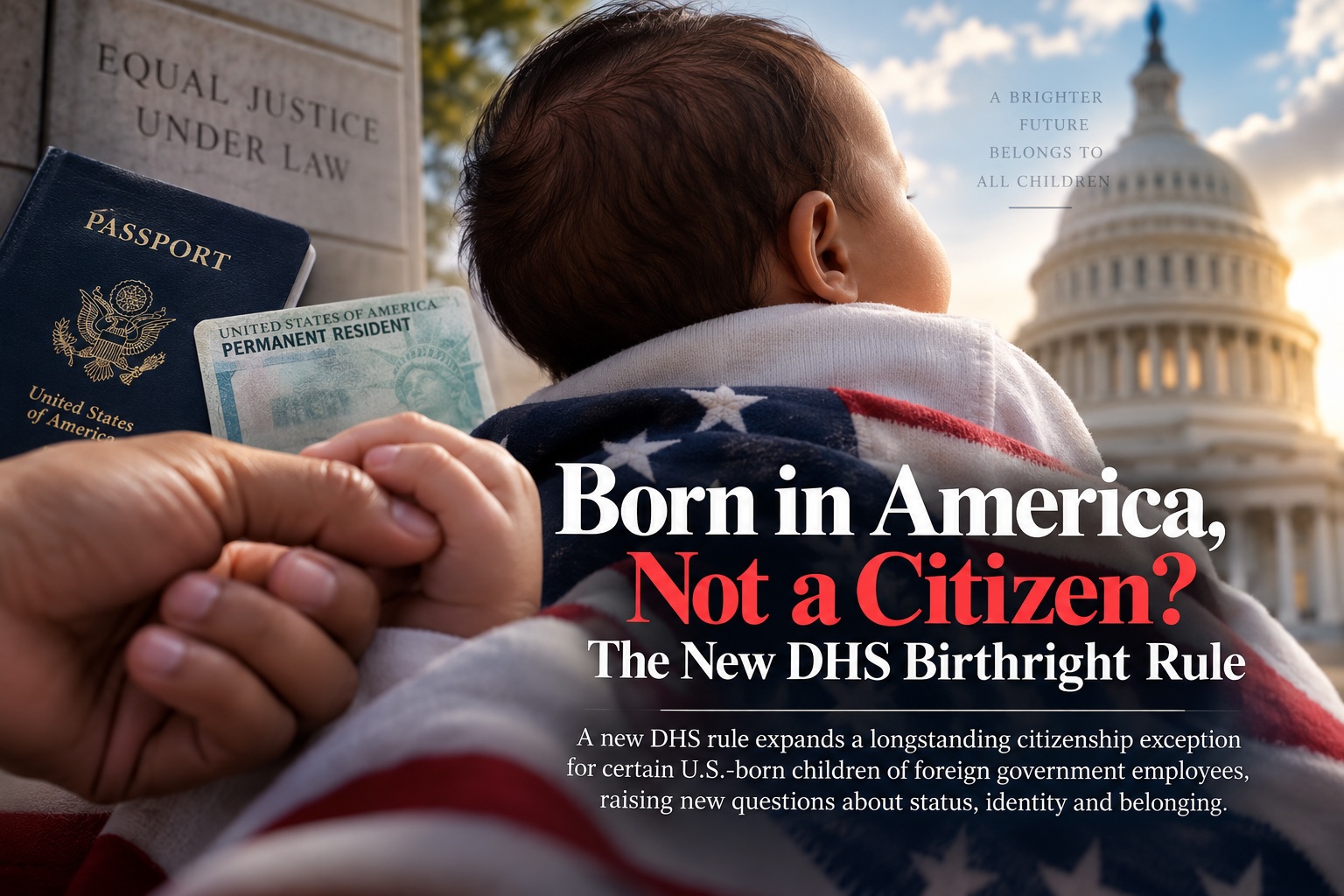
A new DHS rule expands a longstanding citizenship exception for certain U.S.-born children of foreign government employees, raising new questions about status, identity, and belonging.
What does it mean to be born in America if America does not recognize you as a citizen at birth?
That is the heartbeat question beneath a new Department of Homeland Security rule that could easily disappear into the bureaucratic language of federal regulations, immigration forms, and legal definitions.
But this is not simply a paperwork story.
It is a story about the first legal identity assigned to a child.
Effective September 4, 2026, the DHS interim final rule expands regulations governing certain children born in the United States to foreign government employees. When neither parent is a U.S. citizen and at least one parent falls within the government’s newly defined category of a “foreign government employee,” an eligible child may register as a lawful permanent resident rather than being recognized by the government as a citizen at birth under the policy.
The rule applies prospectively to covered children born on or after September 4.
For the families affected, the distinction is profound.
Imagine the ordinary intimacy surrounding a birth: a name chosen, a tiny wristband secured, photographs traveling instantly to grandparents across borders and time zones. Amid all that joy, there is now, for some internationally connected families, a legal question with lifelong implications:
What is this child’s status in the country where the child was born?
The answer begins with a constitutional phrase that has shaped American citizenship for generations.
The Fourteenth Amendment provides that people born or naturalized in the United States and “subject to the jurisdiction thereof” are citizens of the United States.
But birthright citizenship has never been without recognized exceptions. Children born to certain foreign diplomats have historically occupied one because their parents’ diplomatic status places them in a distinctive relationship to U.S. jurisdiction.
That history is crucial because the new DHS rule does not create the diplomatic exception from nothing.
What it changes is the reach of the regulatory category.
Previously, the relevant regulations referred to children born to a “foreign diplomatic officer.” DHS has now replaced that term with the broader “foreign government employee.”
Under the new definition, the category can include accredited foreign diplomatic officers, certain embassy and consular employees, people working for a foreign government in an official capacity, and qualifying employees of international organizations possessing immunity.
DHS also identifies who does not fall within that definition, including certain contractors, personal employees or attendants, third-country nationals employed by foreign governments, some employees of state-owned enterprises, and foreign government personnel visiting the United States in a personal capacity.
Those distinctions may look technical on a government website.
They are anything but technical when applied to a newborn child.
A lawful permanent resident and a U.S. citizen may grow up on the same street, attend the same school, speak with the same accent and consider the same city home.
Legally, however, those statuses are not interchangeable.
Permanent residence provides significant rights, including the ability to live and work permanently in the United States. Citizenship carries additional constitutional, civic, and legal protections.
That is why this rule requires careful language.
It would be misleading to describe it simply as DHS giving green cards to children of foreign officials. It would be equally misleading to suggest that DHS has ended birthright citizenship for children born to immigrants generally.
The rule concerns a specific category of foreign government employment and children whose circumstances fall within that category.
But within those boundaries, the change matters.
DHS is also revising Form I-485, Application to Register Permanent Residence or Adjust Status, and Form G-325R, Biographic Information (Registration), to reflect the expanded definition and account for children covered by the policy.
And the rule does not arrive on uncontested legal ground.
DHS has acknowledged the preliminary injunction in Casa Inc. v. Trump and says it will not implement the rule against members of the certified class, or otherwise take action conflicting with that injunction unless the government obtains relief from the court.
That qualification is not a footnote families should ignore.
A federal regulation can take effect while litigation continues to determine how, and against whom, the government may lawfully enforce the underlying policy.
There is also a serious counterargument that deserves to be heard.
Supporters of the administration’s approach can point out that the Constitution itself contains the phrase “subject to the jurisdiction thereof,” and that an exception involving children of foreign diplomats has existed for generations. From that perspective, the government is not abolishing birthright citizenship but defining which foreign government personnel fall within an already recognized jurisdictional principle while providing affected children a path to lawful permanent residence.
That argument matters because public debate over immigration often collapses complicated legal distinctions into slogans.
But there is an equally important rebuttal.
The central question is not whether the diplomatic exception exists.
It does.
The question is how far that exception can extend.
DHS itself has moved from the narrower regulatory term “foreign diplomatic officer” to the broader term “foreign government employee.” That expansion is the consequential change—and it is precisely why the policy deserves scrutiny from courts, immigration lawyers, affected families and the public.
Because immigration policy rarely stays inside Washington.
Eventually, it comes home.
It arrives when parents apply for their child’s passport.
When a family completes government paperwork.
When a school asks for documentation.
When an immigration form asks someone to define a status that may have been determined before that person could walk or speak.
And years later, perhaps, it arrives as a deeply personal question from a child:
If I was born here, why wasn’t I born a citizen?
For immigrant and internationally connected families, that question carries particular weight.
Their lives may already stretch across countries, languages, passports, and competing ideas of home. Birthplace can feel like one of the few uncomplicated facts in a complicated immigration story.
This rule is a reminder that, under U.S. law, even that fact can intersect with questions of jurisdiction and legal status.
There is also a civic window still open. The interim final rule is accepting public comments through October 5, 2026, giving individuals and organizations an opportunity to place their perspectives into the formal federal rulemaking record.
That matters.
Citizenship debates are often conducted at the altitude of constitutional theory and national politics. Yet the consequences eventually descend into ordinary life.
Behind phrases like “foreign government employee,” “lawful permanent residence,” and “subject to the jurisdiction” are children.
Children who did not choose their parents’ employment.
Children who did not choose diplomatic classifications.
Children who do not know that immigration law exists when they first open their eyes.
They simply arrive.
And from that first breath, the law begins deciding what their birth in America means.
That is why this rule deserves more than a passing headline. Whenever America redraws even one boundary around citizenship and belonging, immigrant communities deserve to know exactly where the line has moved—and whom it may leave on either side.
Stay proud, stay grounded, stay true.
#BirthrightCitizenship #DHS #ImmigrationPolicy #ImmigrantFamilies #USCIS #ImmigrantVoices #Citizenship #ImmigrationNews