
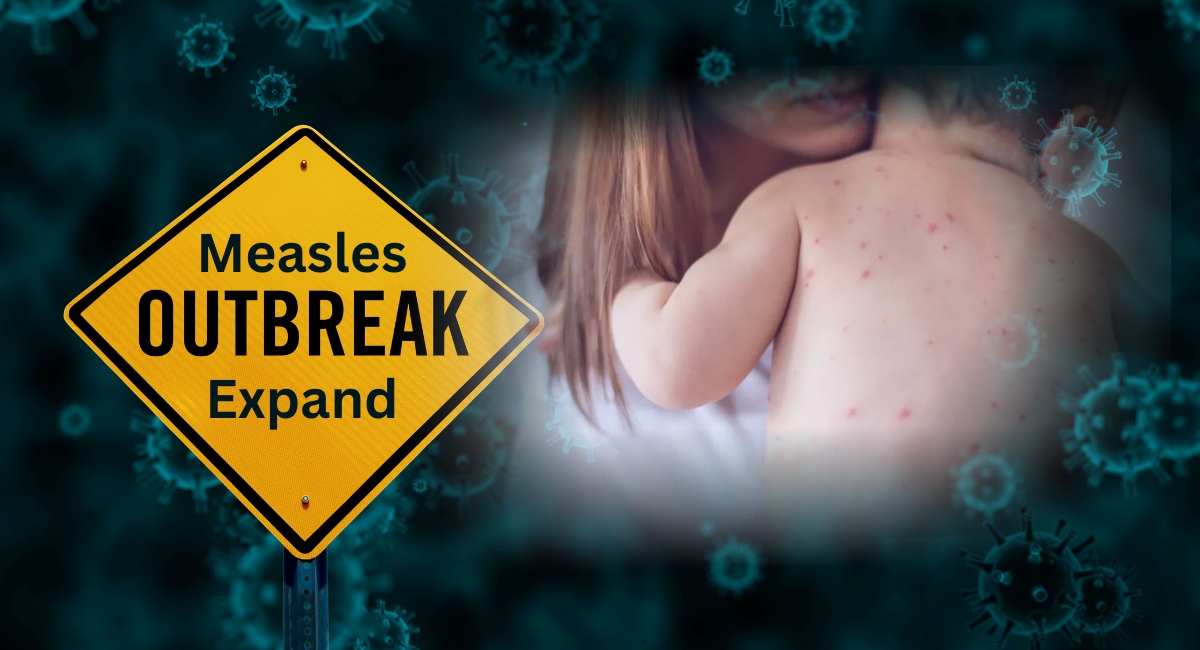
As measles outbreaks spread across the United States, health experts warn that misinformation—not medicine—is fueling the disease’s return, putting immigrant families, young children, and international travelers at greater risk.
For many immigrants, measles is not a word pulled from a history book.
It is a memory.
It is the cousin who never returned to school after an outbreak. The childhood friend left with hearing loss. The anxious line outside a neighborhood clinic where parents waited for a vaccine that promised something priceless: the chance for their children to grow up healthy. For families who crossed oceans in search of safer futures, those memories often felt like part of a life left behind.
Until now.
Across the United States, measles is making an unsettling return. States including Texas, Utah, and South Carolina have reported outbreaks, while public health officials warn that more communities remain vulnerable as childhood vaccination rates continue to decline. Infants too young to be vaccinated, pregnant women, and even adults who assumed they were protected are among those now facing renewed risk. The virus has not become stronger. What has weakened is something far more fragile: public trust.
That sobering reality became the focus of one of American Community Media’s most timely health briefings, where Health Editor Sunita Sohrabji convened leading infectious disease experts and ethnic media journalists serving immigrant and multilingual communities across the nation. Their discussion was about much more than a virus. It was about how misinformation, declining confidence in institutions, shrinking public health resources, and cultural barriers are allowing a disease once thought to be under control to quietly reclaim ground.
Joining the conversation were Patsy Stinchfield, Executive Director of the Measles Collaborative; Dr. Andrew Pavia, Chief of Pediatric Infectious Diseases at the University of Utah; Dr. Benjamin Neuman, professor of biology at Texas A&M University; and Dr. José Romero, former chair of the Centers for Disease Control and Prevention’s Advisory Committee on Immunization Practices. Together, they delivered a message that immigrant communities have heard before in different forms: diseases often exploit the same cracks in society that inequality does—limited access, misinformation, and distrust.
Stinchfield began by correcting one of the most common misunderstandings surrounding measles. Americans often say the disease was “eradicated,” but the more accurate word is “eliminated.” Measles was eliminated from continuous transmission within the United States in 2000, thanks to widespread vaccination. It never disappeared from the rest of the world. As long as the virus continues circulating internationally, every airport, every family reunion abroad, and every international visitor represents an opportunity for it to return.
That distinction matters deeply for immigrant families.
International travel is woven into immigrant life. Visiting aging parents, attending weddings, mourning loved ones, introducing children to grandparents, or maintaining cultural ties often means crossing borders. Most journeys end with treasured memories. Occasionally, however, they can also bring home diseases that Americans have largely forgotten.
The danger is amplified because measles is unlike almost any other infectious disease. One infected person can spread the virus to as many as eighteen others in an unvaccinated community. To prevent outbreaks, approximately 95 percent of a community must be vaccinated. Once coverage falls below that threshold, the virus needs very little help to spread.
Yet numbers alone fail to capture what measles actually does.
Many people still think of it as a childhood rash accompanied by fever. The experts challenged that misconception.
The virus enters through the nose and throat before spreading through the lungs and lymphatic system, eventually reaching organs throughout the body. It can trigger pneumonia, severe dehydration, brain inflammation, hearing loss, blindness, and in some cases death. Even after recovery, the virus can weaken the immune system for months or years, leaving survivors more susceptible to other infections they had previously developed immunity against. It is not merely an illness children “get over.” It is a disease capable of changing lives forever.
If science explains how measles spreads, stories explain why prevention matters.
One story shared during the briefing silenced the room.
Stinchfield recalled a Minnesota family preparing for an international trip. Everyone received recommended travel vaccinations except one sleeping nine-month-old baby. Rather than wake him, the parents decided to wait until returning home. During the trip, the infant contracted measles. Back in Minnesota, he was admitted to a children’s hospital, where he spent fifteen days on a ventilator fighting for his life.
His mother later asked healthcare workers to photograph her son connected to breathing machines—not for sympathy, but so other parents would understand the consequences of delaying a vaccine.
“I didn’t know measles could be this dangerous,” she admitted.
Her words capture the heartbreaking truth behind many outbreaks. They are rarely born from indifference. More often, they begin with incomplete information, understandable hesitation, or the belief that “it won’t happen to us.”
Perhaps nowhere is that lesson more evident than in Minnesota’s Somali community.
Years before COVID-19 turned vaccine misinformation into a national debate, Somali-American families became the target of organized campaigns falsely claiming the MMR vaccine caused autism. Before those campaigns took hold, Somali children had some of Minnesota’s highest vaccination rates. Over time, fear spread faster than facts.
Parents delayed vaccinations.
Children remained unprotected during their most vulnerable years.
Outbreaks followed.
The heartbreaking irony, Stinchfield explained, was that many Somali parents personally remembered the devastation measles caused in East Africa. Some later confessed they had not realized the “M” in MMR stood for measles. Others believed misinformation suggesting the combined vaccine posed unique dangers. What they needed was not condemnation. They needed trustworthy conversations.
Healthcare workers responded by meeting families where trust already existed.
They partnered with Somali physicians, nurses, community leaders, and imams. They held conversations in mosques, apartment complexes, neighborhood centers, and public housing developments. Rather than dismissing parents’ fears, they listened first, answered questions honestly, and acknowledged the emotional weight behind every decision involving a child.
It was a reminder that public health is never just about medicine.
It is about relationships.
That lesson echoed throughout the briefing.
Dr. Andrew Pavia described similar challenges unfolding hundreds of miles away in Utah. Although statewide vaccination rates appeared relatively high, certain communities experienced dramatic declines, with some schools reporting coverage as low as thirty to forty percent. Religious beliefs, distrust of government, geographic isolation, and years of shrinking public health resources created conditions where measles could spread rapidly once introduced.
Official numbers, Pavia cautioned, likely tell only part of the story.
Many families never seek testing because clinics are hours away, transportation is expensive, or they fear government involvement. Using epidemiological modeling and genetic sequencing of virus samples, researchers estimate actual infections may be two to four times higher than reported in some communities.
The resurgence has also surprised many physicians.
Doctors entering practice today often completed their training without ever seeing measles. Adults now represent a significant portion of infections, and pregnant women face particularly severe complications. Infection late in pregnancy can be transmitted to newborns before they have any opportunity to develop protection of their own.
While fear often dominates public conversations, Dr. Benjamin Neuman offered reassurance grounded in science.
Unlike influenza or COVID-19, measles has changed remarkably little over time. Although the virus mutates, the portions recognized by the immune system remain largely unchanged. That is why the MMR vaccine developed decades ago continues to provide exceptionally strong and long-lasting protection.
In other words, the vaccine has not failed.
Our confidence in it has.
The discussion eventually turned from biology to governance.
Dr. José Romero, who formerly chaired the CDC’s Advisory Committee on Immunization Practices, described the rigorous scientific review traditionally required before vaccine recommendations reach the American public. Independent experts evaluate evidence over months, disclose conflicts of interest, debate findings openly, and weigh the risks and benefits before issuing guidance.
That transparency, Romero argued, is essential because public confidence depends not only on scientific evidence but also on confidence in the process itself. When people begin questioning how decisions are made—or who is making them—trust becomes harder to rebuild, especially among communities that already navigate language barriers, historical discrimination, or unfamiliar healthcare systems.
For immigrant families, that reality feels especially familiar.
Moving to a new country often means learning an entirely different healthcare system while deciding whom to believe. Medical advice may conflict with information shared by relatives overseas. Social media circulates frightening stories in multiple languages. Community rumors travel quickly through WhatsApp groups, family chats, churches, temples, mosques, and neighborhood gatherings. In those moments, deciding what is true can feel as overwhelming as the illness itself.
That is precisely why ethnic media matter.
Throughout the briefing, journalists asked the questions their communities are already asking at home: Should immigrants vaccinated overseas receive another MMR shot? Are adults still protected decades later? What about international travel? What risks do pregnant women face? How can public health agencies rebuild confidence before another outbreak begins?
Those questions reflect something larger than curiosity.
They reflect responsibility.
Ethnic media have long served as trusted bridges between scientific institutions and communities that mainstream outlets too often overlook. They translate more than language. They translate context, culture, history, and lived experience. They understand that a parent’s decision is shaped not only by facts but by memory, faith, family, and trust.
The return of measles is ultimately not just a public health story.
It is a human story.
It reminds us that protecting children requires more than remarkable medical discoveries. It requires trusted relationships, honest conversations, and communities willing to meet one another with compassion instead of judgment.
Immigrants understand something the world repeatedly teaches: diseases do not recognize borders.
Neither does hope.
Every generation that arrives in America carries dreams larger than themselves—the hope that their children will inherit healthier, safer, and more secure lives than the ones they left behind. Protecting that dream has always depended on knowledge shared across generations, neighbors looking after one another, and trusted voices speaking with clarity when confusion threatens to take hold.
Science has already given us the tools to prevent measles.
The challenge before us is ensuring every family, regardless of where they come from or what language they speak, has someone they trust enough to believe them.
#ImmigrantMagazine #Measles #PublicHealth #ImmigrantFamilies #Vaccines #ChildrensHealth #CommunityHealth #MMRVaccine #HealthEquity #EthnicMedia







1 Comment. Leave new
I have never felt this excited about online betting until I found this place. It has such a unique personality and I feel like my favorite game is waiting for me with open arms. Every session feels fresh and full of possibilities. Jump into the fun at thgimixo