Magazine, Immigration, ACOM, By Edward Kissam
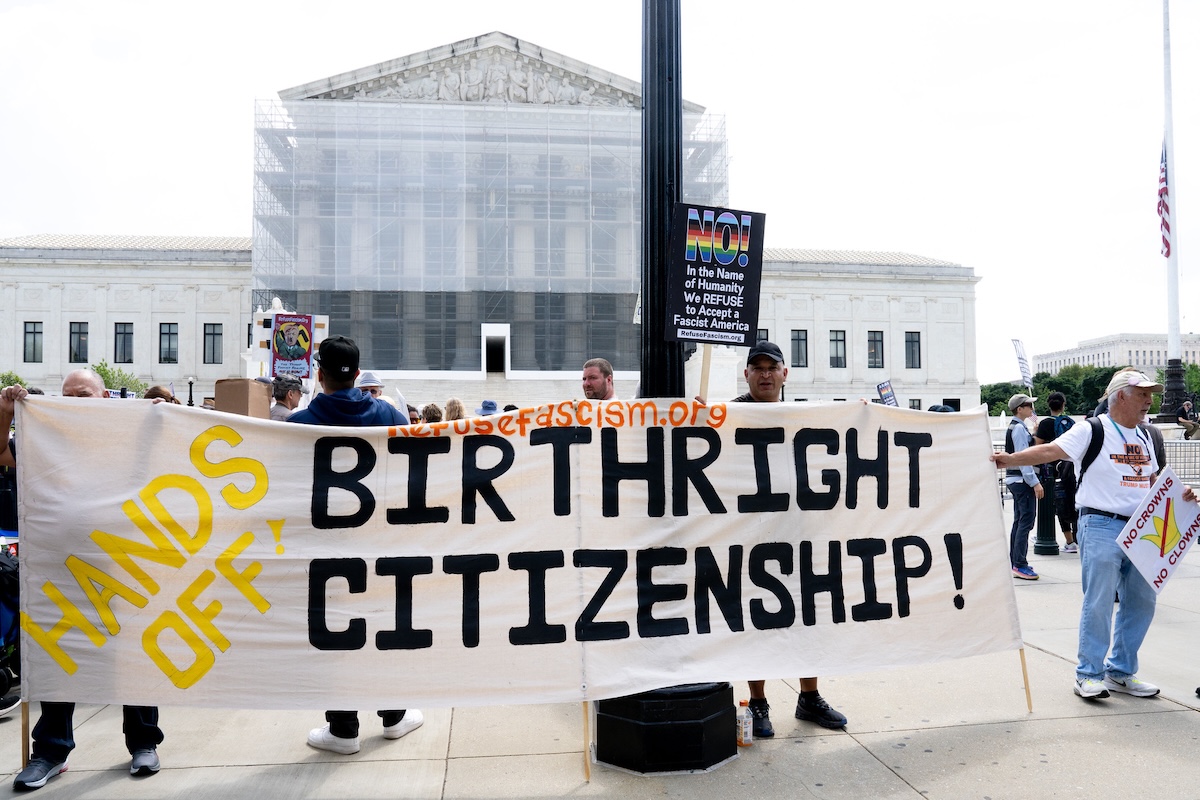
The Supreme Court’s 6-3 decision on June 30 affirming the bedrock constitutional principle of birthright citizenship is a crucial and, in this current climate, exceedingly rare victory for immigrants and all Americans.
Chief Justice John Roberts affirmed the historical importance of the June 30th decision in the case, declaring, “Citizenship, then and now, was the right to have rights — to freely participate in our political community. The Framers of the Fourteenth Amendment extended that promise to ‘every free-born person in this land’ … We keep that promise today.”
The ACLU was a lead litigator in the case, Barbara v. Donald J. Trump. In a statement, Executive Director Anthony Romero explained the political dimensions of the victory, saying, “This was one of the most important constitutional cases of the past 100 years … [President Trump] bet his legacy trying to secure this policy win … and he lost.”
Trump issued his Executive Order seeking to limit birthright citizenship — guaranteed under the 14th Amendment — on Inauguration Day in 2025. It would be the first salvo in what has become a concerted campaign of persecution targeting immigrants nationwide.
In rejecting the move, the Court affirmed that not only are the hundreds of thousands of children born each year to immigrant parents here U.S. citizens. It also indirectly recognizes that the parents themselves, whatever their legal status, are an integral part of U.S. society, important contributors to the country’s culture, civic life, and economic well-being.
U.S. Senator Alex Padilla (D – Calif.), himself the son of undocumented immigrants from Mexico, hailed the ruling, saying, “The Constitution could not be clearer: if you are born in the United States, you are a citizen of the United States. Period. No ambiguity.” Padilla was born in Los Angeles.
Still, Tuesday’s ruling is by no means the final word on an issue that goes to the heart of what it means to be American.
One of the arcane legal issues addressed in the case was whether immigrants — including many who reside here lawfully as well as those who currently lack legal status — are “temporary” and not “subject to the jurisdiction” of the US. Embedded in the Court’s 194-page ruling is an inherent rejection of that legally flawed theory.
Affirmation of birthright citizenship is, in essence, a recognition of the day-to-day life in the real world of U.S. communities; that millions of immigrants — including those who have not yet managed to secure permanent residence or citizenship — live, work, and volunteer side-by-side with their U.S. born neighbors.
Writing for the majority, Justice Roberts pointed to English common law and the concept of jus soli, Latin for “right of the soil,” the notion that a child born within a sovereign’s domain owed allegiance to said sovereign.
“This common law of citizenship,” writes Roberts, “crossed the Atlantic and prevailed in ‘each and all of the states’ after American independence.”
Roberts also cited the Civil Rights Act of 1866 and its culmination in the 14th Amendment, adopted two years later. He then cited the 1898 case of Wong Kim Ark, born in San Francisco to Chinese parents and excluded from returning to the US after a trip to China.
“In Wong Kim Ark, the Court held that the Fourteenth Amendment was ‘declaratory’ of the ‘fundamental rule of citizenship by birth that prevailed at common law,” noted Roberts.
Exceptions to the birthright citizenship law include the children of foreign diplomats and those of hostile invaders, the latter a pejorative that Trump and his allies have tried to attach to immigrants and their families.
The Court’s decision follows rulings last week that granted the president authority to strip protections from Haitians and Syrians living in the country, some of them for decades, under Temporary Protected Status (TPS). Advocates say that ruling threatens to make the more than 1.3 million people with TPS now in the country deportable.
Today’s decision, however, offers a crucial counterbalance to the right-wing assault on diversity and to the Trump administration’s obsession about immigrants as enemies or, absurdly, extraterrestrials. For advocates, it also offers a greenlight to push forward for national policies to affirm equity for all immigrants.
But it will not be the end of the story.
In his dissent, Justice Samuel Alito called the ruling a “serious mistake.” Justice Clarence Thomas rejected the majority’s interpretation of the 14th Amendment’s Citizenship Clause, which he argued was exclusively “designed and understood to secure equal rights for the freed blacks.”
In her opinion concurring with the majority, Justice Ketanji Brown Jackson provided a detailed analysis of the political struggles to enact the 14th Amendment, calling Thomas’ argument “narrow” and one that ignores “the history of [the amendment’s] ratification.”
Jackson has been among the most ardent voices on the Court arguing against the idea of a “unitary executive,” the theory that posits the Constitution vests all executive power in the office of the president. The theory, to which Justice Roberts has long adhered, is behind many of the Court’s more recent rulings granting the president extraordinary powers.
This is not a theoretical issue, particularly for immigrants. Testifying before Congress earlier this month, Department of Homeland Security Secretary Markwayne Mullin refused to commit the agency to adhering to federal court orders, arguing that judges had become “too politicized.”
Unbridled executive authority effectively opens the door to continued arbitrary and unfounded interpretations of immigration law, and violations of constitutionally protected rights by federal immigration agents, leaving those targeted with little legal recourse.
And while the court’s decision affirming birthright citizenship has decisively addressed the legal issues, the impetus behind the initial Executive Order continues to animate the far right.
“Because it goes so deeply to the kind of pluralistic character of the nation,” said University of Pennsylvania Professor of Law Kate Shaw, “it could become something that remains an object of real fixation for the conservative legal movement.”
As the administration continues to pursue its campaign of mass detentions and deportations, the political reality is that despite today’s ruling advocates will have to work fiercely to continue to defend the place of immigrants here.
Still, the decision offers a welcome rebuke to the Trump administration’s efforts to govern by Executive Order, and to the notion that immigrants in the US are simply “birds of passage,” temporary sojourners with no connection or commitment to the country or its people.
They are, as indirectly affirmed by today’s Supreme Court decision, part of the fabric of American life. And the country is better for it.
Image credit: Victoria Pickering. Published via Flickr under CC License 2.0
#BirthrightCitizenship #SCOTUS #ImmigrantRights #FourteenthAmendment #ImmigrationPolicy #Constitution #CivilRights #AmericanDream #TheImmigrantMagazine #Justice