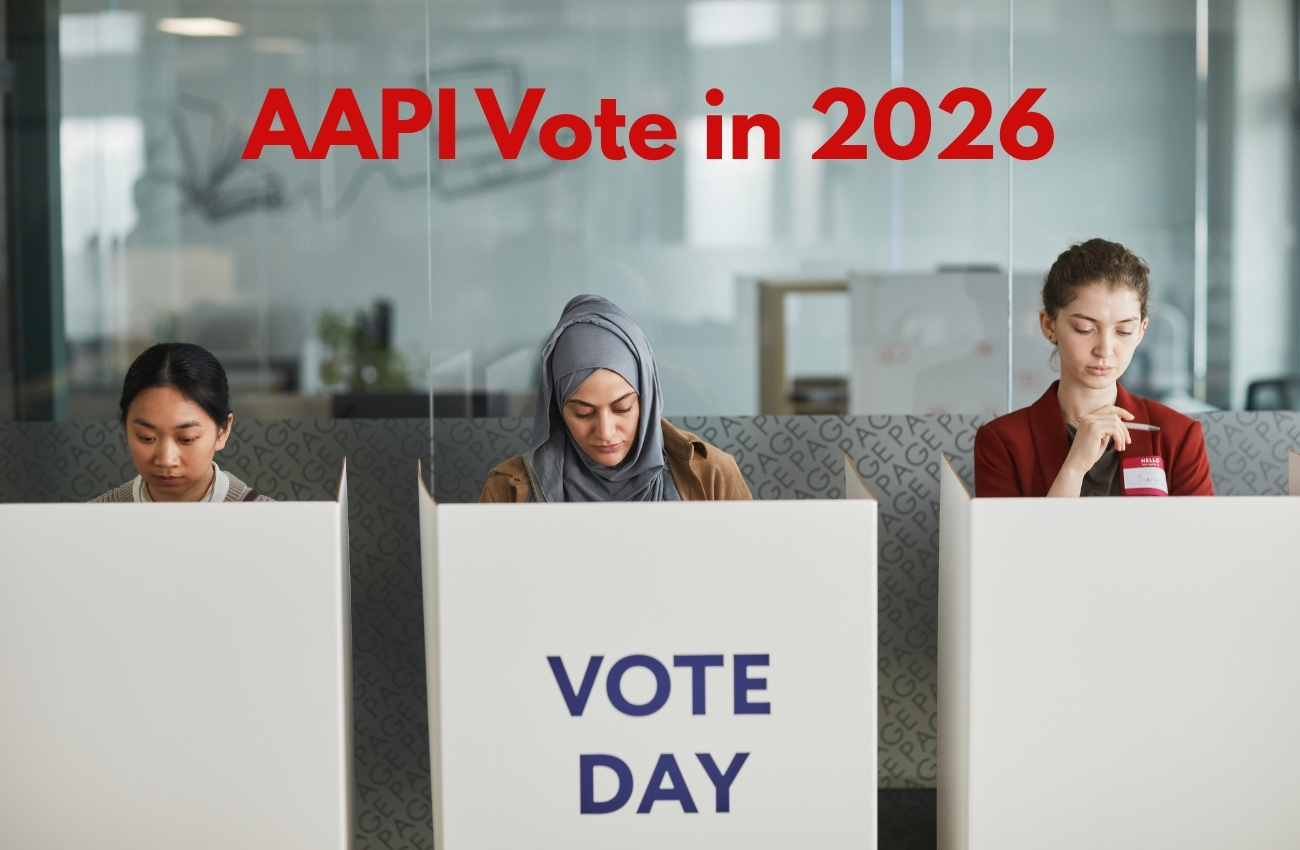
From rising costs and immigration fears to language barriers and young voters feeling overlooked, four experts reveal what’s changing within one of America’s fastest-growing electorates.
Magazine, The Immigrant Experience
Nine out of ten registered Asian American and Pacific Islander voters surveyed say they plan to vote in the 2026 midterms. So why are so many still struggling to be heard?
For some, it’s the language barrier. For others, it’s fear of immigration enforcement, the rising cost of living, or simply not knowing where to find reliable voting information.
And for millions of Asian Americans and Pacific Islanders, there is another challenge: being treated as one community when their experiences, cultures, and concerns are anything but the same.
With the November 3 elections approaching, new national survey findings are drawing attention to an electorate that continues to grow, yet is frequently misunderstood.
There are nearly 17 million eligible AAPI voters nationwide, according to figures shared during an October 16 American Community Media (ACoM) briefing.
But behind those numbers are families whose lives, immigration journeys, and political priorities differ widely.
Moderated by journalist Sunita Sohrabji, the briefing, The AAPI Vote in 2026: What Has Shifted Within This Diverse Electorate?, brought together Karthick Ramakrishnan, founder and director of AAPI Data; Christine Chen, executive director of Asian and Pacific Islander American Vote (APIAVote); Mary Lou Akai-Ferguson, executive director of the Asian American Power Network; and Shekar Narasimhan, chairman of the AAPI Victory Fund.
Together, they examined voter participation, economic pressures, immigration enforcement, young voters, and the obstacles facing communities that are often overlooked.
Their message went beyond election statistics: understanding AAPI voters begins with understanding the people behind them.
Families Are Feeling the Pressure of Rising Costs
For many AAPI families, the most pressing concern is not a political slogan. It’s the cost of everyday life.
Groceries. Rent. Healthcare. Education. The bills that arrive whether or not an election is approaching.
Ramakrishnan said cost of living and inflation remain dominant concerns in AAPI voter surveys.
He also challenged the assumption that Asian American communities are uniformly financially secure.
According to figures he presented, approximately 10% of Asian Americans and 17% of Pacific Islanders live below the federal poverty line.
But many more families worry about keeping up with expenses.
Akai-Ferguson offered an important reminder: affordability looks different depending on whose life we’re talking about.
A technology worker in Michigan may face challenges very different from those of a Filipino American casino worker in Las Vegas.
Both may be struggling, but their needs are not necessarily the same.
That distinction matters when candidates discuss solutions for working families.
Immigration Fears Are Reaching Into Everyday Life
One of the briefing’s most striking findings concerned immigration enforcement.
Ramakrishnan reported that 41% of Asian Americans and Pacific Islanders surveyed said they or someone they knew had started carrying immigration or citizenship documents because of enforcement concerns.
Among South Asians, that figure rose to 53%.
For families who have spent years building a life in America, the decision to carry documents out of fear is deeply personal.
It reflects uncertainty that can follow people to work, school, and everyday activities.
The survey findings also suggest changing attitudes toward immigration enforcement.
Ramakrishnan said support for mass deportation among surveyed respondents declined from 38% in December 2024 to 29% in February 2026.
He connected the shift to public concern surrounding immigration enforcement operations.
His findings challenge the assumption that immigration policies affect only Latino communities.
Asian Americans include substantial immigrant populations, and immigration policies can shape their jobs, family relationships, and sense of security.
AAPI Communities Are Not All the Same
The term AAPI covers people with roots across Asia and the Pacific Islands.
Their histories, languages, economic circumstances, and political views vary widely.
Yet public discussions often group them together as though one experience represents everyone.
Ramakrishnan warned that broad racial statistics can hide significant differences among ethnic communities.
He pointed to populations with more recent migration histories, including Nepalese, Kazakh, Uzbek, and Mongolian communities.
He also emphasized that Asian Americans have substantial language-access needs, something often overlooked in conversations about voting.
Smaller ethnic groups are frequently underrepresented in national surveys because researchers lack the funding needed to reach sufficiently large samples.
That leaves important gaps in what policymakers, journalists, and the public understand.
When people are missing from the research, their concerns are easier to miss in public discussions.
Why Some Voters Remain Unreached
Mary Lou Akai-Ferguson raised a question worth considering.
When someone doesn’t vote regularly, is it because they don’t care? Or because nobody has taken the time to engage with them?
She prefers describing such individuals as inconsistent or unreached voters rather than labeling them by a presumed lack of interest.
In Georgia, community organizations have organized gatherings called Chai and Chat.
People meet in coffee shops and tea houses to ask questions about elections, public policies, and government without feeling embarrassed or judged.
A conversation about rising electricity bills, for example, can become an opportunity to understand how Georgia’s Public Service Commission affects utility costs.
It’s a simple idea: help people connect government decisions to their daily lives.
But Akai-Ferguson said funding shortages have forced organizers to cut programs that build those relationships.
She reported that her network had knocked on approximately 450,000 doors and completed more than 85,000 phone conversations by October 15.
Even with that outreach, some communities remain difficult to reach.
In Nevada, plans to hire Korean American and Chinese American community organizers were canceled because funding was unavailable.
Those organizers would have helped build relationships and understand community concerns well before the election.
The lesson is straightforward: trust takes time. It cannot be built through advertisements alone in the final weeks of a campaign.
Gen Z Wants More Than Election Messages
Young AAPI voters are also navigating their own uncertainties.
They are worried about finding jobs, paying for school, affording housing, and building a future in an expensive economy.
Akai-Ferguson described students struggling with transportation costs and the effects of education funding changes.
She also noted limited enthusiasm for candidates among some young voters, even when those voters are politically engaged.
The challenge is not always a lack of interest. Sometimes young people do not see their concerns reflected in political conversations.
Organizations have tried reaching them through local social media creators, campus programs, and trusted community voices.
But Akai-Ferguson said funding cuts have disrupted some of those efforts.
For Narasimhan, authenticity matters. He emphasized that young voters do not necessarily support candidates simply because they share a cultural or ethnic background.
They want to know what those candidates believe and whether their priorities reflect the issues affecting their lives.
Knowing Your Voting Rights Matters
Christine Chen focused on the practical side of participation.
She described how changes to voting rules, identification requirements, polling locations, and mail-ballot procedures can create confusion.
For first-time voters, naturalized citizens, and people who are more comfortable communicating in another language, that uncertainty can be especially difficult.
Chen discussed concerns about reduced polling locations in parts of Texas and changes to voter identification rules affecting students in Indiana.
She also warned that misinformation about immigration enforcement and voting procedures can discourage participation.
Her organization and its partners, she said, had mailed translated voting information to approximately 1.2 million households in 19 states, using materials in 11 languages.
The work is intended to help eligible voters understand registration, identification requirements, voting options, and available assistance.
Because election rules differ by state, checking accurate local information is essential.
Eligible voters can begin with Vote.gov and their state or county election office.
Representation Is About Being Heard
Shekar Narasimhan shared a revealing story about a congressman who once asked which of several Diwali celebrations he should attend.
Narasimhan encouraged him to attend as many as possible.
His point was that meaningful engagement requires showing up, getting to know people, and understanding their concerns.
AAPI political participation has grown over the years, and campaigns are paying greater attention to Asian American and Pacific Islander communities.
But Narasimhan cautioned against assuming that voters automatically support a candidate because of shared ethnicity.
Communities have different political beliefs. They evaluate candidates through their policies, priorities, and values.
Having diverse representation in government matters, but so does ensuring that community concerns are understood when decisions are made.
A Family Tradition Worth Remembering
Perhaps one of the most relatable moments of the briefing came when Chen shared a memory from her own family.
When she turned 18, her family took her to vote.
Afterward, they went out to eat.
It became a tradition.
That simple memory reminds us that civic participation is not only about campaigns and election statistics.
It can begin with conversations around the dinner table, questions from children, and families learning together how public decisions affect their communities.
For immigrant families, those conversations can be especially meaningful.
Even when some relatives are not eligible to vote, they can still participate in community life, stay informed, and help others understand the issues.
The Work Does Not End on November 3
As the briefing concluded, the experts stressed the importance of reliable information before, during, and after Election Day.
Voting procedures differ by state. Ballots may still be counted after November 3. Rumors and misleading claims can spread when results are not immediately available.
That makes trusted community journalism particularly important.
Asian Americans and Pacific Islanders are not one community with one story, one experience, or one political viewpoint.
They are individuals and families with different concerns, hopes, and expectations of the country they call home.
And whether they participate through voting, community organizations, or everyday civic conversations, those experiences deserve to be understood.
The lesson from this election is simple: You cannot understand a community you have not taken the time to know.
And building a democracy in which people can participate meaningfully begins with listening to them—not just during election season, but every day.