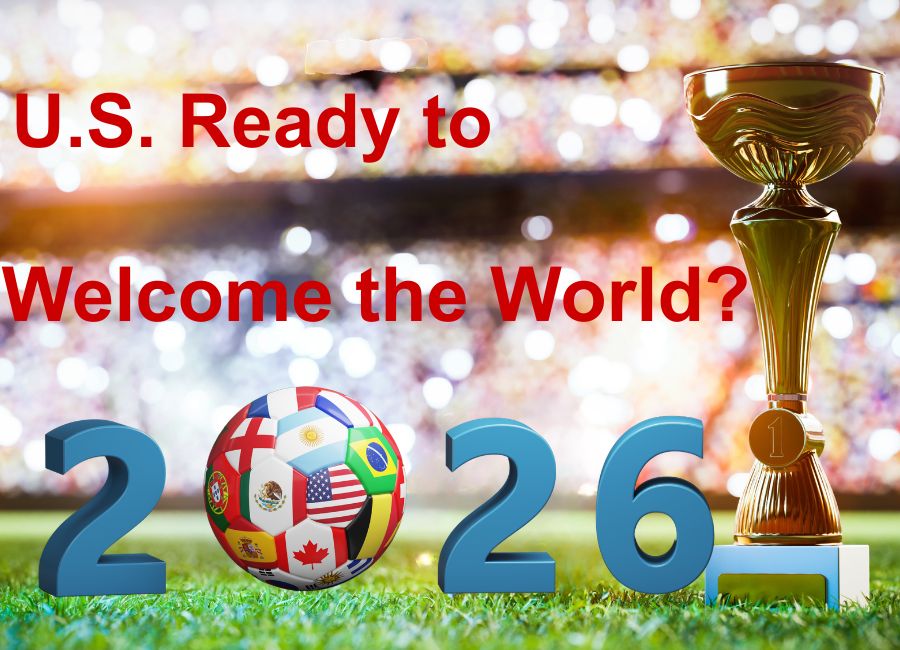
Advocates, civil rights leaders, and immigration experts warn that enforcement policies, visa restrictions, and human-rights concerns could shape how immigrant communities experience the world’s biggest sporting event.
On summer evenings in Los Angeles, soccer arrives long before the opening whistle.
It spills from restaurant televisions in Pico-Union. It sparks debates in neighborhood barbershops. It drifts through family gatherings where grandparents remember matches from another continent and children proudly wear jerseys representing countries they know mostly through stories told around dinner tables.
For many immigrants, the FIFA World Cup is not simply a sporting event.
It is memory wrapped in national colors.
It is a reunion with home.
It is a bridge between where a family began and where it is going.
For ninety minutes at a time, borders seem less important than belonging.
That is why anticipation is building across immigrant communities as North America prepares to host the largest FIFA World Cup in history.
But for one asylum-seeking father, a soccer event meant to create a family memory became something very different.
He attended a Club World Cup event with his two children.
There was nothing unusual about the outing.
A father.
Two children.
A shared love of soccer.
The kind of memory families create every day.
Instead, immigration authorities arrested him outside the stadium while his children watched.
Months later, he was deported.
The children eventually reunited with their mother.
The father never came home.
His story became one of the most powerful examples discussed during a recent American Community Media briefing with ethnic media journalists, where human rights advocates, immigration experts, and civil rights leaders gathered to examine a question that is becoming increasingly urgent as the 2026 FIFA World Cup approaches:
Will immigrant communities feel safe enough to fully participate in the celebration?
Moderated by ACOM Associate Editor Pilar Marrero, the conversation brought together Minky Worden of Human Rights Watch, Katherine La Puente of Human Rights Watch, Jamal Watkins of the NAACP, and Ariel Ruiz Soto of the Migration Policy Institute.
What emerged was more than a policy discussion.
It was a warning.
Not a prediction of what will happen.
A warning about what could happen if governments, FIFA, and host cities fail to adequately protect immigrant communities, workers, children, journalists, and visitors.
The concerns discussed during the briefing touched on immigration enforcement, child safety, visa restrictions, workers’ rights, freedom of expression, and community trust.
But beneath all of those topics sat a larger question:
Who gets to belong when the world comes to America?
That question extends far beyond U.S. borders.
During the briefing, Human Rights Watch’s Minky Worden pointed to Iranian fans and women’s rights activists as an example of how sport, freedom, and identity often intersect.
For years, Iranian women fought for the right to enter stadiums in their own country. Some were arrested. Others became symbols of a broader movement for equality. International tournaments often provided rare opportunities to bring their stories before a global audience.
Worden warned that visa restrictions and political tensions threaten to narrow those opportunities at a tournament designed to unite nations.
For many diaspora communities, the issue is not merely about attending a game.
It is about visibility.
It is about dignity.
It is about the right to belong.
Throughout the discussion, speakers repeatedly returned to concerns about immigration enforcement.
Human Rights Watch has called for what it describes as an “ICE truce” during the World Cup, arguing that immigrant families should not have to choose between celebrating the world’s most popular sport and fearing detention or deportation.
Advocates also warned that journalists covering demonstrations, immigrant communities, or controversial issues surrounding the tournament could face challenges crossing borders or reporting freely.
The briefing’s focus on children carried particular urgency.
Katherine La Puente argued that FIFA’s recently announced child-protection measures may be arriving too late and raised concerns about family separation, exploitation, trafficking risks, and the systems intended to protect vulnerable young people during the tournament.
The message was simple.
A World Cup that welcomes families must also protect them.
The conversation eventually turned toward accountability.
While much attention has focused on government policies, advocates argued that FIFA itself must answer difficult questions.
The organization has spent years promoting the 2026 tournament as the most inclusive World Cup in history. Yet speakers questioned whether FIFA has done enough to enforce its own human-rights commitments and ensure that protections promised on paper become realities on the ground.
Concerns were also raised about host-city preparedness.
According to Human Rights Watch, several host cities had yet to publicly release required human-rights action plans designed to demonstrate how local communities, workers, journalists, and vulnerable populations would be protected throughout the tournament.
For advocates, those omissions raise questions about transparency and readiness.
Economic concerns surfaced as well.
Jamal Watkins of the NAACP warned that major sporting events often generate enormous profits while leaving local communities with fewer benefits than promised.
For immigrant-owned restaurants, vendors, transportation workers, and small businesses, the World Cup represents both opportunity and uncertainty.
Will local communities share in the rewards?
Or will they simply absorb the disruptions?
The questions raised by ethnic media journalists reflected those same concerns.
Unlike national sports coverage focused on ticket sales, sponsorships, and match schedules, ethnic media reporters repeatedly asked practical questions.
Will families feel safe attending events?
Will immigrant-owned businesses benefit?
What should communities know before participating?
In many ways, the briefing functioned as both a reporting session and a community preparedness effort.
Another major concern centered on international travel.
Migration Policy Institute analyst Ariel Ruiz Soto outlined how visa restrictions and travel barriers could affect supporters hoping to attend the tournament.
The contradiction is difficult to ignore.
The World Cup is intended to bring nations together.
Yet some supporters may find themselves excluded because of where they were born.
Still, Ruiz Soto urged caution against assuming the worst.
He noted that similar concerns surfaced before previous major sporting events and that large-scale enforcement actions at venues did not ultimately materialize.
His perspective served as an important reminder that the future is not predetermined.
There is still time to get this right.
Next summer, billions of people will watch the world’s greatest soccer tournament.
They will celebrate goals, rivalries, and unforgettable moments.
But in Los Angeles and immigrant communities across America, another story will be unfolding alongside the matches.
Parents will decide whether they feel comfortable attending public events.
Small business owners will hope the promised economic benefits reach their neighborhoods.
Journalists will work to ensure community voices are heard.
Children will pull on jerseys connecting them to countries they may never have seen but still call their own.
That is the quiet power of the World Cup.
Like immigration itself, it is ultimately a story about people carrying pieces of one place into another and finding ways to belong.
The hope expressed throughout the American Community Media conversation was simple.
That when the world comes to America, immigrant communities will not experience the World Cup as outsiders looking in.
They will experience it as what they have always been.
Part of the story.
Part of the celebration.
Part of the American journey itself.
#FIFAWorldCup2026 #WorldCup2026 #ImmigrantVoices #ImmigrantCommunities #HumanRights #EthnicMedia #ImmigrationPolicy #DiasporaLeadership #CommunityJournalism #TheImmigrantMagazine