At an ACOM (American Community Media) briefing, experts warn the new dietary guidelines may deepen confusion, inequality, and health risks for communities already navigating food access
Magazine, Living Well, The Immigrant Experience
The new federal food pyramid is already stirring confusion. At an American Community Media briefing, experts and ethnic media examined what it means for public health—and for immigrant communities already navigating food access.
Hosted by American Community Media (ACOM) and moderated by health editor Sunita Sohrabji, the briefing brought together three leading voices: Dr. Christopher Gardner of Stanford University, who served on the Dietary Guidelines Advisory Committee; Dr. Marian Nestle, professor emerita of nutrition, food studies, and public health at New York University; and Dr. Sailesh Rao, founder of Climate Healers. Each approached the issue from a different angle—clinical science, public policy, and environmental impact—but all pointed to the same concern: the new guidelines risk creating more confusion than clarity.
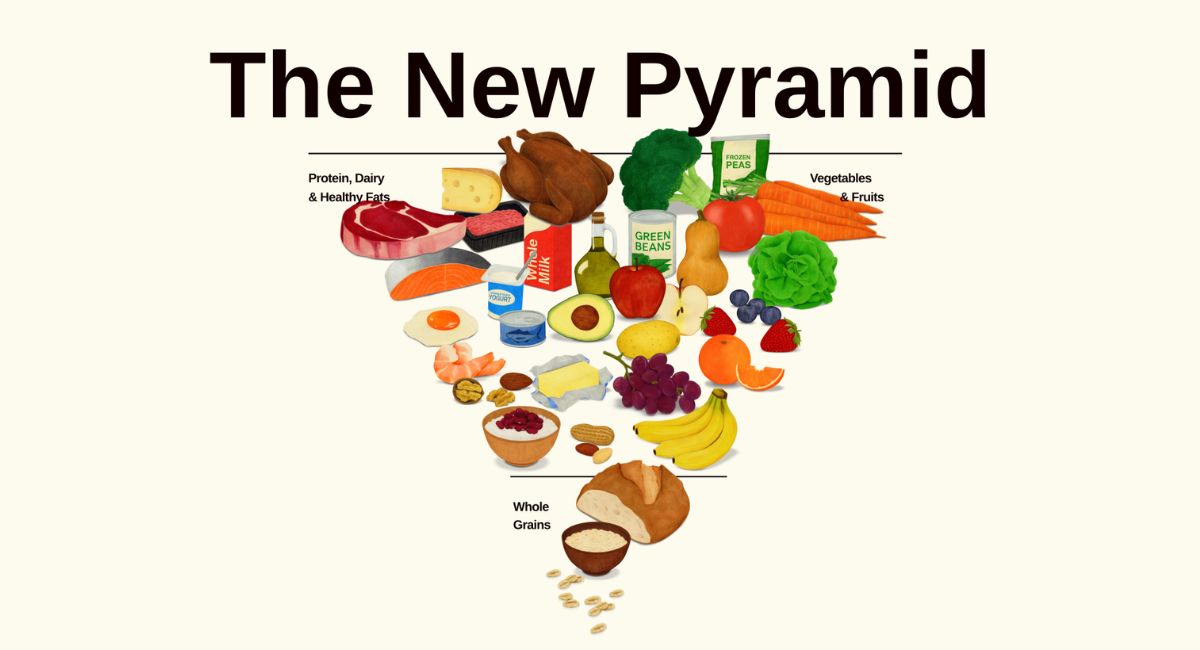
At the center of the debate is a newly released, inverted food pyramid—part of the 2025–2030 Dietary Guidelines for Americans. Unlike earlier models that placed grains, fruits, and vegetables at the base, this version elevates protein, full-fat dairy, and fats, while pushing whole grains downward. It discourages ultra-processed foods and added sugars but nearly doubles recommended protein intake and promotes daily dairy consumption.
For many Americans, the shift may appear bold. For immigrant communities, it raises deeper questions about cost, culture, and what “healthy eating” actually looks like in practice.
Dr. Christopher Gardner began with what he knows best: the science.
After two years reviewing nutrition evidence for the federal advisory committee, he expected the final guidelines to reflect a clear trend—more plant-based foods like beans, lentils, and peas and less red and processed meat.
However, the public message presented a different perspective.
“Beef is back. Butter is back. Meat is back,” Gardner noted, referencing how the guidelines were promoted after release. That messaging, he explained, stands in tension with the committee’s own findings.
While he praised the stronger stance against ultra-processed foods and added sugars, Gardner raised concern about the heavy emphasis on protein. In the United States, protein deficiency is not a widespread issue. Yet the new pyramid places it at the center of daily consumption, reinforcing a culture already saturated with protein marketing.
The risk is not just excess but misunderstanding.
Americans, he warned, often equate protein with meat. And when guidelines amplify that message, it can drive dietary patterns that increase the risk of heart disease and other chronic illnesses—especially when paired with higher consumption of saturated fats.
That concern becomes more urgent in school systems.
Federal nutrition programs are required to follow these guidelines, meaning millions of children rely on them every day. For many low-income and immigrant families, school meals provide a significant portion of daily nutrition.
But schools are already under financial strain. Recent funding cuts have reduced support for fresh, local foods. Now, they are expected to implement more protein-heavy and dairy-rich meals without additional resources.
“How is a school lunch director supposed to do this?” Gardner asked.
It’s a logistical question but also a moral one.
Dr. Marian Nestle shifted the conversation from nutrients to systems.
Having served on an earlier dietary guidelines committee, she described how the process has changed over time. What was once driven largely by scientific consensus is now shaped more directly by federal agencies—where political priorities and industry influence play a greater role.
In the current guidelines, she sees a clear emphasis on personal responsibility.
Americans are told to eat better, reduce ultra-processed foods, and make healthier choices. But the responsibility for change rests almost entirely on individuals.
For Nestle, that approach ignores the realities of how people live.
If education alone worked, she pointed out, decades of food pyramids would have already improved public health outcomes. They haven’t.
Instead, the modern food environment is dominated by ultra-processed products—cheap, accessible, and designed for convenience. For families working multiple jobs, living far from grocery stores, or lacking time and resources to cook, these foods are not simply a choice. They are often the only option.
She stated, “You are fighting the entire food system on your own.”
Immigrant families face an additional layer of complexity in this fight.
It’s the parent balancing affordability with cultural tradition. The child is navigating meals at home that look nothing like what is served at school. The household where time, transportation, and income all shape what ends up on the plate.
The guidelines advise reducing ultra-processed foods but offer no structural solutions to make that shift possible. No regulations. No marketing limits. No economic changes that would make healthier food more accessible.
For Nestle, that gap reflects a deeper truth: policy often protects industry more than it supports people.
Throughout the briefing, ethnic media journalists brought these realities into sharp focus.
They asked how families with limited income could afford the recommended foods. They questioned whether rising meat prices would make the guidelines unrealistic. They raised concerns about language access—whether information would reach communities that do not speak English or Spanish.
They also challenged the cultural assumptions embedded in the pyramid itself.
Many immigrant diets already emphasize plant-based foods—lentils, beans, grains, and vegetables. These are not trends. They are traditions rooted in generations of knowledge about nourishment, affordability, and balance.
What happens when those traditions are overshadowed by a national narrative that prioritizes meat and dairy?
The question is not just nutritional. It is cultural.
Dr. Sailesh Rao expanded the conversation even further—to the planet.
From his perspective, the guidelines are not only about health but also about environmental survival.
He described the current food system as part of what he calls “Planet A”—a model driven by extraction, profit, and ecological strain. The alternative, “Planet B,” centers regeneration, sustainability, and long-term balance.
The new guidelines, he argued, reinforce the former.
By promoting increased consumption of dairy and meat, they overlook the environmental costs of animal agriculture—water depletion, deforestation, greenhouse gas emissions, and land use.
Producing a single gallon of milk can require roughly 1,000 gallons of water. Beef production generates significantly higher emissions than plant-based proteins like lentils. Yet these realities are not reflected in the guidelines.
For Rao, that omission is critical.
And for many immigrant communities, it is also ironic.
Plant-based eating—beans, grains, vegetables, spices—is already embedded in cultural traditions across Africa, Asia, and Latin America. These diets are not only nutritionally sound but also environmentally sustainable.
The knowledge exists. It has always existed.
What is missing, he suggests, is recognition.
By the end of the briefing, one thing was clear: the new food pyramid is not just a nutritional guide. It is a reflection of priorities—scientific, political, and economic.
For some Americans, it may offer direction. For others, it adds confusion.
But for immigrant families, it highlights a familiar tension—between what is recommended and what is possible, between policy and lived reality, between systems that speak broadly and communities that live specifically.
The question is not only whether the new food pyramid is healthy.
It is whether it sees everyone it is meant to serve.
#ImmigrantVoices #FoodJustice #PublicHealth #NutritionPolicy #FoodEquity #ACOM #DiasporaDiets #HealthyCommunities