Singapore’s Migration Controls Seek to Balance Population Growth, Global Ambitions, and National Priorities

The skyline of Singapore. (Photo: iStock.com/TomasSereda)
Since its beginnings as a British trading outpost in the early 19th century, Singapore has thrived as a port city commanding a pivotal position at the crossroads of travel and trade routes. Through a century and a half of colonial rule characterized by a liberal open-door immigration policy followed by six decades of careful post-independence planning in pursuit of economic growth and nation-building, Singapore has developed into a global city par excellence, with a distinctive multiracial complexion and cosmopolitan landscape. Limited land space and scarce natural resources have compelled Singapore to imagine itself as a global hub inextricably connected to the world, while rapidly declining fertility rates in the post-independence era have necessitated reliance on immigration to tackle labor shortages, population aging, and economic competitiveness.
Singapore thus faces a constant challenge balancing the demands of nation-building against its globalized outlook. On the one hand, the imperatives of nation-building require constantly safeguarding the borders of a 287-square-mile (744-square-kilometer) country that former Prime Minister Lee Kuan Yew called a resource-scarce “precious, accidental, improbable, unlikely… nation in the making.” On the other hand, as a global city, it is part of Singapore’s “destiny” as a “small, open economy” to “remain a cosmopolitan and accepting society” (again, Lee’s words). International migration—across the skills spectrum and in different spheres of life—is hence both vital and unavoidable for a nation-state aspiring to join the top ranks of the world’s global cities. As of 2025, 40 percent of the country’s population of 6.1 million people were noncitizens.
Singapore has adopted a highly managed approach to migration by carefully calibrating its policies towards diverse streams of migrants. In the past two decades, this approach has been affected by watershed developments including the disruptions to international mobility during the COVID-19 pandemic and the large virus outbreaks in migrant worker dormitories as well as local demographic changes. However, these interruptions have not significantly shifted the course of Singapore’s migration trajectory, even as the country grappled with the challenges and dilemmas of migration-led population growth and diversification. Following a brief account of Singapore’s migration trends in colonial and post-independence times, this article examines how Singapore has managed migration-related challenges in its adaptation to shifting demographic, economic, and political pressures.
Race and Migration in Colonial Society and Postcolonial Nationhood
Fuelled by migration from China, India, the Malay Archipelago, and beyond, Singapore’s population rose from under 11,000 in 1824 to nearly 1 million by 1947. Valued primarily as a trading emporium and maritime port, colonial Singapore was governed as a cosmopolitan—if segregated—society. Migration-led population growth was instrumental to Singapore’s eventual cityhood, contributing to Singapore’s accension to the British Commonwealth in 1951.
Given its population had diverse backgrounds, the concept of nationhood did not gain traction until the end of World War II. Following the severance of colonial ties and a short-lived merger with the Federation of Malaya, Singapore gained independence from the United Kingdom in 1965. In the immediate post-independence years, the island’s heterogeneous population of almost 2 million had little sense of shared history or common destiny. One of the most urgent challenges of postcolonial nation-building was hence to forge a cohesive identity among diasporic sojourners on the basis of being “many races, one people,” as the country would later claim. The state embarked on a project of institutionalizing citizenship and immigration control, beginning with the 1957 Singapore Citizenship Ordinance, later reinforced by the 1966 Modification of Laws (Immigration) Order. These measures aimed to provide a path to citizenship for residents born in Singapore or the Federation of Malaya, while other foreign-born residents required long-term settlement to become citizens. Dual citizenship was prohibited to cement loyalty to the nascent state.
Importantly, the state began espousing a “separate but equal” multiracialism, formalized through the so-called CMIO (Chinese, Malay, Indian, and Others) framework for managing people of different backgrounds, continuing the classifications that informed British rule. This policy defined official racial categories and sought to shape inter- and intra-ethnic relations in different spheres of life, enabling the state to manage diversity by promoting coexistence and equitable representation of different racial groups. As then Prime Minister Goh Chok Tong described in 2000, the CMIO model of “building a multiracial nation” through the “pragmatic arrangement of seeking integration through [four] overlapping circles has underwritten [Singapore’s] racial and religious harmony.”
Migration-Led Population and Labor-Force Growth
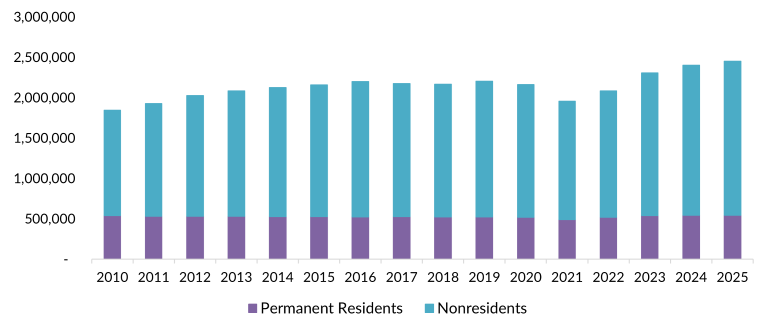
As part of riding the “globalization wave to move Singapore forward,” in the 2015 words of then Prime Minister Lee Hsien Loong, the government geared up its development for a population projected to reach as high as 6.9 million by 2030. Plummeting fertility rates and rapid aging, however, have meant that immigration must be a key engine of growth. Singapore’s population rose from 5.5 million people in 2015 to 6.1 million in 2025, largely because of immigration. From 2010 to 2025, Singapore’s nonresident population (including international students and certain migrant workers) grew by 46 percent, from 1.3 million to 1.9 million (see Figure 1). During the same period, the resident population grew by 11 percent, from 3.8 million to 4.2 million.
Figure 1. Noncitizen Population of Singapore, by Residency Status, 2010-25

Sources: Singapore Department of Statistics, Census of Population 2010 (Singapore: Singapore Department of Statistics, 2011), available online; Singapore Department of Statistics, Population Trends 2025 (Singapore: Singapore Department of Statistics, 2025), available online.
The growth rates of the resident population (including births and grants of permanent residency) have remained low, averaging less than 1 percent yearly from 2010 to 2025, while the annual average growth rate of the nonresident population was nearly 3 percent (see Figure 2).
Figure 2. Annual Growth of Population of Singapore, by Residency Status, 2011-25

Note: Data for permanent residents do not include citizens.
Sources: Singapore Department of Statistics, Census of Population 2010; Singapore Department of Statistics, Population Trends 2025.
Migrants enter Singapore via various channels and in different categories, per a stratified hierarchy of passes and permits. These include “foreign talents” (for skilled professionals, managers, executives, and technicians); workers with mid-level skills (such as chefs and health-care workers); and unskilled or semi-skilled foreign workers holding permits in the construction, manual labor, and domestic industries. Work-permit holders represented 60 percent of the 1.9 million nonresidents in Singapore in 2025, while holders of employment passes (for foreign talents) and S passes (for mid-skilled workers) accounted for 11 percent and 9 percent of this population, respectively. International students (of all levels) and family (spouses, parents, or unmarried children of Singapore citizens and permanent residents, as well as mothers accompanying students in Singapore schools who stay as dependents or on long-term visit passes) made up the remaining 20 percent of Singapore’s nonresident population (see Figure 3).
Figure 3. Population of Singapore, by Immigration Status, 2025

Notes: CMP Work-Permit Holders refers to immigrants in the construction, marine shipyard, and process sectors; the S pass is for mid-skilled workers.
Source: Singapore National Population and Talent Division (NPTD), Population in Brief 2025 (Singapore: NPTD, 2025), available online.
These categories offer differentiated privileges and pathways. Unlike work-permit holders, individuals with employment and S passes earning above certain salary thresholds are eligible for permanent residency, which permits them to reside in Singapore on a longer-term basis with certain rights. However, to ensure the suitability of its resident population in the long term and allay fears about eroding Singaporean identity, grants of permanent residency have been carefully calibrated over time. Notably, the tightening of the immigration framework led to a drastic decrease in grants, from 59,500 in 2009 to 29,300 the following year, before stabilizing (see Figure 4). The Immigration and Checkpoints Authority (ICA) has remained opaque about eligibility and approval criteria, noting only that it considers factors such as family ties, economic contributions, academic qualifications, age, family profile, and length of stay to assess applicants. Because permanent residency is a stepping stone to citizenship, naturalization has also been carefully managed, remaining stable at around 20,000 new citizens annually from 2012 to 2024.
Figure 4. Annual Grants of Citizenship and Permanent Residency in Singapore, 2009-24

Source: NPTD, Population in Brief 2025.
Alongside differential birth rates, the inflow of permanent residents and new citizens has been an important dynamic affecting the resident population’s makeup and proportions of CMIO categories. From 1970 to 2025, a period marked by post-independence immigration growth, immigration led to moderate shifts within the ethnic mix of Singapore’s resident population, but overall the influx has been carefully calibrated to maintain a stable racial composition that is broadly consistent with the CMIO ratios at independence. The proportion of residents of Indian background increased from 7 percent to 9 percent over this time, and the share of “Others” grew from about 1 percent to nearly 4 percent; meanwhile, the proportion with a Chinese background declined from 77 percent to 74 percent, and that of people with Malay heritage fell from 15 percent to 14 percent.
Low-Skilled Migration and the COVID-19 Pandemic
Singapore’s demand for workers is particularly pronounced in low-wage, labor-intensive sectors such as construction, manufacturing, and domestic work that locals are often disinclined to fill. Consequently, Singapore’s dependence on foreign labor has steadily intensified. There were nearly 1.6 million foreign workers in Singapore in 2024, according to the Ministry of Manpower (MOM), constituting nearly 40 percent of the total labor force—the highest proportion in Asia (not including the Gulf countries). Notably, low-skilled workers comprised roughly 74 percent of this foreign-born labor force.
While traditional sources such as China and Malaysia continue to supply many workers, a substantial share also comes from countries deemed as nontraditional sources for Singapore, including Bangladesh, India, Myanmar, and the Philippines. Recruitment from these countries is confined to labor-intensive sectors where manpower shortages are most acute. In 2025, Bhutan, Cambodia, and Laos were added to the list of recruitment countries, while the list of occupations was expanded to include heavy vehicle drivers, cooks, and others.
While Singapore relies heavily on importing labor for lower-skilled but essential work, the presence of large numbers of these migrants is often seen as disruptive to society. Work-permit holders are thus governed through a temporary migration regime aimed at creating a transient and disposable workforce with limited rights and without pathways to permanent residency and citizenship. These passes are generally valid for two years and are accompanied by significant restrictions. Holders are only allowed to work for the employer and occupation specified in their work permit, though a transfer of employment is permissible under certain conditions. Termination of employment results in the permit’s invalidation; the holder must leave Singapore within seven days. The government formerly capped the number of years work-permit holders could work in Singapore, but removed the cap in 2025 to allow employers to retain experienced workers. Instead, holders must be below a maximum employment age, pegged to two years below the local retirement age; the maximum age limit to work in Singapore was 63 years in 2026.
Work-permit holders cannot marry Singaporean nationals or permanent residents without approval from MOM, or else risk repatriation, and they cannot bring family members as dependents. They are also subject to regular medical examinations that include a chest x-ray and a test for HIV/AIDS. For female holders—including some 300,000 domestic workers who perform child care, elder care, and housework—compulsory half-yearly medical examinations by a Singapore-registered doctor also include screens for pregnancy; pregnant workers can be deported. Thus, through a stringent set of employment, social, and medical regulations, the work-permit system ensures that low-skilled migrant laborers are highly regulated, closely monitored, and denied pathways to long-term settlement.
Housing Struggles Exposed by the Pandemic
While migrant domestic workers have mandatory live-in arrangements with their employer, most of the 460,000 work-permit holders in the so-called CMP sectors of construction, marine shipyard, and process (including making petrochemicals and petroleum) live in 1,500 dormitories across the island. Adequate housing for these laborers is a perennial concern in land-scarce Singapore. Often located on the urban periphery away from residential housing estates, migrant workers’ dormitories vary in size and amenities but are invariably densely packed. Overcrowding was tolerated as a practical necessity for years, until the pandemic dramatically exposed the vulnerabilities of this system, bringing longstanding concerns into sharp relief.
During the initial phases of the pandemic, Singapore was lauded as a poster child of virus mitigation, swiftly rolling out measures that significantly curtailed the virus’s spread, including rigorous testing, strict quarantines, and contact tracing. However, this veneer of invulnerability was stripped away by April 2020, as it became apparent that the virus was spreading exponentially within migrant dormitories. Rates of infection were amplified by the enclosed and dense nature of dormitory living. Most concerningly, at the height of the outbreak, infections among dormitory residents accounted for more than 90 percent of Singapore’s COVID-19 cases, reflecting the disproportionate impact on these workers. Workers were trapped in cramped and unsanitary conditions in dormitories designated as isolation zones. The rise in infections was exacerbated by a lack of affordable health-care options for low-skilled migrant workers and a lack of knowledge about their medical entitlements such as paid sick leave, which dissuaded many from seeking medical attention early. These lapses drew significant criticism locally and internationally, which highlighted the state’s blindness to the risks of dormitory living.
In response, the government implemented a series of enhancements to protect the health security of low-wage migrant workers. These included a primary care plan, introduced in 2021 to provide affordable and accessible health services. Employers cover most of the cost while workers bear a small co-payment to encourage personal responsibility. The plan will be further enhanced starting April 2027. Also enacted were upgrades to medical insurance for low-wage migrant workers and new official dormitory standards, including a maximum room capacity, a minimum living space per worker, and the provision of en suite toilet and hygiene facilities. However, by September 2024 only a fraction of dormitories had met the new standards. Retrofitting existing dormitories placed additional pressure on operators and an already strained supply of bed space. As a result, dormitory operators have been given until 2040 to adhere to the new regulations, leaving the vast majority of migrant workers in a protracted transition period.
Still, more than 95 percent of migrant workers expressed satisfaction with work and living conditions in Singapore, according to a 2025 MOM survey, the highest share since the survey was first conducted in 2011. This indicated that most workers intended to continue working in Singapore or return in the future, reflecting a strong sense of confidence in the country as a preferred work destination. While the state attributed this to its post-pandemic efforts to uplift migrant workers’ living conditions, local migrant advocacy groups have raised concerns regarding the survey’s methodology and campaigned for further progress.
Singapore is highly dependent on low-cost, temporary migrant labor to meet demands in many sectors of the economy. Although the COVID-19 crisis’s shockwaves underscored the need to revisit structural dimensions of this pattern, improvements to migrant rights, welfare, and living conditions have remained underprioritized—if not outright illusory.
High-Skilled Migration: Dilemmas and Discontents
Highly skilled migrants are fundamental to bolstering Singapore’s talent pool. While individuals in the professional and managerial class were historically drawn from countries such as Australia, France, Japan, South Korea, the United Kingdom, and the United States, policy shifts in the 1990s have meant that growing proportions now hail from China and India. Maintaining this steady stream of foreign talent has been critical for Singapore’s global competitiveness.
The government has continually calibrated immigration policy in response to a quickening global race for talent, including by facilitating pathways toward permanent residency and citizenship. Visas for skilled migrants are hence significantly less restrictive. Besides improved prospects in obtaining permanent residency, employment- and S-pass holders may enjoy privileges for their dependents if salary thresholds are met, as well as more employment flexibility. They are also free to marry and start families with Singaporeans and permanent residents. Multiple visa subcategories include the EntrePass, for foreign entrepreneurs intending to start and operate businesses in Singapore that are venture-backed or harnessed to innovative technologies, and the Personalized Employment Pass (PEP) for higher-earning employment-pass holders. Recent policy innovations also include the Overseas Networks and Expertise (ONE) pass targeting top talent across any sector, allowing holders to start, operate, and work for multiple companies simultaneously.
Despite the state’s constant messaging that global talent is essential to Singapore’s competitiveness, policies have generated considerable tensions and debate. Local sentiments frame the influx of new immigrants and naturalized citizens as unfairly intensifying competition for jobs and undermining social integration. In 2019, hundreds of Singaporeans gathered at Speakers’ Corner, a designated site permitted for Singaporeans to hold demonstrations and exhibitions, to protest the India-Singapore Comprehensive Economic Cooperation Agreement (CECA), worried that the free-trade agreement allowed Indian nationals unfettered access to work in Singapore. The event was discernibly anti-foreign talent in nature and fuelled by public furor over the behavior of a certain naturalized financier from India who had drawn public ire a few weeks prior.
In response to longstanding discontent, the government has progressively tightened visa requirements for skilled migrants, first by raising the salary requirements for employment- and S-pass applicants. The adjusted qualifying salary is now benchmarked against the top one-third of resident professionals by age; salary thresholds are further differentiated by applicants’ age and industry of work. Older applicants and those working in financial services need to earn progressively higher salaries. The government has also raised levies for S-pass holders and introduced a new points-based Complementarity Assessment Framework (COMPASS) which assesses applicants based on four foundational and two bonus criteria. Overall, these measures aim to ensure fair hiring practices and protect the economy and residents alike, while also recruiting the best qualified and most essential foreign talent.
MOM has also relaxed its usual refusal to provide information on skilled foreigners, by releasing select data showing the foreign workforce’s beneficial impacts on the economy and resident workers. Additionally, the state has bolstered efforts to promote integration and openness to migrants in the workplace and the larger community. It has set up the OneWorkplace program to promote workplace inclusivity and integration, and established the National Integration Council and the Community Integration Fund to promote interactions between Singaporeans and immigrants. At the community level, volunteers function as “integration and naturalization champions” to help new immigrants settle into the community, build friendships with locals, and understand their neighbors.
Public unease over highly skilled migration has extended to international students, prompting the shelving of plans to attract 150,000 students by 2015 and transform Singapore into “the global schoolhouse.” Much of the public concern about this earlier proposal centered on perceptions that international students displaced locals at universities and disproportionately benefited from subsidies and scholarships. In 2011, the government began capping international students at 15 percent of university enrollment. At the same time, citizens were assured that foreign students receiving scholarships would be required to work in Singapore for a period proportional to the financial support provided.
Despite tensions, the government has made it clear that Singapore must continue to attract and retain global talent. For a city-state without a hinterland, however, growing the talent pool to keep ahead of global competition can strain the social compact between the state and citizens. Managing this migration in an even-handed manner is hence integral to Singapore’s future as a global nation-state.
International Marriages and Hyphenated Identities
Foreign-born spouses account for another major strand of immigration. Marriages between locals and noncitizens have constituted a significant proportion of all such ceremonies in Singapore, reaching a peak of 41 percent in the mid-2000s and stabilizing around one in three since the pandemic (37 percent of citizen marriages in 2024 were to a noncitizen). While international marriage occurs across socioeconomic lines, it is bolstered by working-class Singaporean men who seek brides from Southeast Asia; these women are perceived to be more willing to uphold traditional gender roles and values. More than 90 percent of foreign brides are from Asia; China, Malaysia, and Vietnam top the list of origins, followed by Indonesia, the Philippines, and Thailand. In contrast, the parallel trend of Singaporean women marrying foreign grooms—which occurs less often but has risen in popularity—involves a greater array of countries in Asia and the West.
Marriage migrants who are capital-poor are not automatically granted residency or citizenship, and usually confront a long and tenuous pathway towards permanent residency. Their stay in Singapore is dependent on a series of renewable visit passes offering temporary residence for up to two years. Since 2012, couples with at least one Singaporean child may be eligible to apply for a three-year Long-Term Visit Pass-Plus (LTVP+) that grants additional health-care and employment benefits. Marriage itself does not guarantee visa approval and applications for permanent residency depend on criteria that are deliberately left opaque but known to include the applicant’s education qualifications, economic contributions, and the citizen sponsor’s financial stability. As with labor migration policies, marriage migration is governed with reference to economic criteria, rather than on strictly humanitarian or family-reunification grounds.
The trend of international marriages has significant ramifications for Singapore’s multiracial template. As the number of children born to noncitizen mothers increases, families and the population as a whole are becoming more diverse and hybrid, in racial and ethnic terms. Recognizing this fact, since 2011 the government has offered hyphenated race options to children with parents of different ethnicities. While it is unclear how many babies are born to parents of different ethnicities, the share registered as such more than doubled from slightly under 13 percent in 2014 to more than 28 percent in 2023, reflecting a growth in popularity of using hyphenated race as a strategy of personal identification amid increasing diversification.
It should be noted that the flexibility of choice about ethnicity has no major consequences on ethnicity-based policies based on the CMIO model or official statistics. To register a so-called double-barrelled race, parents must indicate the baby’s primary race. This designation determines how individuals are classified within the CMIO framework, shaping their position in educational and social policies, their categorization in official statistics, and the identity they are legally able to pass down to their children. Former Prime Minister Lee Hsien Loong has described the embrace of hyphenation as a form of liberalization, rather than revolution. The policy was implemented to “simply give people greater choice in identifying or describing themselves,” he said in 2010, and would not destabilize the CMIO categories. While CMIO-multiracialism is likely to endure, the longer-term impact of recognizing hyphenated identities on race consciousness and integration remains uncertain.
As immigration to Singapore continues to intensify, Singaporeans are also packing their bags and moving abroad. Temporary emigration—for education, training, business, and work—has been encouraged since the 1990s as a way for the city-state to become more globally oriented and competitive, and is also associated with prestige. Experience working or studying overseas is often held in high regard.
As of June 2025, an estimated 222,000 Singaporeans lived overseas. This number has grown steadily over the past few decades, rising from 157,000 in 2003 and only dipping during the COVID-19 period. Malaysia, Australia, the United Kingdom, the United States, Indonesia, and China are the top destinations. Many emigrants are students, some of whom are on government scholarships and obligated to return after graduation. Many highly skilled Singaporeans also migrate for work in sectors such as banking, information technology, medicine, engineering, and science and technology.
In the past, emigration has sparked concerns about brain drain. While data are not publicly available, the Ministry of Home Affairs has stated that citizenship renunciations averaged below 1,500 in recent years, accounting for less than 0.1 percent of citizens. Because Singapore does not allow dual citizenship, this statistic provides a rough approximation of permanent emigration.
As Singapore has embraced globalization as the path to the future, internationally mobile citizens have been viewed as bridge-builders and indispensable to the country’s economic development. With outflows of local talent invariably offset by inflows of skilled migrants, Singapore has reoriented its diaspora policies towards reconnecting and retaining ties with nationals overseas. The constitution was amended in 2004 to enable Singaporeans born overseas and Singaporean women to pass along citizenship to their children. Additionally, the Overseas Singaporean Unit was established in 2006 to oversee initiatives including linking overseas Singaporeans with prospective employers in Singapore, providing updates on national developments, and setting up clubs and social events abroad (such as Singapore Day). These measures aim to maintain emotional, social, and professional links between overseas Singaporeans and their homeland, encouraging them to eventually return and contribute their experience gained abroad.
The Road Ahead
Migration has long been central to Singapore’s story, creating a society where mobility and diversity are a facet of everyday life. Today, migrants continue to form a significant share of the population, although many—particularly low-wage workers—remain excluded from the rights and securities afforded to citizens and permanent residents. Overall, immigration policy has been driven by the economic imperatives of securing a labor force, sustaining growth, and countering demographic decline.
Singapore’s reliance on temporary migrant workers has only deepened since the pandemic, highlighting the need to address systemic issues around these individuals’ vulnerability, exclusion, and segregation. While policies have been adjusted to attract global talent and manage the nation-state’s aging demographics, questions remain regarding whether the system can be recalibrated to address inequality, reduce precarity, and strengthen inclusion. At the same time, citizens’ emigration and temporary mobility, ultra-low fertility, a growing elderly population, and anxieties over integration complicate the future demographic landscape. Nonetheless, migration will remain a defining feature of Singapore’s social and economic fabric for years to come.
Sources
Baey, Grace and Brenda S.A. Yeoh. 2018. “The Lottery of My Life:” Migration Trajectories and the Production of Precarity among Bangladeshi Migrant Workers in Singapore’s Construction Industry. Asian and Pacific Migration Journal 27 (3): 249-72.
Chan, Emil. 2025. Singapore Sees Highest Migrant Worker Satisfaction; 9 in 10 Satisfied with Working Conditions: MOM Survey. Channel News Asia, August 21, 2025. Available online.
Chan, H.C. and H.D. Evers. 1978. National Identity and Nation Building in Singapore. In Studies in ASEAN Sociology: Urban Society and Social Change, eds. Peter S. J. Chen and Hans-Dieter Evers. Singapore: Chopmen Enterprises.
Cheng, Yi’En. 2012. Transnational Masculinities in Situ: Singaporean Husbands and Their International Marriage Experiences. Area 44 (1): 76-82.
Dormitory Association Singapore Limited (DASL). 2025. Worker Dormitories in Singapore H1 2025. Singapore: DASL. Available online.
Furnivall, J.S. 1948. Colonial Policy and Practice: A Comparative Study of Burma and the Netherland Indies. Cambridge, UK: Cambridge University Press.
Goh, C.T. 2000. Building a Multi-Racial Nation through Integration: Speech at the Second National Convention of Singapore Malay/Muslim Professionals. Singapore Ministry of Information and the Arts, November 5, 2000. Available online.
Goh, Danielle Lynn. 2024. Health Security of Low-Wage Migrant Workers Post-Covid-19 Pandemic. S. Rajaratnam School of International Studies commentary, Singapore, October 2024. Available online.
Ho, Elaine Lynn-Ee. 2011. “Claiming” the Diaspora: Elite Mobility, Sending State Strategies and the Spatialities of Citizenship. Progress in Human Geography 35 (6): 757-72.
Hussain, Z. 2010. Little Impact on Ethnic-Based Policies: PM Lee; New Move Is “a Liberalisation, Not a Revolution.” The Straits Times, January 16, 2010.
Institute of Policy Studies (IPS). 2018. IPS Survey on Emigration Attitudes of Young Singaporeans (2016). Media release, September 28, 2018. Available online.
Koay, Andrew. 2019. Hong Lim Park Event Criticising CECA & [redacted] Draws 1,000 S’poreans, Lim Tean & Tan Kin Lian. Mothership, November 4, 2019. Available online.
Kok, Yufeng. 2024. Home Away from Home: MOM’s New Dorm a Big Step Forward for Migrant Workers, but Long Road Awaits. The Straits Times, November 23, 2024. Available online.
Lee, Amanda. 2015. The Big Read: More S’poreans Overseas, but Brain Drain Concerns Dissipate. Today, March 7, 2015. Available online.
Lim, Joyce. 2020. Coronavirus: Workers Describe Crowded, Cramped Living Conditions at Dormitory Gazetted as Isolation Area. The Straits Times, April 6, 2020. Available online.
Lin, Weiqiang and Brenda S.A. Yeoh. 2021. Pathological (Im)mobilities: Managing Risk in a Time of Pandemics. Mobilities 16 (1): 96-112.
Neo, Chai Chan. 2015. Ride Globalisation Wave to Move S’pore Forward: PM. Today, October 26, 2015. Available online.
Oswin, Natalie and Brenda S.A. Yeoh. 2010. Introduction: Mobile City Singapore. Mobilities 5 (2): 167-75. Available online.
People’s Association. 2026. Community Integration. Updated January 14, 2026. Available online.
Rocha, Zarine L. 2015. Mixed Race Identities in Asia and the Pacific: Experiences from Singapore and New Zealand. London: Routledge.
Rocha, Zarine L. and Brenda S.A. Yeoh. 2020. Measuring Race, Mixed Race, and Multiracialism in Singapore. In The Palgrave International Handbook of Mixed Racial and Ethnic Classification, eds. Zarine L. Rocha and Peter J. Aspinall. Cham, Switzerland: Springer.
Saw, Swee-Hock. 1969. Population Trends in Singapore, 1819–1967. Journal of Southeast Asian History 10 (1): 36-49.
Singapore Department of Statistics. 2011. Census of Population 2010. Singapore: Singapore Department of Statistics. Available online.
—. 2021. Census of Population 2020: Statistical Release 1: Demographic Characteristics, Education, Language and Religion. Singapore: Department of Statistics. Available online.
—. 2025. Population Trends 2025. Singapore: Singapore Department of Statistics. Available online.
Singapore Immigration and Checkpoints Authority (ICA). 2011. Greater Flexibility with Implementation of Double-Barrelled Race Option from 1 January 2011. December 29, 2011. Available online.
—. 2025. Immigration and Checkpoints Authority. Singapore: ICA.
Singapore Ministry of Culture, Community and Youth. 2025. National Integration Council. 2025. Updated May 27, 2025. Available online.
Singapore Ministry of Health. 2020. Measures to Contain the COVID-19 Outbreak in Migrant Worker Dormitories. Press release, December 14, 2020. Available online.
Singapore Ministry of Home Affairs. 2022. Written Reply to Parliamentary Question on Number of Singaporeans Who Renounced Their Citizenship Over the Past Three Years. January 10, 2022. Available online.
Singapore Ministry of Manpower (MOM). 2015. Labour Force in Singapore 2014. Singapore: MOM. Available online.
—. 2023. Around 1,000 Dormitories to Transition to Improved Standards to Strengthen Migrant Worker Housing Resilience. Press release, October 11, 2023. Available online.
—. 2024. Written Answer to PQ on Number of Dormitories that Have Started Retrofitting to Meet Interim Standards and New Dormitory Standards. September 9, 2024. Available online.
—. 2025. Factsheet on Foreign Workforce Policy Announcements at COS 2025. Singapore: MOM. Available online.
—. 2025. Foreign Workforce Numbers. Updated September 22, 2025. Available online.
—. 2025. Six-Monthly Medical Examination (6ME) for Female Migrant Workers. Updated June 9, 2025. Available online.
—. 2026. Summary Table: Labour Force. January 29, 2026. Available online.
Singapore National Population and Talent Division (NPTD). 2012. Population in Brief 2012. Singapore: NPTD. Available online.
—. 2024. Population in Brief 2024. Singapore: NPTD. Available online.
—. 2026. People & Society. Updated January 29, 2026. Available online.
Singapore Prime Minister’s Office. 2024. PM Lee Hsien Loong’s Interview with Local Media – Section 2: The Economy (May 2024). May 10, 2024. Available online.
Tay, Hong Yi. 2025. GE2025: PAP, WP and PSP Agree that Singapore Needs Foreign Talent. But They Differ on the Balance. The Straits Times, April 5, 2025. Available online.
Toh, Elgin. 2011. Singapore Still a Work in Progress: MM Lee. The Straits Times, January 22, 2011. Available online.
Wee, Kellynn, Charmian Goh, and Brenda S.A. Yeoh. 2019. Chutes-and-Ladders: The Migration Industry, Conditionality, and the Production of Precarity among Migrant Domestic Workers in Singapore. Journal of Ethnic and Migration Studies 45 (14): 2672-688.
Yeoh, Brenda and Weiqiang Lin. 2012. Rapid Growth in Singapore’s Immigrant Population Brings Policy Challenges. Migration Information Source, April 3, 2012. Available online.
Yeoh, Brenda S.A., Heng Leng Chee, Rohini Anant, and Theodora Lam. 2021. Transnational Marriage Migration and the Negotiation of Precarious Pathways Beyond Partial Citizenship in Singapore. Citizenship Studies 25 (7): 898-917. Available online.
Yeoh, Brenda S.A., Alice Chen. and Theodora Lam. 2016. Urban Dreams in an Island-Nation-City-State. In Singapore Dreaming: Managing Utopia, eds. H. Koon Wee and Jeremy Chia. Singapore: Asian Urban Lab.
Yeoh, Brenda S.A. and Theodora Lam. 2016. Immigration and Its (Dis)Contents: The Challenges of Highly Skilled Migration in Globalising Singapore. American Behavioral Scientist 60 (5-6): 637-658.
—. 2022. Managing the Non-Integration of Transient Migrant Workers: Urban Strategies of Enclavisation and Enclosure in Singapore. Urban Studies 59 (16): 3292-311. Available online.
—. 2024. The Nation and Its Margins: The Cultural Politics of Multiracialism and Migration in Singapore. In Migration and Nationalism, eds. Michael Samers and Jens Rydgren. Cheltenham, UK: Edward Elgar Publishing.
Yong, Clement. 2020. $1.5m Condo Parking Saga: Resident Given Stern Warning for Verbally Abusing Security Guard. The Straits Times. January 17, 2020. Available online.