This post was originally published on this site
Moldova Shoulders Disproportionately Large Ukrainian Population, in the Shadow of the European Union and Russia

A woman and child at the Moldova-Ukraine border. (Photo: IOM/Muse Mohammed)
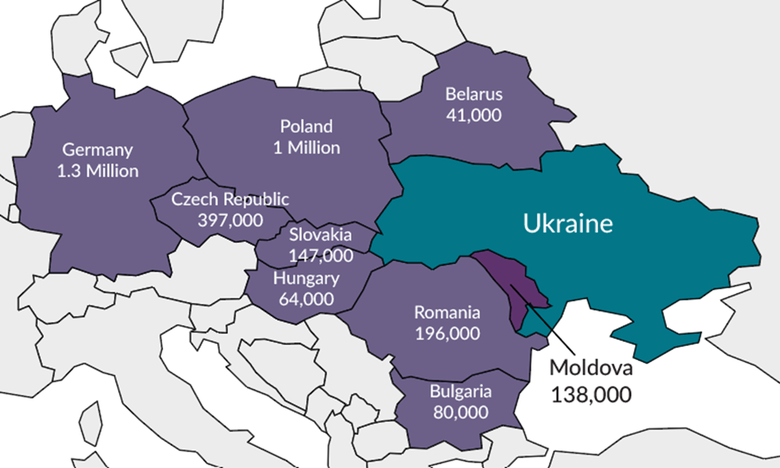
Wedged between Ukraine and the European Union, Moldova has been a crucial host and transit country for people fleeing Ukraine since Russia’s full-scale invasion in 2022. While the approximately 138,000 Ukrainians in Moldova as of late 2025 comprised a fraction of the several million Ukrainians still displaced globally, they accounted for about 5 percent of Moldova’s total population—a larger share than in any other country.
More than one-quarter of all displaced Ukrainians have passed through Moldova at one point. As a non-EU Member State, Moldova has far fewer financial, logistical, and political resources than large countries such as Germany or Poland, but has nonetheless responded to the Ukrainian displacement with remarkable compassion and resilience. This generosity has come at a cost for Moldova, which is among the poorest countries in Europe by per-capita gross domestic product (GDP; $7,600 in 2024, according to the World Bank) and where nearly one-third of the total population lives below the poverty line.
Moldova’s response has unfolded against a backdrop of political division and persistent Russian influence. Moldova was a soviet republic until 1991, and historically political power has alternated between pro-European and pro-Russian parties. Since 1992, Russian troops have been stationed in the Transnistrian region, a pro-Russian separatist area of Moldova. As a result, Moldovans have split attitudes towards Russia’s invasion of Ukraine, as evidenced by the high-stakes 2025 parliamentary elections in which, despite major reported interference from Russia, the ruling pro-European Party of Action and Solidarity (PAS) secured 50.1 percent of the vote compared to the pro-Russian Patriotic Electoral Bloc’s 24.2 percent.
This political divide is reflected in how Moldovans perceive and respond to the presence of Ukrainians. Nationwide, around 72 percent of Moldovans said in 2024 they would accept Ukrainians as their neighbors, but public perception varies by political party and by region. Moldovans living in and around the capital, Chișinău, where humanitarian assistance for Ukrainians has been most concentrated, are more likely to have a positive attitude towards the European Union and are more likely to support hosting refugees. On the other hand, despite Northern Moldova being more Russian-language dominant and therefore easier for Ukrainians to integrate linguistically, the region tends to view Russia more favorably and has lower acceptance rates of Ukrainian arrivals. This has impacted locals’ willingness to provide services to the newcomers.
The administration of President Maia Sandu, the founder of PAS, has been hailed for its leadership in responding to the Ukrainian displacement. Upon the breakout of full-scale war in Ukraine in February 2022, Moldova immediately coordinated with aid organizations and citizens to connect Ukrainians with food, shelter, transportation, and other services. In March 2023, the government launched more long-term protection and integration efforts, including offering Temporary Protection (TP).
Despite these efforts, gaps in humanitarian services remain, especially amid international funding cuts that began in early 2025. Some aid organizations have since halted operations in Moldova and many Ukrainians are reporting urgent, unmet needs. While many Ukrainians have been able to integrate socially, they often struggle to access jobs, education, and medical services.
This article provides an overview of Moldova’s response to Ukrainian displacement and the experiences of both Ukrainians and native Moldovans.
Why Do Ukrainians Stay in Moldova?
Of the 6.9 million Ukrainians who fled their country after Russia’s invasion in 2022, approximately 1.9 million transited through Moldova. The overwhelming majority did not stay, instead seeking opportunities for higher incomes and living standards in other countries, chiefly in the European Union. As of July 2025, around 2 percent of all displaced Ukrainians worldwide were in Moldova.
Figure 1. Displaced Ukrainians in Moldova and Surrounding Region, 2025

Note: Map shows selected countries and not the total population of Ukrainians in Europe.
Source: UN High Commissioner for Refugees (UNHCR), “Operational Data Portal: Ukraine Refugee Situation,” updated November 14, 2025, available online.
Although some Ukrainians experience a lower living standard in Moldova than in pre-war Ukraine or the European Union, many stay due to the country’s proximity to their homeland and the shared linguistic and cultural ties. Being near the border allows Ukrainians to return to visit loved ones, access health care (which they must often do in Ukraine; more details below), and check on their property more easily than if they had relocated farther away. The cost of living in Moldova and Ukraine is also similar, and lower than some other destinations; even with government programs and individuals’ savings, it remains a leap of faith to move to an EU country.
Legal Protections
As a non-EU Member State, Moldova is not bound by the EU Temporary Protection Directive, which offers displaced Ukrainians legal residency and access to the labor market, schools, and health care across the European Union. However, in March 2023 Moldova introduced TP for Ukrainians, in line with its asylum law, giving beneficiaries the legal right of residence, work, and access to health care, education, social inclusion services, and accommodation in temporary centers. As of October 2025, about 60 percent (80,000) of the 135,000 Ukrainians in Moldova had received TP. Approximately 28 percent had a pending TP application, 5 percent held a valid residence permit, and 1 percent were registered in the asylum system. Since the beginning of the war, more than 2,300 had acquired Moldovan citizenship as of this writing.
To obtain TP in Moldova, individuals must first upload documentation through the website for the General Inspectorate for Migration (previously the Bureau of Migration and Asylum) and then arrange an in-person appointment to verify documents, often at a regional office. This poses significant challenges for people without access to transportation, digital devices, or basic literacy. Local nonprofits have stepped in to bridge these gaps, but the problem continues to disproportionately affect ethnic Roma people, who have low literacy rates and less access to the internet. Many Roma (also known as Romani) did not have adequate legal documentation in Ukraine before the war began, which has posed a challenge in displacement.
Barriers to Integration
Given Ukraine bars most men from ages 23 to 60 from leaving the country, most Ukrainians who have fled are women and children, older, or have disabilities. As a result, they face risks including gender-based violence, sexual exploitation, trafficking, and forced labor. These risks exist within Ukraine, as people flee, and once they cross borders.
Ukrainians in Moldova face several barriers to securing meaningful employment. While language is not a major obstacle in daily life—many Ukrainians speak Russian, which is widely spoken in Moldova—it remains a challenge for higher-paying jobs, which often require fluency in both Romanian and Russian. For many Ukrainians, the salaries offered in Moldova are considerably lower than what they previously earned in Ukraine, making the available positions financially unattractive or unsustainable. In addition, bureaucratic and regulatory hurdles make it difficult for Ukrainians to open their own businesses, even for those with entrepreneurial experience. While some government and nonprofit funding is available for job training, it often does not cover the cost of obtaining necessary professional licenses. Finding employment is especially difficult for older individuals, who face more limited job prospects, and for women, whose ability to work is restricted by the lack of accessible child care.
With adequate health care improving but still challenging even for Moldovans, accessing basic medical services remains a significant challenge for many Ukrainians in Moldova. Women face additional barriers accessing reproductive health care, while pediatric services for children are often insufficient or difficult to reach. People with chronic or severe mental health conditions also face significant gaps in services. Moldova is not necessarily unique in this regard: Ukrainians elsewhere in Europe have also cited frustration with host countries’ health systems, including long delays in receiving care, as one of the main reasons to regularly return to Ukraine.
All Ukrainian children can legally enroll in school in Moldova, regardless of status. However, as of May 2025, just 15 percent of Ukrainian children had done so. Many families have prioritized online education offered by the Ukrainian Ministry of Education and Science, for fear of losing access to or not being recognized by the Ukrainian education system. The use of Romanian language in Moldovan schools and a different curriculum creates significant barriers. Additionally, many schools, especially in regions with a significant number of Ukrainians, lack the capacity and resources to accommodate the increased student population. Rising enrollment without corresponding investment further strains the system.
In addition to learning setbacks for children, the lack of enrollment restricts mothers’ ability to enter the labor market and hinders their broader integration into Moldovan society. In response, the Moldovan government has partnered with the UN High Commissioner for Refugees (UNHCR), the UN Children’s Fund (UNICEF), and the Inter-Agency Refugee Education Working Group to develop a roadmap for fully integrating all Ukrainian children into Moldova’s education system by the end of 2026.
An estimated 20,000 Ukrainian men entered Moldova irregularly from the start of the invasion to July 2024. This trend accelerated substantially after Ukraine’s April 2024 decision to lower the military draft age from 27 to 25, in response to sustained battlefield loses. Moldova has limited support services for single men, and those who remain have struggled to get assistance with employment, housing, and financial aid. Additionally, they have often faced social stigma and discrimination from other Ukrainians, who perceive them as draft dodgers. Most young men tend to stay only briefly—usually for about a month—typically seeking temporary shelter and short-term work to support themselves before moving further west.
There is also a structural denial of access to basic rights for displaced Roma people, who have faced severe marginalization and stigmatization in Ukraine and across Europe for centuries. Approximately 100,000 Roma are estimated to have fled Ukraine since the onset of the war, and approximately 40,000 Roma sought refuge in Moldova as of February 2023 (the most recent date for which data are available; despite mapping of Roma communities in Moldova throughout the response, there is no consensus on the number of Ukrainian Roma people who have passed through or remained in Moldova). Many have reported systematic discrimination in access to housing, such as being turned away from government-run refugee accommodation centers. Some have stayed in separate, inferior facilities, including abandoned buildings. In addition, private landlords have reportedly refused to rent to Roma people. Many Roma also lack identification documents, experience language-related difficulties (many speak a dialect of the Romani language instead of Russian or Romanian), or have often been falsely accused of abusing the benefits systems.
Russia’s invasion of Ukraine produced an unprecedented influx to Moldova. Pulled by a shared culture and history, and with many believing the fate of Moldova’s sovereignty was tied to Ukraine’s, Moldovans mobilized to support Ukrainians. Before international aid organizations could respond on the ground, community-based groups and ordinary people launched grassroots efforts to provide aid, including organizing rides from the border, distributing food, and absorbing Ukrainians into local programs.
In this spirit of solidarity, Moldovan families went so far as to open their homes to people fleeing the conflict. In early 2022, 95 percent of Ukrainians in Moldova were being hosted by local families. Three and a half years later, in September 2025, 44 percent of Ukrainians still lived with Moldovan host families (the vast majority with Moldovan relatives). In reaction to the Moldovan people’s embrace of and hospitality toward Ukrainians, Moldova became known as “a small country with a big heart.”
At the same time, the situation pressured Moldovans on both sides of the Dniester River, which forms part of the border with Ukraine and elsewhere demarcates the separatist Transnistrian region, especially since the influx was accompanied by significant economic and energy challenges. By August 2022, Moldovans listed increases in the cost of fuel and high prices for other goods as challenges on par with the influx of Ukrainians, according to the Centre for Sustainable Peace and Democratic Development. Prior to the conflict, Moldova imported 90 percent of its electricity, but in 2022 Russia withheld gas exports to Moldova and EU countries, and unleashed an energy crisis when it attacked Ukraine’s energy infrastructure. Withholding gas from Moldova served a political purpose for Moscow, creating heating hardships that could shift public blame onto the pro-EU government and thereby bolster pro-Russian influence.
Throughout the cold winter months, Moldovans were subjected to blackouts, restrictions in energy usage, and a 30-percent increase in inflation; many were forced to spend more than 70 percent of their household income on utility bills. In January 2025, Russia cut off gas supplies to the Transnistrian region, triggering a state of emergency. Amid harsh winter conditions, families struggled without heat or water and faced rising unemployment as businesses were severely affected. Businesses could not afford to stay open because rising energy costs and other expenses made their utility bills too high to manage. While Moldova has taken measures to strengthen its energy infrastructure and reduce prices, Moldovans continue to face high costs of living and uncertainty.
Growing Frustration
While Moldovans’ support for displaced Ukrainians has been well recorded, so too has the growing frustration and resentment toward the newcomers and the humanitarian assistance offered to them. Comments online and in the media underscore grievances about Ukrainians’ seeming disproportionate access to resources. Ukrainians have been depicted as wealthy—or at least wealthier than Moldovans—and taking advantage of aid. Some commenters accuse the government of overspending and diverting funds from the social welfare system to support Ukrainians, allegedly at the expense of impoverished Moldovans. While assessments have found these sentiments likely stem from or are stoked by Russian disinformation campaigns, which seek to undermine public trust in Moldova’s government and support for Ukraine, these beliefs and frustrations echo particularly in Northern Moldovan cities and villages that already have pro-Russian attitudes.
In some cases, local authorities have refused to coordinate assistance for resident Ukrainians unless a portion of humanitarian funds are earmarked for socially vulnerable Moldovans. Between 2022 and 2025, public support for policies assisting Ukrainians slightly declined, as did support for social assistance and public administration reforms. These trends suggest that there are Moldovans who view public assistance as inadequate or lacking, have little trust in the government’s ability or willingness to deliver improvements, and question whether ongoing aid to Ukrainians is a fair or effective use of scarce resources. While some of these attitudes may be fueled by foreign meddling, the discontent suggests genuine concerns about cooperation and social cohesion.
To respond to local needs and mitigate social tensions, the government has notably included Moldovans in humanitarian assistance efforts since Ukrainians started fleeing to Moldova. Local organizations, authorities, and international groups advocated for including socially vulnerable Moldovans in programs such as food and hygiene distribution, mental health supports, psychosocial activities, and medical assistance. While the share of Moldovans receiving humanitarian assistance varies, many programs split support equally between socially vulnerable Moldovans and Ukrainians.
Consequences of Declining Humanitarian Aid
As the conflict in Ukraine nears the start of its fifth year in February 2026, it has evolved into a prolonged humanitarian crisis, devastating Ukrainian lives and sending immediate shock waves and longer-term ripple effects across neighboring countries such as Moldova.
Despite the influx of Ukrainians into Moldova and continued need to provide health care, education, livelihoods, and other support, funding for the displacement response has declined. In 2023, the Moldova Refugee Response Plan coordinated by UNHCR received just $243 million of the nearly $425 million sought. For 2025, $206 million was requested, with a decline to $159 million projected for 2026. This drop reflects a reduction in available funding for the Ukraine response, not a decline in needs.
As funding from major donors has dwindled, several international organizations have withdrawn from Moldova, and many assistance programs have been terminated. Financial assistance for Ukrainians, especially in the form of cash support, has been reduced. In May 2024, UNHCR introduced a new system to decide who in Moldova qualifies for this support, involving household interviews, a scorecard based on vulnerability, and a requirement to apply for TP. The number of people receiving cash assistance subsequently dropped by more than half. Applicants deemed ineligible were primarily single-parent households and the elderly. In 2025, UNHCR further reduced the amount of cash available per household and announced that, due to budget cuts, it would begin reviewing eligibility again. Newly arriving Ukrainians were not scheduled to receive cash assistance until December; those found ineligible may face serious financial challenges in winter.
Reduced spending has also forced the closure of some refugee accommodation centers; some Ukrainians living there have been relocated to other centers, while others may be eligible to receive rental assistance and a select few have been able to relocate to the European Union through the EU+ Air Transfer Program, which offers free plane tickets and other assistance. Evidence suggests that Ukrainians who are affected by accommodation center closures and are denied other assistance may be forced to return to Ukraine, where war still rages.
A Plan for the Future—If It Can Hold
With humanitarian funding declining, UNHCR and other humanitarian actors have worked with the Moldovan Ministry of Internal Affairs to support a long-term integration strategy for Ukrainians. In May 2025, the government approved a National Program for the Integration of Foreigners, running from 2025 to 2027, which guarantees the same rights as Moldovan citizens to foreign nationals with temporary or permanent residence, asylum seekers, stateless people, beneficiaries of international or temporary protection, unaccompanied minors, and other vulnerable individuals. This program aims to permanently integrate Ukrainians through access to employment, Romanian language courses, health care, vocational training, and social assistance. This effort aligns with Moldova’s ambitions to join the European Union and its RESTART reforms. These reforms aim to modernize the social protection system by establishing regional social assistance agencies, coordinating services between localities, and investing in hiring and training to improve assistance for vulnerable families.
The 2025-27 program, recent reforms, and the success of Sandu’s PAS in the 2025 elections all show that the Moldovan public and government are committed to continue supporting Ukrainians. However, the ongoing war, uncertainty about when it will end, and continuous funding cuts could undermine these efforts. Ultimately, the government’s ability to sustain public support and secure funding to implement the National Program will be crucial for the successful integration of Ukrainians in Moldova.
Sources
Data for Impact. 2024. Quality of Life Survey: Republic of Moldova. Chapel Hill, NC: Data for Impact, University of North Carolina at Chapel Hill. Available online.
Forbes Romania. 2022. Maia Sandu: “Asigurarea țării cu energie electrică este o provocare zilnică.” November 2, 2022. Available online.
Government of Moldova. 2025. 2025-2026 Moldova Refugee Response Plan: Snapshot. Chișinău: Government of Moldova. Available online.
Human Rights Watch. 2022. Moldova: Romani Refugees from Ukraine Face Segregation. New York: Human Rights Watch. Available online.
Internews. 2023. Floods and Deserts: Information Access and Barriers in Moldova’s Refugee Response. Arcata, CA: Internews and UN High Commissioner for Refugees (UNHCR). Available online.
Jack, Victor. 2022 Putin Puts the Energy Squeeze on Pro-EU Moldova. Politico, November 21, 2022. Available online.
Kieff, Leah. 2024. How Do You Solve a Problem Like Transnistria? Center for Strategic and International Studies (CSIS) commentary, May 17, 2024. Available online.
Markovic, Dejan. 2024. Monitoring of the Situation of Ukrainian Roma Refugees in Poland, Hungary, Czechia, Romania, Moldova, and Slovakia. Brussels: ERGO Network. Available online.
McGrath, Stephen. 2025. Moldova’s Pro-EU Party Wins Clear Parliamentary Majority, Defeating Pro-Russian Groups. Associated Press, September 29, 2025. Available online.
Méheut, Constant. 2023. For Ukrainian Refugees, Seeing the Doctor Can Be Worth a Risky Trip Home. The New York Times, November 14, 2023. Available online.
Moldova Ministry of Education, Culture, and Research. 2025. Roadmap for the Inclusion of Refugee Children in the Education System in the Republic of Moldova. Chișinău: Moldova Ministry of Education, Culture, and Research. Available online.
Moldova Ministry of Internal Affairs. 2025. Equal Rights for All: Government Approves National Program for the Integration of Foreigners in Moldova. May 14, 2025. Available online.
Moldova Ministry of Labor and Social Protection. 2023. Ministry of Labor and Social Protection Launched the Reform of the Social Assistance System “RESTART.” March 27, 2023. Available online.
Necsutu, Madalin. 2024. Moldova Stalls Over Call to Extradite Ukrainians Fleeing Enlistment. Balkan Insight, July 24, 2024. Available online.
Norwegian Refugee Council (NRC), Plan International, Save the Children, and World Vision. 2023. Prioritizing School Enrolments for Ukraine Refugee Children in Moldova, Poland, and Romania. N.p.: NRC, Plan International, Save the Children, and World Vision. Available online.
Novosolova, Nadiia and Tornike Zurabashvili. 2024. Understanding Social Tensions in Moldova: A Household Survey. Nicosia, Cyprus: Centre for Sustainable Peace and Democratic Development (SeeD). Available online.
Petruleac, Dumitru. 2025. Integrating Ukrainian Refugee Children into Schools Is Costly; Authorities Seek Funding. TeleRadio Moldova, May 27, 2025. Available online.
Radio Free Europe/Radio Liberty. 2024. More than 23,000 Ukrainian Men Crossed Illegally into Moldova since Start of Invasion. July 10, 2024. Available online.
Rorke, Bernard and Anastasiia Zhuravel. 2023. Roma Rights Under Siege: Monitoring Reports from One Year of War in Ukraine. Brussels: European Roma Rights Centre. Available online.
Severi, Riccardo, Ana Gnip-Balan, and Olga Derejovschi. 2025. Turning a New Page: Ukrainians in Moldova Celebrate Culture, Create Community. International Organization for Migration (IOM), April 9, 2025. Available online.
Social Cohesion and Reconciliation (SCORE) Index. N.d. Moldova, General Population, 2022: Support for Narratives: Russia as a Threat. Accessed October 31, 2025. Available online.
Timu, Andra and Lina Grau 2024. Inflation Collapse in Moldova Helped by EU After Russia Fallout. Bloomberg, January 17, 2024. Available online.
UN Children’s Fund (UNICEF). N.d. Every Child Has Access to Education in the Republic of Moldova. Accessed October 30, 2025. Available online.
UN Educational, Scientific and Cultural Organization (UNESCO). 2023. Republic of Moldova’s Education Responses to the Influx of Ukrainian Refugees. Updated November 2023. Available online.
UN High Commissioner for Refugees (UNHCR). 2024. Refugee Response Plan: 2023 Year End Report – Republic of Moldova. Chișinău: UNHCR. Available online.
—. 2024. Ukraine Situation: Moldova – Brief Note on Vulnerability-Based Targeting Process. Chișinău: UNHCR. Available online.
—. 2025. Regional Protection Profiling & Monitoring: Protection Risks and Needs of Refugees from Ukraine. Updated September 22, 2025. Available online.
—. N.d. Ukraine Refugee Situation: Republic of Moldova. Accessed October 30, 2025. Available online.
UNHCR Moldova. 2025. Important Announcement for Refugees Receiving UNHCR Cash Assistance. October 20, 2025. Available online.
UN News. 2022. Moldova: ‘A Small Country with a Big Heart.’ May 8, 2022. Available online.
—. 2022. Moldovans Open Their Borders, Homes and Hearts – UN Chief. May 10, 2022. Available online.
—. 2025. “Never Be Afraid to Ask for Help”: Ukrainians Scarred by War Find Space to Heal. October 9, 2025. Available online.
UN Regional Information Center for Western Europe (UNRIC). 2024. Ukraine: Over 6 Million Refugees Spread Across Europe. November 9, 2024. Available online.
Varenikova, Maria. 2025. Why Ukraine Is Allowing More Young Men to Leave the Country. The New York Times, August 27, 2025. Available online.
Vyshlinsky, Hlib et al. 2025. Ukrainian Refugees after Three Years Abroad: How Many and Who Will Return? The Fourth Wave of Research. Kyiv: Center for Economic Strategy. Available online.
Women’s Refugee Commission. N.d. The Humanitarian Crisis in Ukraine. Accessed October 30, 2025. Available online.