Frequently Requested Statistics on Immigrants and Immigration in the United States

Immigrants take the oath of allegiance during a naturalization ceremony. (Photo: Tia Dufour/DHS)
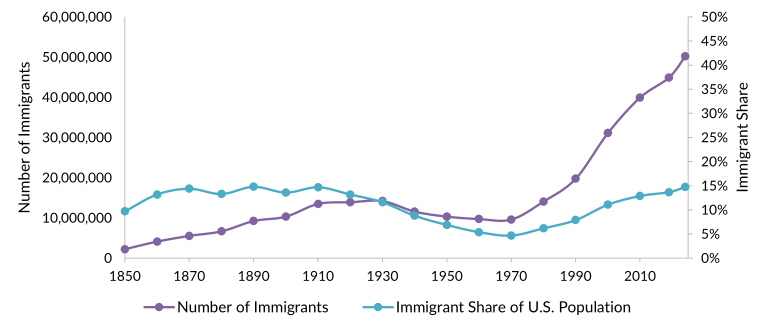
Both the size and share of immigrants in the U.S. population stood at record highs as of 2024, the most recent year for which data are available. The immigrant population numbered slightly more than 50.2 million people, or 14.8 percent of the country’s 340.1 million residents. The only prior period in U.S. history when the immigrant share was as high was in 1890, when it also stood at 14.8 percent. These recent record levels mark a turnaround from 1970, when an all-time low of just 4.7 percent of the U.S. population was foreign born. In the decades since, the immigrant population has not only increased year over year but also diversified, shifting from predominantly European origins to those in Latin America and Asia.
Despite the dominance of unauthorized immigration in the policy and public discourse, more than three-quarters of all immigrants in the country as of 2023 were there legally, as naturalized citizens, lawful permanent residents (LPRs, commonly known as green-card holders), or temporary visa holders.
Download a Print-Friendly Version
U.S. immigration policies are in flux, with major changes implemented since the return of the Trump administration in January 2025, with consequences for future immigration levels that have yet to be fully realized. The administration has moved in unprecedented fashion to leverage the full power of the federal government to arrest unauthorized immigrants, strip more than 1.5 million humanitarian migrants of temporary protections, scrutinize temporary visa holders—including international students and H-1B skilled workers—as well as green-card holders and naturalized citizens, and restrict future temporary and permanent arrivals.
Immigration has been a significant driver of overall U.S. population growth, which has slowed over the past decade due to falling birth rates. And immigrants and their U.S.-born children have accounted for the entire growth of the prime working-age population since 2000. If current policy trends lead to less immigration, the overall population may grow at a considerably slow rate or even reverse.
This Spotlight offers information about immigrants resident in the United States as well as temporary visitors and the U.S.-born children of immigrants. Drawing from the most authoritative and current data available, this article offers an overview of present and past U.S. immigration trends, sociodemographic information about who is immigrating, and the channels through which they arrive. It also provides data on the government’s immigration enforcement actions and visa processing. In part because the government has released less data than in previous years, it is harder to fully assess the Trump administration’s immigration enforcement actions and the populations affected. Some of the data in this article are older than others but represented the most recent information available at the time of writing.
For more detailed information on U.S. and global immigration data sources and one-click access to these datasets, see the Migration Policy Institute’s (MPI) Immigration Data Matters guide. Data tools and maps in this article can be accessed through MPI’s Migration Data Hub.
Click on the bullet points for more information on each topic:
- Population Size and Evolving Origins
- Immigrants’ Characteristics and Families
- Top U.S. Destinations
- Permanent Immigration and Naturalization
- Refugees and Asylum Seekers
- Temporary Visas
- Unauthorized Immigration and Enforcement
Population Size and Evolving Origins
How many immigrants live in the United States?
More than 50.2 million immigrants lived in the United States in 2024, the most in U.S. history. That year, immigrants comprised 14.8 percent of the U.S. population of 340.1 million, matching the record level set in 1890. The immigrant population grew by more than 2.4 million people from 2023 to 2024, or about 5 percent, the largest annual growth since at least 2010.
How have the number and share of immigrants changed over time?
In 1850, the first year the United States began collecting nativity data through the decennial Census, the country had 2.2 million immigrants, representing nearly 10 percent of the U.S. population.
Between 1860 and 1920, the immigrant share fluctuated between 13 percent and nearly 15 percent of the population, peaking at 14.8 percent in 1890 amid high levels of immigration from Europe. Restrictive immigration laws in 1921 and 1924 limited permanent immigration almost exclusively to arrivals from Northern and Western Europe. Combined with the Great Depression and onset of World War II, this led to a sharp drop in immigration from the Eastern Hemisphere. Immigration steadily declined through 1970, when 9.6 million immigrants comprised a record-low 4.7 percent of all U.S. residents (see Figure 1).
Figure 1. Size and Share of the Immigrant Population in the United States, 1850-2024

Sources: Migration Policy Institute (MPI) tabulation of data from U.S. Census Bureau 2010-24 American Community Surveys (ACS), and 1970, 1990, and 2000 decennial census; and Campbell J. Gibson and Emily Lennon, “Historical Census Statistics on the Foreign-Born Population of the United States: 1850 to 1990” (Working paper no. 29, U.S. Census Bureau, Washington, DC, 1999).
Since 1970, the number of immigrants and their share of the U.S. population have increased rapidly, mainly because of increased immigration from Latin America and Asia. This followed important changes in U.S. immigration law such as enactment of the Immigration and Nationality Act of 1965, which abolished national-origin admission quotas, and the creation of a formal refugee resettlement program with the Refugee Act of 1980. Other factors driving higher immigration have included the growing U.S. economy’s need for workers across skills levels; desires by U.S. citizens and legal permanent residents to reunite with family members; evolving U.S. economic, social, and military ties with southern neighbors as well as countries in Asia and Africa; and major economic transformations and rising displacement in countries around the world.
- Data tool: U.S. Immigrant Population and Share over Time, 1850-Present
- Article: Immigration Has Been a Defining, Often Contentious, Element Throughout U.S. History
- Article: A Century Later, Restrictive 1924 U.S. Immigration Law Has Reverberations in Immigration Debate
- Article: Unleashing Power in New Ways: Immigration in the First Year of Trump 2.0
Where are immigrants from originally?
The 11.1 million U.S. residents born in Mexico represented by far the largest immigrant group in the United States in 2024, although this population has declined by about 567,000 since 2010. Mexican immigrants made up 22 percent of the U.S. immigrant population in 2024, down from 29 percent in 2010.
India and China (including Hong Kong and Macao but not Taiwan) were the next largest origin countries, accounting for approximately 3.2 million and 2.6 million immigrants, respectively, or about 6 percent and 5 percent of the overall foreign-born population. Other top countries of origin included the Philippines (4 percent); Cuba, El Salvador, Vietnam, Guatemala, and the Dominican Republic (about 3 percent apiece); and Colombia (2 percent).
Together, these ten countries accounted for 27.5 million people, or 55 percent of all U.S. immigrants in 2024.
Learn more about various immigrant groups with the Migration Information Source’s U.S. Immigrant Population Spotlights. These data snapshots provide a wealth of information about groups including Mexicans, Indians, Chinese, and Filipinos, as well as more recent populations such as Afghans, Ukrainians, and Venezuelans.
How do today’s top countries of origin compare to those of the past?
Significant immigration from Latin America and Asia in recent decades represents a sharp turnaround from the mid-1900s, when immigrants came overwhelmingly from Europe. In the 1960s, no single country accounted for more than 15 percent of the U.S. immigrant population; Italians were the top origin group, making up 13 percent of the foreign born in 1960, followed by Germans and Canadians (about 10 percent each).
Immigrants from Mexico have comprised the largest group since 1980, but the composition of new arrivals has changed since the 2007-09 recession. By 2013, India and China had displaced Mexico as the top origins for new arrivals, however Mexico regained its position as the top origin of new arrivals in 2021, amid COVID-19 pandemic-related mobility restrictions and increased regional movement. As of 2024, the top origins for immigrants arriving within the last year were Mexico, India, and Venezuela.
From 2010 through 2024, the immigrant population from India increased by nearly 1.4 million and the population from China rose by 815,000. Although the number of Mexican immigrants increased slightly between 2023 and 2024 (from 10.9 million to 11.1 million), this population declined by almost 567,000 between 2010 and 2024, representing the largest absolute decline of any immigrant group during the period.
The number of immigrants from Venezuela, Cuba, Guatemala, Colombia, Honduras, the Dominican Republic, Brazil, the Philippines, El Salvador, Nigeria, and Haiti each increased by at least 250,000 from 2010 to 2024.
Among the groups numbering at least 100,000 in 2024, the Venezuelan immigrant population increased the fastest, by 437 percent since 2010, followed by immigrants from Afghanistan (330 percent), Nepal (200 percent), Nigeria (143 percent), Bangladesh (130 percent), and Brazil (114 percent). In comparison, the total foreign-born population grew by 26 percent in this period.
- Data tool: Regions of Birth for Immigrants in the United States, 1960-Present
- Data tool: Countries of Birth for U.S. Immigrants, 1960-Present
- Data tool: Largest U.S. Immigrant Groups over Time, 1960-Present
How long has the immigrant population lived in the United States?
As of 2024, 41 percent of the immigrant population had arrived prior to 2000. Additionally, 21 percent entered from 2000 through 2009, and 38 percent had come since 2010.
What are the largest diaspora groups?
Four of the five largest U.S. groups tracing their origin or ancestry to a particular country are European, reflecting a centuries-long history of immigration from Europe.
Germany is the largest diaspora, with more than 40.7 million U.S. residents—spanning both immigrants and their descendants—who traced their origin or ancestry there as of 2024. The Mexican diaspora ranked second, with approximately 40.5 million people. The United Kingdom came third, with more than 38.8 million, followed by Ireland, with close to 35 million, and Italy, with 16.3 million.
The overwhelming majority of diaspora members are people born in the United States whose ancestors had previously immigrated.
- Data tool: Top Diaspora Groups in the United States
Are most immigrants in the country legally?
About 74 percent of immigrants in the United States held permanent legal status (as a naturalized citizen, green-card holder, or refugee or asylee) or a long-term nonimmigrant visa (such as an international student or temporary worker) as of 2023 (see Figure 2).
Figure 2. Immigrant Population in the United States by Legal Status, 2023

Note: Figure shows a preliminary estimate.
Source: Julia Gelatt, Ariel G. Ruiz Soto, and James D. Bachmeier, Changing Origins, Rising Numbers: Unauthorized Immigrants in the United States (Washington, DC: Migration Policy Institute), available online.
Immigrants’ Characteristics and Families
How old are immigrants?
The median age for all immigrants in 2024 was 47, making the population older than the U.S.-born one, which had a median age of 37 years.
One reason for this difference is that immigrants arrive largely as adults, whereas their U.S.-born children contribute to the younger median age of the native-born population. Less than 1 percent of immigrants were under age 5 in 2024, compared to 6 percent of the U.S. born. Just under 6 percent of immigrants were children ages 5 to 17, compared to 18 percent of the U.S. born. Seventy-six percent of immigrants were of working age (18 to 64 years), a much higher figure than the 58 percent of the U.S. born. Approximately 18 percent of both the foreign- and U.S.-born populations were age 65 or older.
What is the racial makeup of the immigrant population?
In 2024, about 27 percent of immigrants reported their race as single-race Asian, 20 percent as White, 9 percent as Black, 1 percent as American Indian and Alaska Native, less than 0.5 percent as Native Hawaiian and other Pacific Islander, and 20 percent as some other race. About 22 percent reported having two or more races.
- Data table: State Immigration Data Profiles
- Fact sheet: A Profile of the Growing Black Immigrant Population in the United States
How many immigrants are Hispanic or Latino?
In 2024, 45 percent of U.S. immigrants (22.7 million people) reported having Hispanic or Latino ethnic origins.
Note: The Census Bureau classifies Hispanic and Latino as ethnic categories, separate from the racial categories listed above (see Box 2 for more information).
How many Hispanics are immigrants?
Most U.S. Hispanics are U.S. born. Of the 68 million U.S. residents in 2024 who self-identified as Hispanic or Latino, 67 percent (45.4 million) were native born and 33 percent (22.7 million) were immigrants.
Which languages are most frequently spoken at home?
Regardless of nativity, in 2024 approximately 77 percent (247.9 million) of all 321.7 million U.S. residents ages 5 and older reported speaking only English at home.
Of the 73 million people who reported speaking a language other than English at home, 61 percent spoke Spanish. Other top languages were Chinese (including Mandarin and Cantonese, 5 percent); Tagalog (almost 3 percent); and Vietnamese, Arabic, and French (including Cajun; about 2 percent each; see Table 1).
Table 1. Top Languages Other than English Spoken at Home by U.S. Residents (ages 5 and older), 2024

Note: Chinese includes Mandarin and Cantonese, French includes Cajun, Portuguese includes Cape Verdean Creole, and Tagalog includes Filipino.
Source: MPI analysis of data from the U.S. Census Bureau 2024 ACS, accessed from IPUMS USA, University of Minnesota, available online.
Aside from English, Spanish was the most commonly spoken language at home in all but four states: Alaska (Eskimo–Aleut languages), Hawaii (Tagalog), and Maine and Vermont (French for both). Not including English or Spanish, the following languages were among the most common: Chinese (in 13 states), German (in eight states), French (in six states), Arabic and Vietnamese (in four states each; see Figure 3).
Figure 3. Map of Most Commonly Spoken Languages Other than English and Spanish, by State, 2020-24

Notes: Chinese includes Mandarin and Cantonese; Dakota+ includes Dakota, Lakota, Nakota, and Sioux; French includes Cajun; Portuguese includes Cape Verdean Creole; and Tagalog includes Filipino.
Sources: MPI analysis of data from the U.S. Census Bureau pooled 2020-24 ACS, accessed from IPUMS USA.
How many immigrants have limited proficiency in English?
In 2024, 47 percent (23.5 million) of all 49.8 million immigrants ages 5 and older reported speaking English less than “very well,” accounting for about 81 percent of the country’s 28.9 million individuals with limited proficiency in English.
- Data table: Number and Share of Limited English Proficient (LEP) Persons, by State: 1990 to 2024
- Report: New Frameworks for Language Access: Tracking the Expansion & Features of State & Local Laws & Policies
How many immigrants have a college degree?
In 2024, 36 percent of all 44.2 million immigrant adults ages 25 and older had a bachelor’s degree or higher, a rate similar to that of U.S.-born adults (37 percent; see Figure 4). Newer arrivals tend to be better educated; 45 percent of immigrants who entered the country between 2020 and 2024 held at least a bachelor’s degree.
Figure 4. Educational Attainment of the U.S. Population (ages 25 and older), by Origin, 2024

Note: Recently arrived immigrants are those who entered the United States between 2020 and 2024.
Source: MPI tabulation of data from the U.S. Census Bureau 2024 ACS.
Educational attainment rates vary by country of origin. Three-quarters or more of adults from India (82 percent), Saudi Arabia (81 percent), and Taiwan (75 percent) had a bachelor’s degree or more in 2024, as did 74 percent of adults from Singapore. The college-educated share is also relatively high among Venezuelans (48 percent), who represent the fastest-growing U.S. immigrant group.
Among immigrants who arrived between 2020 and 2024, the share who were college graduates was the largest among Indians (88 percent) and Taiwanese (86 percent), followed by those from France, Korea, and Spain (between 80 percent and 83 percent).
- Article: College-Educated Immigrants in the United States
- Data table: Educational Attainment among U.S.-Born Adults and All Immigrant Adults by Country of Birth in 2024
How many immigrants are in the U.S. labor force?
Immigrants constituted more than 18 percent (32.2 million) of the 175.3 million people in the U.S. civilian labor force in 2024, including both the employed and the unemployed looking for work (see Box 3). Immigrants’ share of the labor force has more than tripled since 1970, when they accounted for approximately 5 percent of workers.
- Data tool: Immigrant Share of the U.S. Population and Civilian Labor Force, 1980-Present
- Explainer: Immigrants and the U.S. Economy
- Short read: The Overlooked Impact of Immigration on the Size of the Future U.S. Workforce
What types of jobs do immigrants do?
Of the 30.7 million employed foreign-born workers ages 16 and older in 2024, the largest share (38 percent) worked in management, professional, and related occupations (see Figure 5).
Figure 5. Employed Workers in the U.S. Civilian Labor Force (ages 16 and older), by Nativity and Occupation, 2024

Note: Numbers may not add up to 100 as they are rounded to the nearest whole number.
Source: MPI tabulation of data from the U.S. Census Bureau 2024 ACS.
- Data table: State Immigration Data Profiles
What incomes do immigrants earn and are they more likely to live in poverty?
Immigrants’ median household income in 2024 was approximately $82,400, slightly higher than that of U.S.-born households: $81,400.
At the same time, immigrants were slightly more likely to live in poverty than their U.S.-born counterparts: 14 percent versus 12 percent. (The U.S. Census Bureau defines poverty as having an income below $32,100 for a family of four in 2024.)
What share of immigrants has health insurance?
Approximately 57 percent of immigrants had private health insurance in 2024 (compared to 69 percent of the U.S. born), and 33 percent had public health insurance coverage (compared to 38 percent for the native born). Meanwhile, 18 percent lacked health insurance (compared to 7 percent of the U.S. born).
Note: Health insurance coverage is calculated only for the civilian, noninstitutionalized population. Since some people simultaneously hold both private and public health insurance coverage, the sum of these rates may be greater than the total share of people with health insurance.
How many U.S. residents are from immigrant families?
Immigrants and their U.S.-born children numbered more than 97.2 million people, or 29 percent of the total noninstitutionalized U.S. population in 2024. This was an increase of approximately 24.2 million (or 33 percent) from 2010.
How many U.S. children live with an immigrant parent?
Approximately 18.3 million U.S. children lived with at least one immigrant parent in 2024. They accounted for 26 percent of all 69.1 million children under age 18, up from 24 percent in 2010, 19 percent in 2000, and 13 percent in 1990.
Most of these children are U.S. born. Second-generation immigrant children (those under age 18 born in the United States with at least one immigrant parent) accounted for 85 percent (15.5 million) of all children with immigrant parents. The remaining 15 percent (2.8 million) were born abroad.
Note: These data include only children ages 17 and younger (regardless of nativity) who reside with at least one parent. The number of children shown here is therefore smaller than the overall number of U.S. children under 18.
- Data tool: Children in U.S. Immigrant Families
How has the number of children in immigrant families changed over time?
From 2023 to 2024, the number of children with immigrant parents grew slightly, from 17.9 million to 18.3 million. Despite a brief decline in recent years, the trend over the past decade has been one of growth. Between 2010 and 2024, the number of children with immigrant parents grew by about 8 percent, from just under 17 million. This was a significantly smaller rate of growth than during the 2000-10 era, when the number grew by 30 percent, from 13.1 million.
The number of U.S.-born children with immigrant parents increased by 7 percent between 2010 and 2024 (from 14.6 million to 15.5 million) and 40 percent between 2000-10 (when they numbered 10.4 million).
The number of first-generation immigrant children (those under age 18 who were born abroad to foreign-born parents) also increased, from 2.4 million in 2010 to 2.8 million in 2024 (or 17 percent), following a 12-percent decline from 2000 (when they numbered 2.7 million).
The growth of the number of children of immigrants between 2010 and 2024 (an increase of 1.4 million) partially counterbalanced the drop in children of U.S.-born parents (a decline of 2.8 million). Overall, the total U.S. child population fell by 1.5 million during this period.
How many children living with immigrant parents are in low-income families?
Regardless of nativity, 23.6 million children under age 18 lived in families with incomes below 200 percent of the federal poverty threshold in 2024 ($64,200 for a family of four with two children). Of them, 7.5 million (32 percent) had at least one parent who was an immigrant.
Of the 18.3 million children of immigrants, 41 percent were in low-income families, a higher rate than for children of U.S.-born parents (32 percent of 50.8 million).
- Data table: State Immigration Data Profiles
Top U.S. Destinations
Which states and cities have the most immigrants?
The states with the most immigrants in 2024 were California (10.9 million), Texas (5.8 million), Florida (5.4 million), New York (4.6 million), and New Jersey (2.4 million). As a percentage of the total population, immigrants made up the largest shares in California (28 percent), New Jersey (25 percent), New York and Florida (23 percent apiece), and Nevada (20 percent).
In terms of cities, the New York City metropolitan area was home to the most immigrants (close to 6 million) as of the 2020-24 period, followed by the greater Los Angeles (4.2 million), Miami (2.6 million), Houston (1.8 million), and Chicago (1.7 million) areas (see Figure 6). More than 42 percent of greater Miami’s population was born abroad, the highest share in the country.
Figure 6. Metropolitan Areas of Residence for U.S. Immigrants, 2020-24

Note: Not shown is the population in Alaska, which is small in size.
Source: MPI tabulation of data from the U.S. Census Bureau pooled 2020-24 ACS.
- Data tool: Immigrant Population by State, 1990-Present
- Interactive map: U.S. Immigrant Population by State and County
- Interactive map: U.S. Immigrant Population by Metropolitan Area
Which states have experienced the fastest growth of their immigrant populations?
Florida and Texas, which have long been traditional immigrant destinations, gained the largest absolute number of new immigrants between 2010 and 2024, but other states have seen much larger relative growth. In some cases, this is because the states’ initial foreign-born populations were quite small, so a relatively small absolute increase translated into high-percentage growth. For instance, more immigrants (1.7 million) moved to Florida between 2010 and 2024 than any other state, but the size of the immigrant population in North Dakota grew by the largest relative share (152 percent; see Table 2).
Table 2. Top U.S. States by Absolute and Relative Immigrant Population Growth, 2010-24

Source: MPI tabulation of data from the U.S. Census Bureau 2010 and 2024 ACS.
Where do most children in immigrant families live?
In terms of absolute numbers, the top states for children under age 18 living with an immigrant parent in 2024 were the same as for immigrants overall: California (3.6 million), Texas (2.5 million), Florida (1.6 million), New York (1.4 million), and New Jersey (844,000). These states accounted for 54 percent of the 18.3 million U.S. children with immigrant parents.
As a share of all children, the top states for those with immigrant parents in 2024 were California (where 45 percent of all children had an immigrant parent), New Jersey (43 percent), New York (38 percent), and Florida and Nevada (36 percent each).
Which states have experienced the fastest growth of the number of children in immigrant families?
Florida and Texas experienced the largest absolute growth in the number of children with an immigrant parent between 2010 and 2024, but other states have seen much larger relative growth (see Table 3). In states such as North Dakota, the initial number of children with immigrant parents was quite small, so relatively small absolute increases translated into high-percentage growth.
Table 3. Top U.S. States by Absolute and Relative Growth in Number of Children with Immigrant Parents, 2010-24

Source: MPI tabulation of data from the U.S. Census Bureau 2010 and 2024 ACS.
Permanent Immigration and Naturalization
How many immigrants obtain a green card?
In fiscal year (FY) 2024, close to 1.4 million immigrants became lawful permanent residents (LPRs, also known as green-card holders). This was a 16 percent increase from the 1.2 million green cards issued in FY 2023 and a 92-percent increase over the 707,000 issued in FY 2020, the lowest level in the last decade and a period that covered part of the first Trump administration and the first few months of the COVID-19 pandemic.
The lower numbers in FY 2020 and FY 2021 (740,000) were largely due to the fewer green cards granted to individuals living outside the United States, amid processing delays and other interruptions during the pandemic. In the past decade, immigrants obtaining a green card have been about evenly divided between those already living in the United States who are adjusting their status and those applying from abroad. Just 31 percent of new green cards in FY 2021 were issued to applicants abroad; that share increased to 42 percent in FY 2024, in line with pre-pandemic levels. Of the 574,000 new green-card holders from abroad in FY 2024, 77 percent were immediate family members of U.S. citizens and LPRs.
Meanwhile, 58 percent (783,800) of new LPRs in FY 2024 received a green card from within the United States. Most of these new permanent residents were spouses, children, and parents of U.S. citizens and green-card holders (53 percent), followed by people who adjusted from refugee or asylee status (28 percent) or obtained a green card through employment (15 percent).
- Data tool: Legal Immigration to the United States, 1820-Present
- Explainer: How the U.S. Legal Immigration System Works
- Article: Antiquated U.S. Immigration System Ambles into the Digital World
What are the pathways to a green card?
There are four main pathways to obtain LPR status: through a family relationship, employer sponsorship, humanitarian protection (for refugees and asylees), and the Diversity Visa (DV) lottery (also known as the green-card lottery). Some categories within these pathways have annual caps.
Of the 1.4 million immigrants who received a green card in FY 2024, 49 percent were immediate relatives of U.S. citizens (an uncapped visa category) and 14 percent were in family categories that are limited by visa and country caps (see Figure 7). About 13 percent of new LPRs were sponsored by their employer or self-petitioned (including investors who create jobs), a decline from 27 percent of new LPRs in FY 2022.
Figure 7. Immigration Pathways of New Lawful Permanent Residents in the United States, FY 2024

Notes: Immediate Relatives of U.S. Citizens: Includes spouses, minor children, and parents of U.S. citizens. Family-Sponsored Preferences: Includes adult children and siblings of U.S. citizens as well as spouses and children of green-card holders. The Diversity Visa lottery allows entry to immigrants from countries with low rates of immigration to the United States; 55,000 diversity visas are made available each fiscal year. Percentages may not add up to 100 as they are rounded to the nearest whole number.
Source: MPI tabulation of data from Department of Homeland Security (DHS), “Legal Immigration and Adjustment of Status Report: FY 2024 (Quarterly),” updated June 24, 2025, available online.
What are the most common countries of origin for new permanent immigrants?
The top countries of nationality for new green-card holders in FY 2024 were Mexico (15 percent); Cuba (13 percent); mainland China, the Dominican Republic, and India (5 percent each); Afghanistan and the Philippines (4 percent each); Vietnam (3 percent); and El Salvador and Colombia (2 percent each). Together, these ten countries were the origins of about 57 percent of all new green-card recipients in FY 2024.
How many people are selected in the Diversity Visa lottery and where are they from?
The lottery is available to individuals from countries with low rates of immigration to the United States. Created in 1990, the lottery sets aside 55,000 green cards annually, of which 5,000 must be used for applicants under the Nicaraguan Adjustment and Central American Relief Act of 1997.
Interest in the lottery is significantly higher than the number of available visas. More than 20.8 million qualified applications were filed for the 2026 lottery—higher than the 19.9 million filed for the 2025 lottery but fewer than the 22.2 million for 2024. (The number of applications varies in part because the list of eligible countries is modified annually.) Before receiving permission to immigrate, lottery winners must provide proof of at least a high school education or its equivalent or show two years of work experience within the past five years in an occupation that requires at least two years of training or experience. They also must pass a medical exam and a background check.
In FY 2024, 49,600 people received a green card as diversity immigrants, representing 4 percent of all 1.4 million new LPRs.
In FY 2023 (the most recent year for which data by country of birth and class of admission are available), the leading countries of birth were Nepal and Algeria (6 percent each), Morocco and Russia (5 percent each), and Egypt (4 percent). Together, these countries accounted for 26 percent of all Diversity Visa recipients that year.
The State Department suspended visa issuances to Diversity Visa applicants as of December 23, 2025, linking the decision to the fatal shootings of two Brown University students and a Massachusetts Institute of Technology (MIT) professor, allegedly by a DV-lottery recipient. Issuances of new visas remained suspended as of this writing.
- State Department Visa Bulletin
- DHS report: 2023 Yearbook of Immigration Statistics
How many immigrants are naturalized citizens?
Close to 25.8 million immigrants were naturalized U.S. citizens as of 2024, accounting for 8 percent of the total U.S. population of 340.1 million.
Of these, 44 percent were naturalized in 2010 or later, 24 percent from 2000 through 2009, and 32 percent prior to 2000.
In general, the requirements for naturalization are being at least 18 years of age, passing English and civic exams, and residing in the United States with LPR status continuously for at least five years (three years for those married to a U.S. citizen).
How many immigrants become U.S. citizens annually?
About 818,500 green-card holders became naturalized citizens in FY 2024, a 7 percent decrease from the 878,500 in FY 2023.
From a historical perspective, the number of annual naturalizations has increased dramatically in recent decades. On average, fewer than 115,000 LPRs became citizens each year between FY 1950 and FY 1969, 145,000 in the 1970s, 210,000 in the 1980s, 500,000 in the 1990s, 685,000 during the 2000s, and about 730,000 between 2010 and 2019. Naturalizations reached an all-time high of 1,047,000 in FY 2008, as a result of impending application fee increases and the promotion of U.S. citizenship.
The amount of time U.S. Citizenship and Immigration Services (USCIS) takes to process naturalization applications increased from an average of 5.6 months in FY 2016 to a high of 11.5 months in FY 2021 but then returned to 5.6 months in FY 2025.
- Data tool: Naturalization in the United States, 1910-Present
- Article: Naturalized Citizens in the United States
- USCIS data: Historical National Average Processing Time for All USCIS Offices
- USCIS fact sheet: Military Naturalization Statistics
- USCIS data: Naturalization Statistics
Where in the United States do newly naturalized citizens live?
About 56 percent of people naturalized as U.S. citizens in FY 2024 lived in one of five states: California (18 percent), Florida and New York (11 percent apiece), Texas (10 percent), and New Jersey (6 percent).
The cities with the largest number of new naturalizations were the greater New York (14 percent), Miami and Los Angeles (7 percent each), Washington, DC (4 percent), and Houston (3 percent) areas. These six metro areas were home to 35 percent of all immigrants who became citizens in FY 2024.
How many green-card holders are eligible to naturalize?
About 8.7 million of the 12.8 million green-card holders in the United States as of January 2024 were eligible to become U.S. citizens based on how long they had held LPR status, according to the most recently provided DHS estimates. The top nationalities for those eligible to naturalize were Mexico (2.3 million), mainland China (560,000), the Dominican Republic (390,000), Cuba (370,000), and the Philippines (330,000). Application costs, the need to pass a test (which became harder in 2025, with the addition of more questions), limited English proficiency, and lack of desire to become a U.S. citizen are among the top reasons cited for not pursuing U.S. citizenship.
- DHS report: Estimates of the Lawful Permanent Resident Population in the United States and the Subpopulation Eligible to Naturalize: 2024 and Revised 2023
- USCIS data: Eligible to Naturalize Dashboard
How long does it take on average for green-card holders to naturalize?
On average, immigrants who became U.S. citizens in FY 2024 had previously held a green card for 7.5 years, a decrease from an average of eight years during the FY 2017-19 period.
The time varied by place of origin. In FY 2024, immigrants from Mexico spent nearly 11 years on average in LPR status before naturalization, while those from China spent nearly eight years and those from India spent about six years.
- USCIS fact sheet: Naturalization Statistics
How many visa applications for lawful permanent residence are backlogged?
Because of limits on certain visa categories and per-country caps, the U.S. government in some cases is still processing applications from 25 years ago. In March 2026, the State Department was processing some family-sponsored visa applications filed in April 2001 and employment-related visa applications submitted in August 2014.
According to the most recent available data, more than 4 million applicants (including spouses and minor children) were on the State Department’s immigrant visa waiting list as of November 1, 2023. (This number does not include prospective immigrants already in the United States waiting to adjust their status.) The overwhelming majority of applications in this backlog were from family-sponsored applicants (more than 3.8 million, including principal applicants and their immediate family members), while about 261,000 were applicants for employment-sponsored channels and their families. Of all 4 million applicants, the largest number (1.2 million) were citizens of Mexico, followed by those from India (291,000), the Philippines (288,000), the Dominican Republic (251,000), and mainland China (231,000).
USCIS also publishes backlog statistics for petitions approved in one of the five employment-based categories. As of June 2025, nearly 946,000 approved employment-based immigrant petitions were awaiting an open visa slot.
- State Department Visa Bulletin
- State Department report: Annual Report of Immigrant Visa Applicants in the Family-Sponsored and Employment-Based Preferences Registered at the National Visa Center as of November 1, 2023
- USCIS: Employment-based immigrant petition backlog data
Refugees and Asylum Seekers
How many refugees are resettled each year, and where are they from?
Every year, the president in consultation with Congress sets the annual refugee admissions ceiling and allocations by region of origin. Since the formal creation of the modern resettlement program in 1980, both the ceiling and number of refugee arrivals have varied; the number resettled rarely reaches the annual ceiling.
The Trump administration’s refugee admissions ceiling for FY 2026 is the lowest in the program’s history: 7,500. The administration largely suspended the program on January 20, 2025, allowing in only a small number of refugees in 2025 and early 2026, mostly White South Africans. The administration’s policies followed a period during which the Biden administration had set the ceiling at 125,000 annually for FY 2022-25. More than 100,000 refugees were resettled in FY 2024, the most in 30 years; slightly more than 38,000 arrived in FY 2025.
Overall, nearly 3.7 million refugees were resettled from FY 1975 through the first five months of FY 2026. For refugees arriving in FY 2025, nationals of Afghanistan, the Democratic Republic of the Congo (DRC), and Venezuela comprised the top origin groups, collectively representing 45 percent (approximately 17,000 individuals). The nearly 32,000 nationals of the top ten origin countries comprised 84 percent of all refugee arrivals in FY 2025 (see Table 4). Of the 3,158 resettlements during the first five months of FY 2026 (the most recent data available as of this writing), 3,155 were from South Africa and three from Afghanistan.
Table 4. Top Countries of U.S. Refugee Admissions, by Nationality, FY 2025

Source: MPI tabulation of U.S. State Department, Bureau of Population, Refugees, and Migration, “Summary of Refugee Admissions,” updated February 28, 2026, available online.
- Article: Refugees and Asylees in the United States
- Article: How the Rebuilt U.S. System Resettled the Most Refugees in 30 Years
- Data tool: U.S. Annual Refugee Resettlement Ceilings and Number of Refugees Admitted, 1980-Present
- State Department Refugee Processing Center data: Admissions and Arrivals
What are the most common religions of resettled refugees?
Refugees identifying as Christian comprised 52 percent of resettled refugees in FY 2024 (the most recent year for which data are available), while Muslims comprised 42 percent. The remainder included Buddhists (1 percent), Hindus and Jews (0.1 percent combined), and those who reported no religious affiliation or being atheists (about 5 percent).
Overall, the largest share of resettled refugees has tended to be Christians. From FY 2010 through FY 2024, Christians represented 49 percent (390,800) of all 798,000 refugees, compared to 36 percent (283,000) who were Muslim.
Note: Refugee demographic data are based on self-identification, so religious breakdowns include major religions as well as denominations.
- State Department data: Refugee Arrivals Fiscal Year by Nationality and Religion Group and Religion
How many asylum applications are filed annually?
Approximately 364,000 affirmative asylum applications were received by USCIS through the first nine months of FY 2025 (the most recent period for which there are available data), compared to 420,000 during all of FY 2024.
Meanwhile, more than 833,000 new defensive asylum applications, which are filed by individuals crossing the border without authorization or who are placed into removal proceedings from within the United States, were received by the immigration courts (formally the Executive Office for Immigration Review, or EOIR) in FY 2025. This was down from 898,000 filings in FY 2024, by far the most on record. (See Box 5 for definitions on affirmative and defense asylum processes.)
What is the current asylum application backlog?
Due to the large application volume and limited resources, both the affirmative and defensive asylum systems have extensive backlogs. At USCIS, 1.5 million asylum applications were pending as of June 2025, up from 1.3 million in September 2024. As of January 2026, more than 2.4 million asylum cases were pending in the immigration courts, down from almost 2.5 million in FY 2025.
- Policy brief: Breaking the Cycle of Dysfunction at the U.S. Immigration Courts
- USCIS data: All USCIS Application and Petition Form Types (Fiscal Year 2025, Quarter 3)
- EOIR data: Workload and Adjudication Statistics
How many people receive asylum?
In FY 2023 (the most recent year for which full data are available), 54,350 individuals were granted asylum, including principal applicants, their spouses, and unmarried children under age 21. This was the most since at least FY 1990 and a 228 percent increase from the decade low of 16,600 grants in FY 2021. Of new asylees, 22,300 were granted asylum affirmatively and 32,050 defensively.
That year, an additional 4,800 individuals received derivative asylum status as immediate family members of principal applicants and 13,900 were approved for derivative status outside the United States. (This number reflects travel documents issued to these family members, not necessarily their arrival in the United States.)
USCIS paused issuing decisions on asylum applications in late 2025, following the shooting, allegedly by an Afghan asylum seeker, of two National Guard members in Washington, DC, one of whom died. The pause remained in place as of this writing.
From which countries do most asylum seekers originate?
Afghanistan was the top origin for those receiving asylum in FY 2023, with 14,500 people (close to 27 percent of total asylum grants), followed by mainland China (4,900, or 9 percent), Venezuela (3,800, or 7 percent), El Salvador (3,000, or 6 percent), and India (2,700, or 5 percent). Together, nationals of these countries made up 53 percent of new asylees in FY 2023.
- Report: Outmatched: The U.S. Asylum System Faces Record Demands
- EOIR data: Workload and Adjudication Statistics
- DHS report: 2023 Asylees Annual Flow Report
Temporary Visas
How many nonimmigrant visas does the State Department issue each year?
The State Department issued nearly 9.9 million temporary visas during the first 11 months of FY 2025 (October 2024 through August 2025), fewer than the 11 million in FY 2024 (the most recent full year for which data are available). Temporary visa issuances in FY 2024 marked an increase over the 10.4 million in FY 2023 and 8.7 million in pre-pandemic FY 2019. In FY 2021, the public-health crisis and the Trump administration travel ban contributed to the issuance of just 2.8 million nonimmigrant visas, the fewest since FY 1996. After the pandemic, the State Department issued nonimmigrant visas at a faster rate in categories for students, temporary workers, trainees, and their family members, temporarily waiving the interview requirement to reduce wait times; the interview requirement was reimposed for many nonimmigrant visas in 2025.
Seventy-seven percent of nonimmigrant visas issued in FY 2024 were temporary business and tourist visas (B and BCC visas). The next largest visa class was for temporary workers and trainees and their family members (H visa categories; 7 percent), followed closely by academic students and exchange visitors and their family members (F and J visa categories; 7 percent).
Note: The number of visas issued does not necessarily match the number of foreign nationals who entered the United States because some nonimmigrant visas may not be used.
How many employment-based temporary visas does the State Department issue each year?
In FY 2024, the State Department issued nearly 1.2 million employment-based temporary visas for foreign workers (along with immediate family members) in multiple categories, down from 1.3 million in FY 2023, but up from 965,000 in FY 2019. Among these were approximately 315,000 H-2A seasonal agriculture worker visas, 223,000 H-1B specialty occupation worker visas, 140,000 H-2B seasonal nonagricultural worker visas, and 72,000 L-1 intracompany transferee visas.
Note: Temporary workers and trainees include workers in specialty occupations (H-1B visa), seasonal agricultural workers (H-2A), seasonal nonagricultural workers (H-2B), workers with extraordinary ability or achievements (O-1 and O-2), athletes and artists (P-1, P-2, and P-3), intracompany transferees (L-1), treaty traders and investors (E-1, E-2, and E-3), people working for employers in the Commonwealth of the Northern Mariana Islands and their immediate families (CW-1 and CW-2), representatives of foreign information media (I-1), workers in international cultural exchange programs (Q-1), workers in religious occupations (R-1), and TN visas reserved for Canadian and Mexican professionals, as well as their spouses and minor children.
- Article: Temporary Visa Holders in the United States
- Article: International Students in the United States
- State Department data: Monthly Nonimmigrant Visa Issuance Statistics
How many nonimmigrant admissions does the Department of Homeland Security grant each year?
Approximately 77.6 million temporary admissions in FY 2024 were of foreign nationals who filled out an I-94 arrival-departure form at a U.S. port of entry (note: This statistic does not include Canadians and Mexicans traveling for business or pleasure, who are exempt from completing the I-94 form; DHS does not provide characteristics for this group). Most of these were tourists (78 percent) or business travelers (10 percent), followed by temporary workers and their families (7 percent; see Table 5). Often, temporary visitors stay in the United States for only a short period, such as for the duration of their vacation or business trip.
Table 5. U.S. Nonimmigrant Admissions by Category, FY 2024 (I-94 only)

Notes: Nonimmigrant admissions represent the number of entries; individuals may have multiple entries within the year. The Department of Homeland Security (DHS) Office of Homeland Security Statistics only reports characteristics of nonimmigrants who must complete an I-94 arrival/departure form at entry.
Source: MPI tabulation of data from DHS, “Legal Immigration and Adjustment of Status Report: FY 2024 (Quarterly),” updated June 24, 2025, available online.
- DHS data: Nonimmigrant admissions
Unauthorized Immigration and Enforcement
How many unauthorized immigrants live in the United States?
MPI estimates there were about 13.7 million unauthorized immigrants in the United States in mid-2023, up from 12.8 million in 2022. The unauthorized population was largely stable in size from 2007 to 2021 but grew following the large number of border arrivals post-pandemic.
Note: The size of the unauthorized population is affected by arrivals as well as departures, deaths, or in certain cases adjustments to legal status.
What are unauthorized immigrants’ top places of birth?
Mexicans and Central Americans accounted for 68 percent (9.3 million) of all U.S. unauthorized immigrants in 2023, according to MPI estimates. Close to 12 percent (1.7 million) were from South America; 7 percent (896,000) from Europe, Canada, or Oceania; about 6 percent (851,000) from Asia; 4 percent (575,000) from the Caribbean; and 3 percent (415,000) from Africa.
The top countries of birth were Mexico (40 percent, or 5.5 million), Guatemala (10 percent, or 1.4 million), Honduras and El Salvador (8 percent, or 1.1 million each), and Venezuela (4 percent, or 486,000).
- Fact sheet: Changing Origins, Rising Numbers: Unauthorized Immigrants in the United States
- Data tool: Unauthorized Immigrant Population Profiles
- Short read: Repealing Birthright Citizenship Would Significantly Increase the Size of the U.S. Unauthorized Population
How many unauthorized immigrants hold DACA, TPS, and other “twilight” status?
The Biden administration provided temporary legal status offering protection from deportation and the right to work (but not a path to a green card) to several million migrants either arriving at the border or already in the United States. Among this population with “twilight” statuses were approximately 532,000 Cubans, Haitians, Nicaraguans, and Venezuelans with sponsors who arrived with humanitarian parole (through what was referred to as the CHNV program). Humanitarian parole was also granted to approximately 76,000 Afghan evacuees following the withdrawal of U.S. troops from Afghanistan in 2021 and roughly 240,000 Ukrainians who arrived through the Uniting for Ukraine program since its creation in 2022. Additionally, in 2023 and 2024 the administration permitted approximately 936,500 people to use the CBP One app to schedule appointments at border posts to be considered for parole into the United States.
The Trump administration has curtailed these and other humanitarian immigration programs since returning to office in early 2025. It has sought to terminate most designations of Temporary Protected Status (TPS), which the U.S. government has occasionally offered to foreign nationals already in the United States whose origin countries experienced natural disasters, armed conflict, or other circumstances making return unsafe. TPS offers work authorization and protection from deportation for periods of six months to 18 months, which can be renewed. El Salvador was the first country to be designated for TPS in 1990, to protect Salvadorans who had fled its civil war.
Approximately 1.3 million individuals from 17 countries held TPS as of March 2025, with the largest number of beneficiaries from Venezuela (605,000), Haiti (331,000), El Salvador (170,000), Ukraine (101,000), and Honduras (51,000). However, a number of these TPS grants were either terminated in 2025 or are set to end in 2026. Court rulings have paused the termination of some programs.
The Deferred Action for Childhood Arrivals (DACA) program had 516,000 active participants as of June 2025. DACA, created in 2012, offers two years of deportation relief and work authorization to unauthorized immigrants who entered the United States before age 16 and meet other conditions. The Trump administration attempted to terminate DACA in 2017 but after multiple court challenges the program has remained alive, albeit closed to new entrants. Between August 15, 2012 (when DACA began) and June 30, 2025, approximately 835,000 applicants were approved, suggesting this is the maximum number of people who have ever benefitted from DACA.
Of the 516,000 active participants as of June 2025, most resided in California (28 percent), Texas (17 percent), and Illinois (5 percent) followed by Florida, New York, North Carolina, and Arizona (about 4 percent each). About 81 percent of DACA participants were from Mexico, with other top countries of origin including El Salvador (4 percent), Guatemala (3 percent), Honduras (2 percent), and Peru, South Korea, Brazil, Ecuador, and Colombia (about 1 percent each).
- Data tool: Deferred Action for Childhood Arrivals (DACA) Data Tools
- Article: Biden’s Mixed Immigration Legacy: Border Challenges Overshadowed Modernization Advances
- Congressional Research Service report: Temporary Protected Status and Deferred Enforced Departure
- USCIS data: Count of Active DACA Recipients
How many unauthorized encounters occur at the border each year?
U.S. Customs and Border Protection (CBP) reported 692,000 migrant encounters at U.S. borders, airports, and seaports in FY 2025, down from 2.9 million in FY 2024 and from a record high 3.2 million in FY 2023. Consistent with prior years, the vast majority (64 percent) were at the U.S.-Mexico border.
- Short read: Can Near-Historic Low Migrant Encounter Levels at the U.S.-Mexico Border Be Sustained?
- Report: Migration at the U.S.-Mexico Border: A Challenge Decades in the Making
- Report: Shifting Realities at the U.S.-Mexico Border: Immigration Enforcement and Control in a Fast-Evolving Landscape
- Article: Biden’s Mixed Immigration Legacy: Border Challenges Overshadowed Modernization Advances
- CBP data: Nationwide Encounters
How many families and unaccompanied children have been encountered at the U.S.-Mexico border?
In FY 2025, authorities recorded 134,000 encounters of individuals traveling in “family units” (government terminology for children under 18 and a parent or legal guardian travelling as families) at the U.S.-Mexico border, accounting for 30 percent of all encounters there. This was down from 804,000 in FY 2024. The top origin countries were Mexico (29 percent), Venezuela (21 percent), and Honduras (10 percent).
There were also 29,000 encounters of unaccompanied minors at the U.S.-Mexico border in FY 2025, accounting for 7 percent of total encounters, down from 110,000 the previous year. Most unaccompanied children were from Mexico (37 percent), Guatemala (26 percent), or Honduras (17 percent).
Single adults accounted for 63 percent of all 444,000 migrant encounters at the southern border that year.
- CBP data: Nationwide Encounters
- CBP data: CBP Enforcement Statistics
How many noncitizens are arrested by U.S. Immigration and Customs Enforcement each year?
U.S. Immigration and Customs Enforcement (ICE) made close to 236,000 administrative arrests of potentially removable noncitizens in FY 2025, according to government information the Deportation Data Project obtained under the Freedom of Information Act. This was more than double the 113,000 administrative arrests in FY 2024, which followed a decline of 34 percent from 171,000 arrests in FY 2023.
How many people are deported yearly?
As of this writing, DHS had not published the total number of deportations its agencies (both ICE and CBP) conducted in FY 2025. Based on ICE detention data, MPI calculates that ICE conducted approximately 333,000 deportations in FY 2025. These figures do not include deportations conducted by CBP, which includes the Border Patrol.
The department (both ICE and CBP) carried out 685,000 deportations in FY 2024, most of which were of individuals who recently crossed the border irregularly. ICE conducted 271,000 removals to more than 192 countries in FY 2024, almost double the number (143,000) the year before.
The number of deportations in FY 2024 was a 47 percent increase over the 466,000 deportations the prior year, but also represented the first full fiscal year since FY 2019 in which authorities did not expel recent unauthorized border crossers under the pandemic-related Title 42. The total number of repatriations in FY 2024 was a 34 percent decline from the more than 1 million in FY 2023 (including deportations and expulsions).
- Explainer: ICE Arrests and Deportations from the U.S. Interior
- Article: Trump Administration’s Expansion of Fast-Track Deportation Powers Is Transforming Immigration Enforcement
- Article: Trump Administration Bends U.S. Government in Extraordinary Ways towards Aim of Mass Deportations
- Article: Comparing the Biden and Trump Deportation Records
- ICE report: Fiscal Year 2024 Annual Report
- DHS data: DHS Repatriations by Type: Fiscal Years 2014 to 2025 YTD (November 2024)
- Deportation Data Project: Dataset on ICE Administrative Arrests