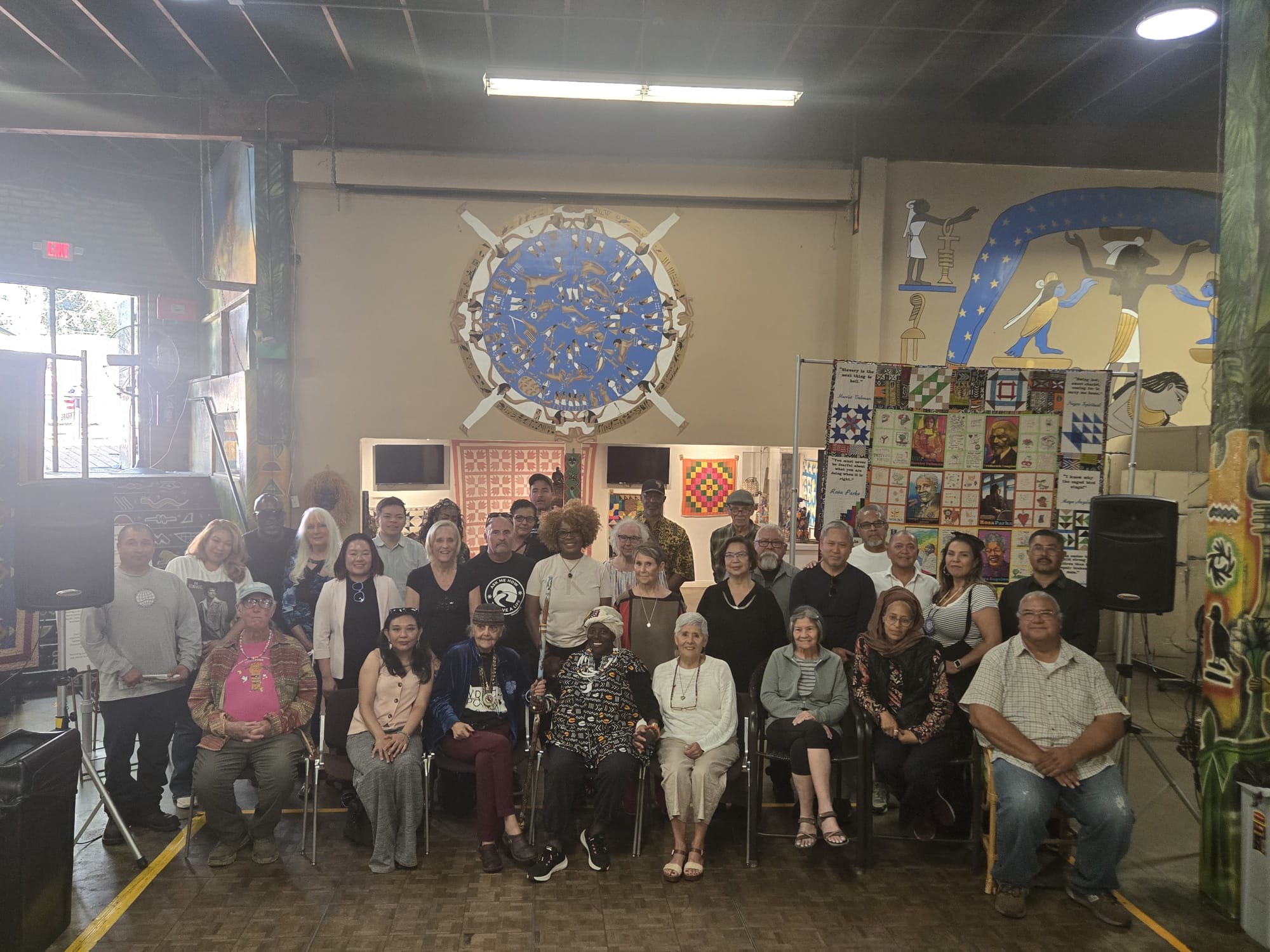
At the cultural sanctuary founded by Makeda Dread Cheatom, journalists, artists, and community storytellers gather to strengthen collaboration across ethnic and Indigenous media—and rediscover the power of cultural memory.
Magazine, The Immigrant Experience
Women’s History Month Spotlight
As I walked through the main hall of the WorldBeat Center in San Diego’s Balboa Park, three pieces of art stopped me in my tracks.
For a moment, the room seemed to disappear.
Because I recognized them immediately.
They were ceremonial pieces from the Kom people of the Northwest region of the Central African country of Cameroon—regalia whose patterns, craftsmanship, and symbolism carry generations of cultural memory. For Charles, CEO of The Immigrant Magazine and a native of the Kom community, the discovery was unmistakable. His reaction was a moment of surprise and pride that was almost impossible to contain.
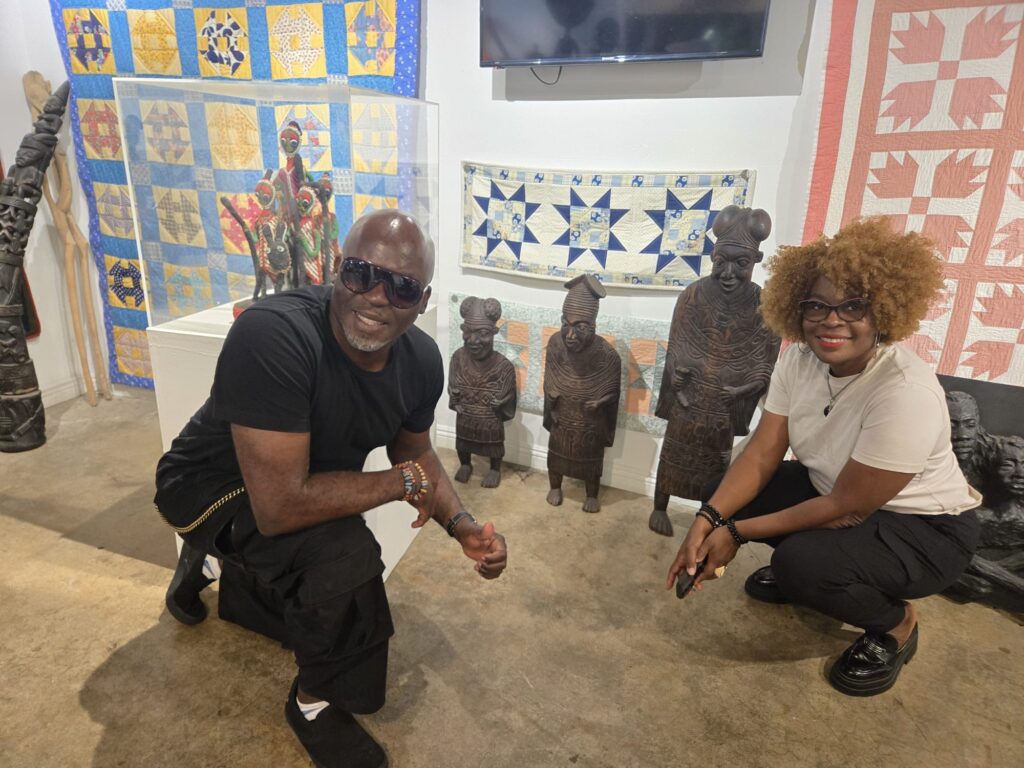
Seeing them here, thousands of miles from home, was deeply moving.
As someone whose roots trace back to that same Kom heritage, the moment carried a quiet sense of recognition—an unexpected reminder that culture has a way of finding us, even far from home.
I had arrived that afternoon with the TIM TV team to attend a gathering of ethnic and Indigenous media leaders, a continuation of a conversation that had begun weeks earlier among community storytellers and journalists. But in that moment, standing before those pieces of Kom heritage, the visit became something more personal.
It became a reminder of how culture travels.
And how sometimes, far from home, you unexpectedly find it waiting for you.
A Gathering of Community Storytellers
On March 8, 2026—International Women’s Day—journalists, writers, podcasters, radio hosts, artists, and community storytellers gathered at the WorldBeat Center for a follow-up convening of ethnic and Indigenous media practitioners.
The gathering continued the momentum of an earlier meeting hosted at Rez Radio, where media voices had first come together to discuss the role of journalism in strengthening community storytelling.
This follow-up meeting brought those conversations forward.
Participants shared their visions and aspirations for their newsrooms, discussed challenges facing independent and community media, and explored ways to strengthen collaboration across ethnic and Indigenous outlets.
Old and new voices sat side by side.
Experienced journalists exchanged ideas with emerging storytellers. Community broadcasters, digital media creators, and independent writers reflected on the future of their work and the communities they serve.
Once again, Julian Do, co-director of American Community Media, and Rose Davis, founder of Indian Voices, whose initiative helped bring the gathering to life, created the bridge that brought these voices together.
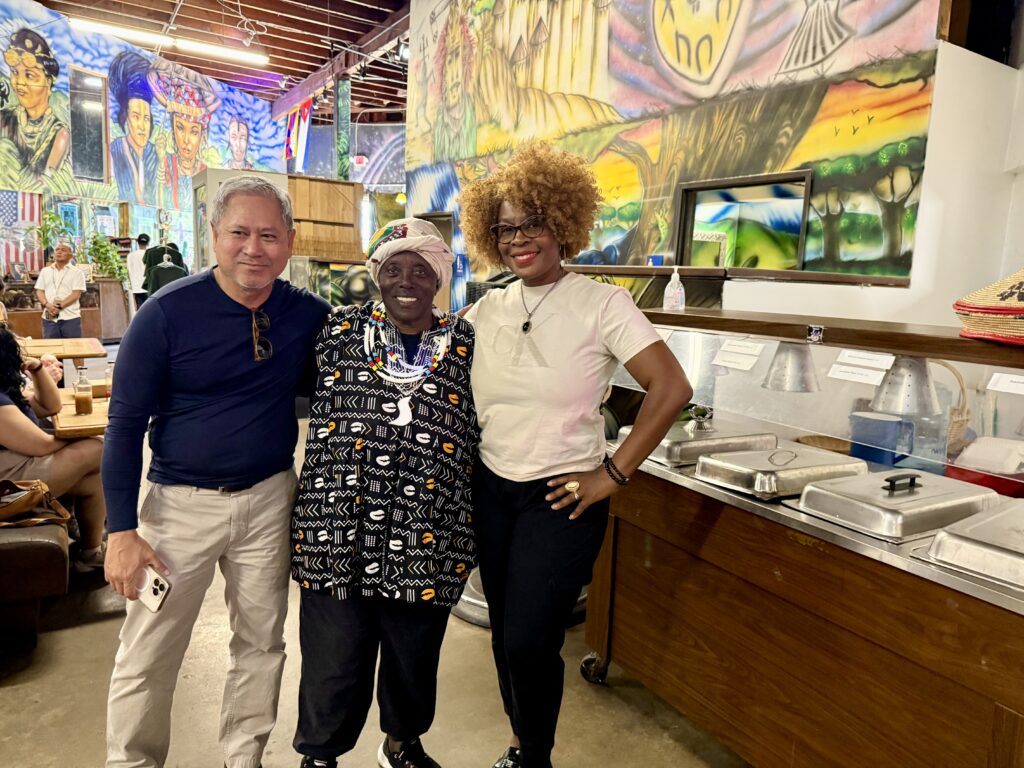
Just as the earlier gathering had done, this meeting continued to solidify bonds among media practitioners who share a commitment to community storytelling.
The gathering carried a powerful spirit captured in its guiding theme:
Indigenous Wisdom Through Media
Heal Humanity and Turtle Island.
Within the walls of the WorldBeat Center, that message resonated deeply.
The Vision Behind the WorldBeat Center
Moments like the one I experienced with the Kom artwork help explain why spaces like the WorldBeat Center matter.
And it is exactly the vision that inspired Makeda Dread Cheatom to create this place.
For decades, Makeda has been a powerful cultural voice in San Diego. A longtime radio broadcaster, community leader, and cultural advocate, she founded the WorldBeat Center as a sanctuary where communities could reconnect with heritage through music, art, dance, and storytelling.
When we sat down to talk, she spoke about the purpose of the center with warmth and conviction.
“This place is about unity,” she said.
The WorldBeat Center, she explained, was created as a space where people from across the African diaspora and beyond could come together to rediscover their cultural roots.
“It’s about all of us coming together,” she said. “And remembering who we are.”
For Makeda, culture is not simply a celebration.
It is awakening.
For generations, she believes, communities across the African diaspora have been separated from knowledge of their cultural identities.
“What they had us forget,” she said, “is who we are.”
Through the arts, the WorldBeat Center works to restore that memory.
Culture as a Bridge
Walking through the center makes that mission visible everywhere.
Art from Africa, Asia, and the Americas fills the halls. Sculptures, textiles, ceremonial garments, and paintings reflect the journeys of cultures that have traveled across oceans and generations.
Mexican and African American histories share space with global traditions, reflecting the diverse cultural landscape of Southern California.
For visitors, the experience can be unexpectedly personal.
Sometimes a piece of art carries a story that connects directly to one’s own heritage.
Sometimes it creates a moment of recognition.
That was the moment I experienced standing before the Kom ceremonial pieces from the Northwest region of Cameroon.
The regalia reflected a tradition deeply connected to Toghu, the richly embroidered ceremonial attire worn by the Kom people and neighboring communities of Cameroon’s Northwest region.
Traditionally worn by royalty, elders, and respected members of society, Toghu garments symbolize dignity, leadership, and cultural pride. Their velvet fabric and intricate geometric embroidery reflect generations of artistry passed down through skilled artisans.
To encounter that heritage in San Diego felt like witnessing culture crossing continents.
Culture as Awakening
When I mentioned this discovery to Makeda, she smiled knowingly.
Moments like that, she explained, represent exactly why the WorldBeat Center exists.
“Music, dance, and culture are the weapons of the future,” she said.
Not weapons of destruction.
But instruments of awakening.
Through culture, communities rediscover identity. Through culture, people reconnect with their roots. And through culture, humanity begins to recognize its shared origins.
Makeda believes that the story of African people is far more expansive than many realize.
“The whole world is Africa,” she said. “We’ve been everywhere.”
Her message was not about division.
It was about connection.
“One people,” she said. “One destiny.”
Where Stories Meet
As the gathering of journalists, artists, and community storytellers continued that afternoon, it became clear that the conversations happening in the room were part of the same mission embodied by the WorldBeat Center.
To preserve memory.
To amplify culture.
To ensure that community stories are told.
Spaces like the WorldBeat Center remind us that culture is not static.
It travels with people.
It evolves, adapts, and finds new homes in unexpected places.
Sometimes those homes appear in moments like the one I experienced—standing before artwork from the Kom community thousands of miles away from the Central African country of Cameroon.
Moments like that remind us that heritage never truly disappears.
It simply waits to be rediscovered.
A Place Where Culture Lives
Today, the WorldBeat Center stands as a testament to the vision of Makeda Dread Cheatom, whose decades of dedication have transformed it into a sanctuary where cultures meet, stories are shared, and communities reconnect with their roots.
But perhaps the center’s greatest impact lies in the quiet moments it creates.
Moments when journalists and storytellers gather to imagine the future of their work.
Moments when strangers discover the power of shared heritage.
And moments—like the one I experienced that afternoon—when a visitor walking through its halls suddenly encounters a piece of art that carries them thousands of miles back home.
Standing before those ceremonial pieces from the Kom people of the Northwest region of the Central African country of Cameroon, I was reminded that culture never truly disappears.
It travels with us.
Across oceans.
Across generations.
And sometimes, when we least expect it, we find it waiting quietly in a place like the WorldBeat Center, reminding us exactly who we are.
#WorldBeatCenter #MakedaDreadCheatom #AfricanDiaspora #EthnicMedia #IndigenousMedia #CommunityStorytelling #CulturalHeritage #KomCulture #CameroonCulture #TIMTV #VoiceOfImmigrants #WomensHistoryMonth
To hear more from Makeda Dread Cheatom and experience the atmosphere of the gathering at the WorldBeat Center, watch the full TIM TV interview below.