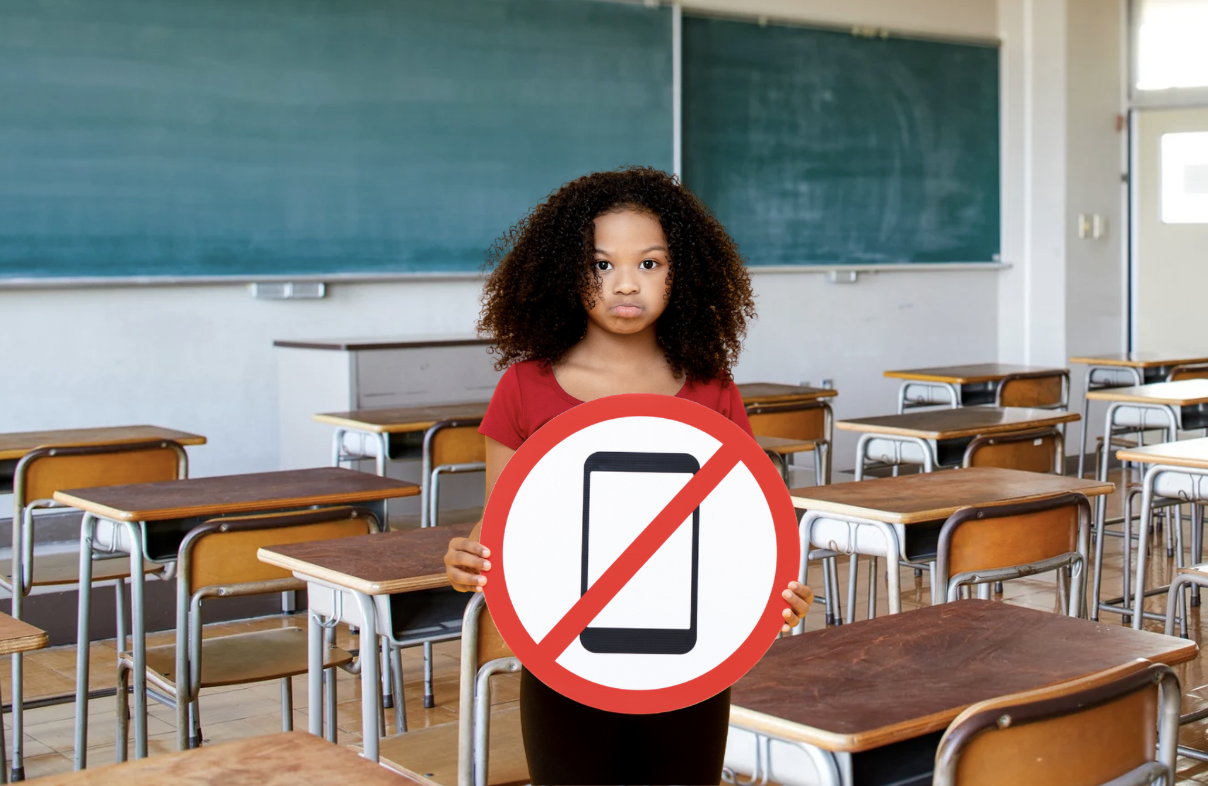
As schools across the U.S. restrict phones, new research and student voices reveal a deeper struggle with addiction, focus, and connection.
Magazine, Living Well, The Immigrant Experience
Across the United States, a quiet policy shift is unfolding inside classrooms. More than 30 states have enacted or proposed restrictions on student cell phone use, many embracing strict “bell-to-bell” bans that eliminate access for the entire school day. The urgency behind these measures is fueled by rising concerns over youth mental health, declining academic performance, and the undeniable pull of social media—where teens now spend four to six hours daily.
At a moment when classrooms are being reshaped by policy and pressure, Sunita Sohrabji moderated a timely national conversation—bringing together voices that rarely share the same table. There was Dr. David Marshall, a former middle and high school teacher now shaping education research at Auburn University; Dr. Timothy Pressley, a psychologist studying how students think, focus, and cope in a digital age; and two young people living the reality behind the data—Kai Bwor, a student journalist and editor-in-chief in Los Angeles, and Nicholas Torres, a recent graduate from Houston still close enough to the classroom to remember its rhythms.
The conversation, hosted by American Community Media (ACOM), unfolded as both a briefing and reality check—grounded in research but sharpened by lived experience. Together, the speakers examined a deceptively simple question: Do cell phone bans actually work—or are we mistaking control for a solution?
What emerged was not consensus, but clarity.
Cell phone bans may address symptoms—but they do not resolve the underlying condition.
Start with the evidence.
Dr. Timothy Pressley and Dr. David Marshall, who have studied cell phone bans across multiple countries, offered a cautious endorsement. Yes, bans can improve academic outcomes—especially for lower-performing students. Yes, classrooms become less chaotic. Yes, students talk to each other more.
But even in the data, there are cracks.
Academic gains are not immediate. In some cases, they take time to materialize. Mental health outcomes remain inconclusive—some studies show reduced bullying, while others show no meaningful change in anxiety or depression. In at least one case, anxiety worsened when phones were removed.
That detail matters.
Because it suggests that what we are dealing with is not just distraction but dependency.
Students are not simply choosing their phones over their lessons. They are, in many cases, psychologically tethered to them. And when that tether is cut abruptly, the result is not clarity but withdrawal.
Then there is the question of behavior.
Teachers overwhelmingly report that bans reduce disruptions. In one Virginia district studied by Marshall, educators described quieter classrooms, more engagement, and even a surprising side effect: a reduced sense of workload. Not because they had less to do, but because they were no longer competing with an algorithm designed to capture attention at all costs.
There was also a social shift. Students spoke more. Hallways grew louder. Participation in extracurricular activities increased.
These are not small gains. In an era where youth isolation is rising, even modest increases in face-to-face interaction matter.
But here, too, the policy reveals its limits.
The effectiveness of these bans largely hinges on their consistency. When some teachers enforce the rules and others do not, the system fractures. Trust erodes. Students test boundaries. The policy becomes negotiable.
Bans don’t fail because students resist them. They fail because systems cannot sustain them.
Then, the most important voices emerge.
The students.
Kai Bwor did not speak like a policy subject. She spoke like someone living inside the contradiction adults are trying to solve.
Yes, she is addicted to her phone. The dopamine hits. The endless scroll. The algorithm that learns her faster than she understands herself.
But she also depends on it.
For connection. For collaboration. For safety.
In a world where parents track their children’s locations and fear shapes freedom, phones have become a kind of digital tether between generations. They are not just distractions—they are reassurance.
Take that away, and you are not just removing a device. You are disrupting a system of trust.
Kai’s argument against bans is not that phones are harmless. It’s that control without education does not work.
“Strict parents create sneaky kids.”
And in classrooms across the country, that is precisely what’s happening. Students hide phones under desks. Check them in bathrooms. Find workarounds faster than policies can keep up.
The ban does not eliminate behavior. It drives it underground.
Nicholas Torres offers another layer to the story.
For him, the phone is less about social media and more about function. Assignments, communication, and navigating a school system that is already digitized.
But even he acknowledges the double edge.
Phones connect—and isolate. They fill silence—and create it.
And when schools restrict access, students don’t disengage from their devices. They simply shift that engagement elsewhere—late at night, at home, behind closed doors.
So the question becomes: what are we really regulating?
Attention during school hours?
Or a broader culture of digital dependence that schools alone cannot address?
What this conversation ultimately reveals is not a failure of policy but a mismatch of expectations.
We are asking schools to solve a societal problem.
We are asking teachers to compete with billion-dollar platforms engineered for addiction.
We are asking students to self-regulate in an environment where even adults struggle to do the same.
And we are asking bans—blunt, enforceable, visible—to stand in for something far more complex: digital literacy, emotional resilience, and cultural change.
This doesn’t mean cell phone bans are useless.
They are not.
They can create immediate improvements in focus. They can restore a measure of order. They can give teachers a fighting chance in classrooms that have become increasingly fragmented.
But they are, at best, a starting point.
Not a solution.
Because the real issue is not whether students have phones in their pockets.
It is whether they have the tools to live with them.
To understand them.
To resist them.
To use them without being used in return.
If there was one moment that lingered, it came not from research but from a student.
“Your phone can wait,” Nicholas said. “Your friends can wait.”
It was a simple statement. Almost old-fashioned.
And yet, in a culture of constant connectivity, it felt radical.
Because what students are navigating today is not just technology—it is time, attention, identity, and belonging.
You cannot ban your way to balance.
You have to teach it.
ImmigrantVoices #EducationDebate #DigitalWellbeing #YouthPerspective #ACOM #SchoolPolicy #TechAndTeens #CommunityMedia