
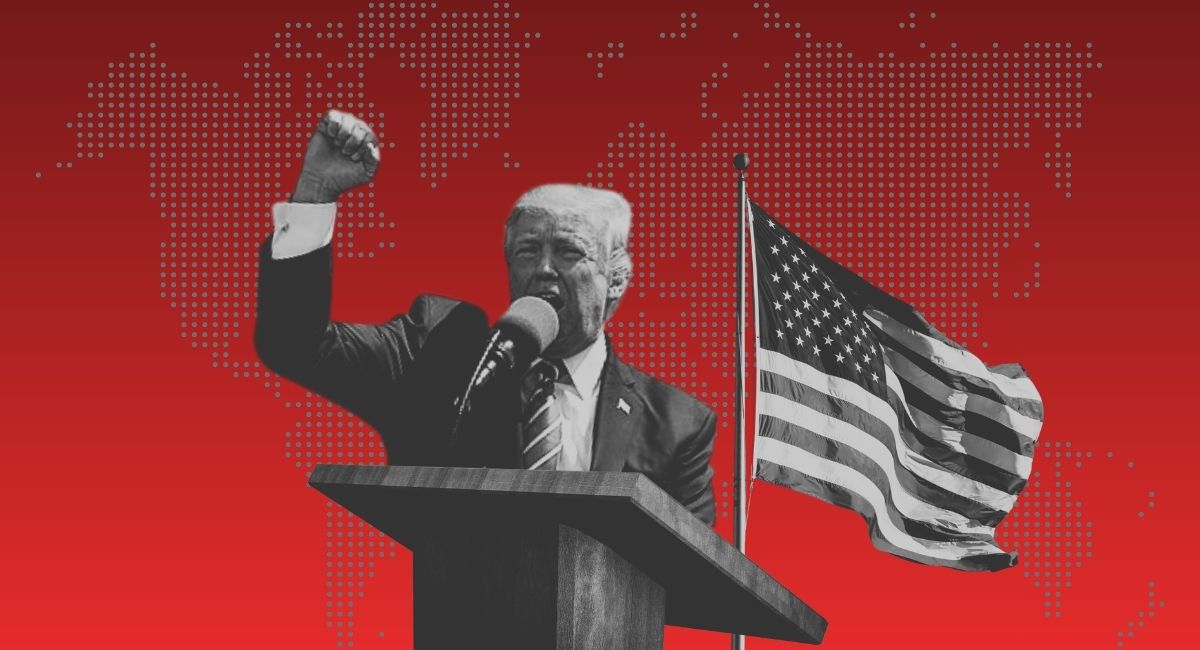
Across borders and ballots, immigrant communities are influencing U.S. policy while navigating identity, division, and global consequences.
Across the United States, diaspora communities are shaping debates on foreign policy, democracy, sanctions, and global conflict—often while navigating the consequences of those same decisions in their lives.
At a recent American Community Media (ACOM) briefing, that reality came into focus through the voices of Helen Zia, journalist and Asian American civil rights activist; Eduardo Gamarra, Professor of Politics and International Relations at Florida International University; and William O. Beeman, Professor Emeritus of Anthropology at the University of Minnesota.
“Diasporas are often described as voting blocs,” moderator Pilar Marrero said. “But they are also political actors with influence, internal divisions, and sometimes contradictions.”
What emerged over the next hour was not a single narrative but a layered one. Memory, migration, and the quiet tension of belonging to more than one place shaped it.
For Cuban Americans, politics is not just policy—it is history that still breathes.
Gamarra traced the roots of their political alignment to the aftermath of the Cuban Revolution, when exile communities formed around loss, displacement, and a deep mistrust of leftist governance. That history continues to shape how many Cuban Americans vote today.
But time has introduced complexity.
In communities like Hialeah, reliance on public programs such as Medicare and the Affordable Care Act is high. At the same time, support for candidates who advocate reducing those programs remains strong.
It is a contradiction often misunderstood from the outside.
But within the community, it reflects something deeper—a political identity shaped less by policy detail and more by lived memory. For many, the fear of returning to what was left behind outweighs present-day policy trade-offs.
Still, that alignment is not fixed.
As newer Cuban migrants face deportation and shifting immigration policies, some families are beginning to feel the direct impact of decisions once viewed at a distance. The conversation is changing—quietly, but unmistakably.
Among Venezuelan Americans, that shift is more immediate—and more visible.
Once largely aligned with Democratic positions, many moved toward Republican candidates after 2016, drawn by promises of decisive action against Nicolás Maduro’s government. For a community shaped by political and economic collapse, those promises carried weight.
But policy has a way of circling back.
As immigration protections like Temporary Protected Status come under pressure, Venezuelan families are confronting a new reality. Legal uncertainty is no longer abstract—it is personal. It is a relative wait. A status expiring. A future put on hold.
Gamarra pointed to emerging data showing that many voters reconsidering their political support have one thing in common: a direct connection to someone affected by these policies.
The divide within the community is no longer just ideological. It is generational. It is experiential. It is the difference between those who arrived decades ago and those still finding their footing.
For the Iranian diaspora, the story stretches further back—and carries a different kind of weight.
Beeman placed its origins in the 1979 Iranian Revolution, a moment that reshaped not only a nation but also the lives of those who left it. Today, the Iranian American community includes a range of political perspectives, from royalists to secular reformists, all navigating what it means to oppose the current regime from afar.
What stands out is how deeply foreign policy shapes political alignment.
Many Iranian Americans support hard-line U.S. positions toward Iran not because of domestic priorities, but because of what they hope those policies might achieve abroad.
It is a reminder that diaspora politics is rarely contained within borders.
It moves between them—carrying with it memory, expectation, and, often, a longing that does not fade with time.
Helen Zia widened the lens, bringing in the long arc of Asian American history.
Her message was clear: what we are seeing now is not new.
From exclusion laws in the 19th century to the rise in anti-Asian violence during the COVID-19 pandemic, Asian American communities have long experienced the ripple effects of U.S. foreign policy. When geopolitical tensions rise, those tensions often land first—and hardest—on immigrant communities.
“When U.S.-China policy develops a sniffle,” Zia said, “Asian Americans get pneumonia.”
The line held the weight of history.
It speaks to a pattern where diaspora communities are pulled into narratives they did not create but are expected to carry.
Throughout the briefing, one idea surfaced again and again: diaspora communities are not passive.
They are engaged. They are evolving. And they are increasingly aware of how they are positioned within American political life.
They are courted in elections. Referenced in foreign policy. Counted in strategy.
But they are also families making decisions in real time—navigating policies that shape where they can live, who can stay, and what futures are possible.
For journalists, Zia offered a reminder that feels both simple and urgent: do not treat these communities as monolithic.
Within every diaspora are differences—of class, of race, of migration history, of political belief. To understand them requires attention to those details and a willingness to move beyond easy narratives.
Because the story of diaspora politics is not one story.
It is many things.
What is unfolding now is a shift in how American politics works—and who shapes it.
Diaspora communities are not only influencing policy debates; they are living with their consequences in real time, across households, across borders, and across generations.
And in that space—between influence and impact—they are redefining what it means to belong, to participate, and to be heard.
#DiasporaVoices #ImmigrantPower #ACOM #ImmigrantMagazine #GlobalPolitics #ImmigrantStories #CivicEngagement #DiasporaPolitics



3 Comments. Leave new
Gave fly33 a spin recently. The performance of the site is pretty smooth. It’s worth having a look at here: fly33
WE999GAME is an okay site. There are some games which I found enjoyable! But nothing great still: we999game
WINLISLOTSLOGIN super smooth. Easy access, good games. Solid stuff. Try it if your free time: winlislotslogin