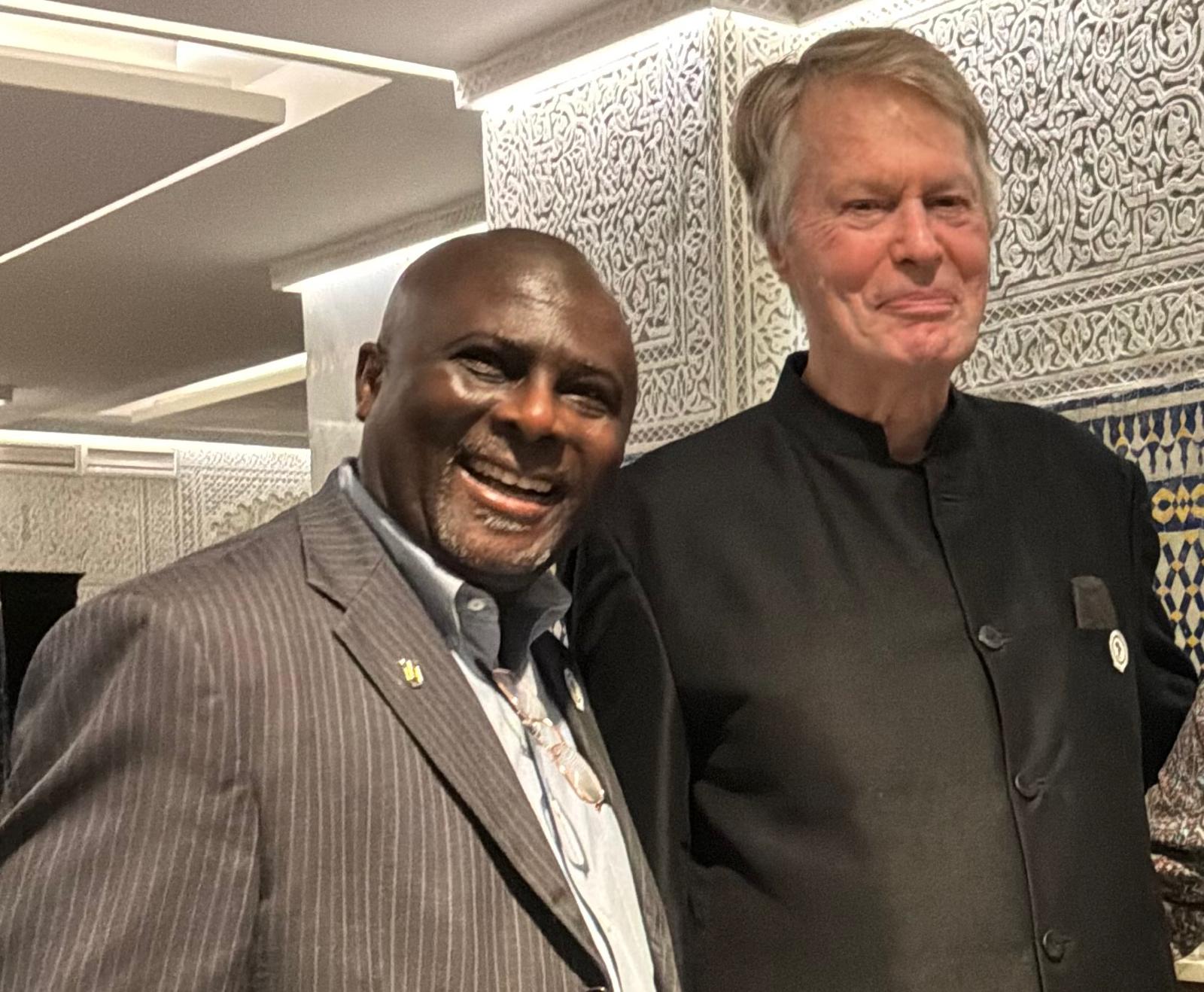
Pr. Bill F Ndi, PAWA President, JMG Le Clézio, 2008 Nobel prize winner
Forty years after Wole Soyinka made history as the first African to win the Nobel Prize in Literature, writers and literary minds gathered in Rabat, Morocco, to celebrate his legacy and the enduring power of storytelling. It was here, at the inauguration of the House of the Worlds of the Book, that Professor Bill F. Ndi sat down with 2008 Nobel Laureate J.M.G. Le Clézio for a deeply personal conversation about his childhood in Cameroon and Nigeria, the painful memories of war, artificial intelligence, and why the stories we carry must never lose their humanity.
Magazine, The Immigrant Experience By Bill F.Ndi, Poet, Playwright, Critique, Language Engineer
What happens when two seemingly distant intellectuals sit down over coffee at the Hassan Palace Hotel in Rabat, Morocco to talk about “everything and nothing”?
On one side of the table sat J.M.G. Le Clézio, the 2008 Nobel Laureate in Literature, a writer and academic whose life and work span France, Mauritius, Nigeria, Cameroon, and Mexico. On the other sat Professor Bill F. Ndi, a Southern Cameroonian American poet, Director of International Programs, and academic from Tuskegee University specializing in Professional, Technical, and Creative writings as well as language engineering.
Their meeting proves that literature is rarely confined to quiet libraries or dusty leather-bound volumes. Instead, a deep conversation about writing quickly opens doors to WWII military aviation, 3D mathematical equations of speech, poetry, forgotten civil wars, and the ethical, intentional, and emotional limits of Artificial Intelligence.
Journey along into the insights from this extraordinary meeting.
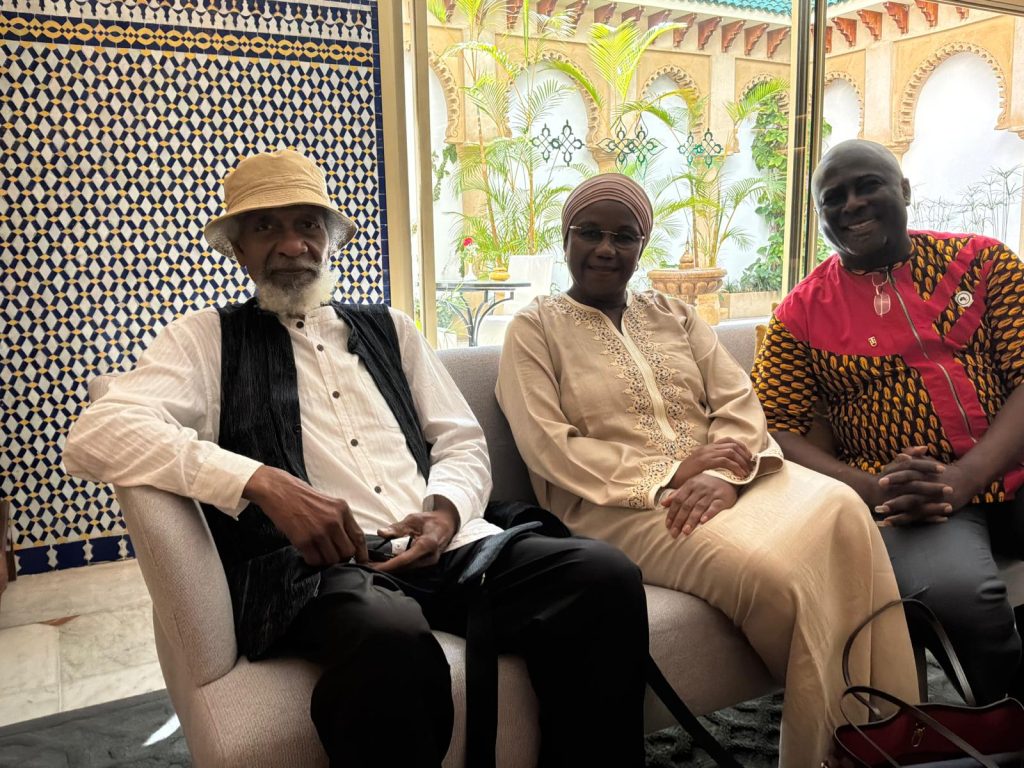
Tuskegee University, Alabama, Helped Win WWII and Dominates STEM Today
When Professor Bill introduced his home institution, Tuskegee University in Alabama, he revealed an astonishing history of educational empowerment that deeply moved Le Clézio, 2008 Nobel laureate in literature.
Founded in the American South by formerly enslaved people of African extraction, Tuskegee was created with a clear vision and purpose: especially the Founding President, Booker T. Washington’s vision of educating the Head, the Heart, and the Hand; aimed at providing higher education and self-determination to people of African descent. Over the decades, its real-world impact expanded exponentially onto the global stage.
During World War II, Tuskegee trained the legendary Black military aviators known as the Tuskegee Airmen. Their precision combat missions were instrumental in helping the Allies defeat Axis forces. Today, the American government officially recognizes Tuskegee for producing more Black officers in the U.S. military than all official military academies combined. Furthermore, besides the wonderful discoveries made by George Washington Carver, the university trains 70-80 percent of African American veterinarians in the United States, along with 100 percent of the Black aerospace engineers produced within that historical HBCU framework and some of the best literary minds such as Ralph Ellison, Claude McKay, and Albert Murray, to name a few are all products of the institution.
“It is the first university for Afro-descendants that was founded by enslaved people with the goal of providing education to every person of African descent… and since then, it is a university that has kept its promise.” — Professor Bill F. Ndi
Le Clézio expressed quiet awe at an institution built from the ground up by marginalized people that went on to shape world history and modern science.
Freedom, Barefoot Summers, and the Best Education Money Can’t Buy
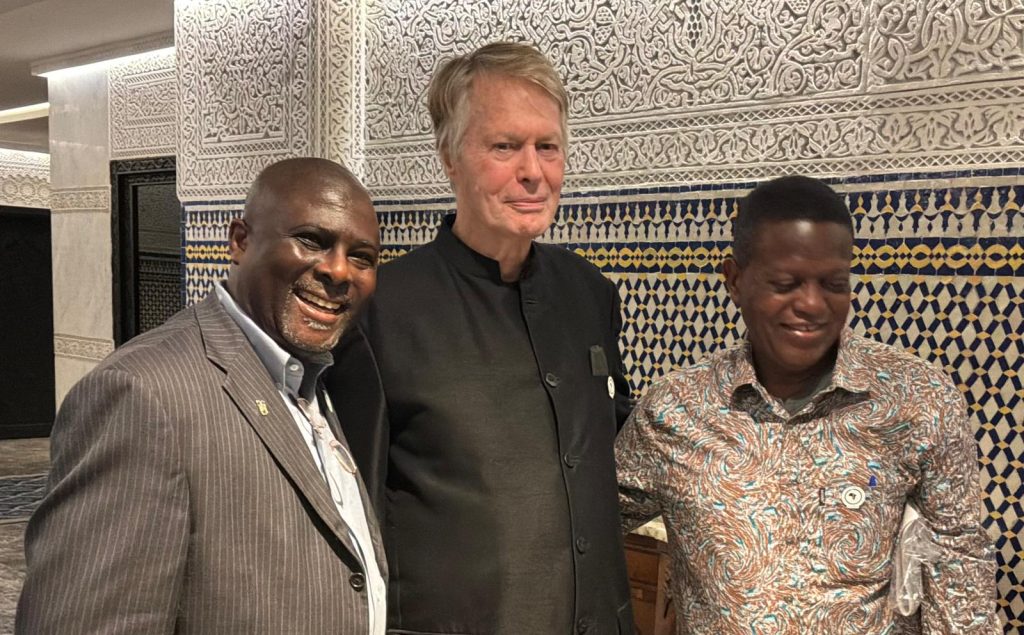
How does a future Nobel Laureate learn to perceive the world? In Le Clézio’s case, the answer lies in spending years completely outside the formal schooling system.
Between the ages of 7 and 10, Le Clézio lived between Banso, Cameroon, and Ogoja, Nigeria, where his father served as the sole surgeon at a hospital run by Irish nuns. From this Nigerian base, his father undertook periodic health reporting and vaccination tours across the border into Cameroon, visiting towns like Banso, Ndop, Bamenda, and Nkongksamba. During these years, neither Le Clézio nor his brother attended formal school. Instead, his mother provided informal lessons in French, English, and basic science as a casual distraction while the boys roamed free.
When his family eventually returned to France, the culture shock was profound. Young Le Clézio walked barefoot, didn’t know basic addition or subtraction, spoke a mixture of Pidgin English and Igbo words rather than formal French, and struggled terribly to adapt to France’s rigid, authoritarian educational structure.
Yet, looking back, Le Clézio considers this “un-schooled” childhood his greatest gift. He observed that the West African children he played with possessed an early maturity, independence, and deep-seated respect for elders and natural laws that formal Western schooling often fails to instill.
“It is a privilege when you have a childhood without school, where nature teaches you respect for insects, reptiles, and daily life—teaching you how to sleep at night without being bothered by the noises of the forest around you.” — J.M.G. Le Clézio.
Can Language Be Mapped in 3D? Why AI Still Fails at True Literature
The dialogue took a fascinating turn into the mechanics of language when Professor Bill F. Ndi introduced his book, Olumo Rock Lion: Poetizing Engineering and Engineering Poetry. In it, he analyzes creative sonnets through the lens of structural engineering, using mathematical, architectural, engineering equations to demonstrate how language engineering builds literary systems.
Le Clézio confessed to being a béotien—a complete layman—when it comes to pure mathematics, yet he recalled that his late brother, a professional linguist, spent his life conducting similar work. His brother used mathematical analyses of frequency, sound, and semantics to convert spoken sentences from novels or everyday speech into physical, three-dimensional geometric objects.
However, both intellectuals reached a hard limit when discussing modern Artificial Intelligence and literary translation. Consider Ken Saro-Wiwa’s masterpiece Sozaboy, written in a complex, fluid blend of Pidgin English, standard English, and Igbo. Standard translations into formal French consistently ruin the text because they fail to capture its living, hybrid rhythm.
Both agreed that AI tools will always fail at deep literary translation because software lacks human consciousness.
“No matter how well we train the machine to translate, the machine will never have intentionality or emotionality. What is inherent to the machine will never possess these.” — Professor Bill F. Ndi.
Without intentionality, emotionality, and political context—such as Saro-Wiwa paying for his socio-political struggles with his life—a machine merely replaces words without understanding their human weight.
When Geography Disappears: The Trauma That Silenced a Nobel Writer
Place is often considered the primary foundation of literature. For Le Clézio, stories always begin with geography, often through a process of creative dislocation or antipodal resonance: looking out his window at tumbleweeds in the New Mexico desert inspires his writing about Mauritius, while his vivid memory of the dense, dark canopy of Nigeria’s Obudu forest serves as the emotional blueprint when depicting a World War I French forest north of Paris.
Yet, trauma can permanently erase a landscape for an author. During the Nigerian Civil War (the Biafran War of 1967–1970), regions like Ogoja and Uli suffered catastrophic devastation, famine, and massacres. For Le Clézio, the conflict wiped out the very playmates and childhood friends he had grown up with.
The tragedy also devastated his father, a quiet man who maintained lifelong correspondences with his former Nigerian and Cameroonian friends. After 1968, the letters abruptly stopped, leaving him to mourn their deaths in silence.
Because these physical sites were and have been transformed by modern development and haunted by tragic loss, Le Clézio has chosen never to return.
“I do not have humility, but I have within me this point of suffering that means, at a certain moment, my memories are worth nothing. My memories are erased for me.” — J.M.G. Le Clézio.
Broadening Scientific Minds with Literature: Teaching Nature to Chinese Astrophysicists
In a surprising detail about his current life, Le Clézio revealed that he actively teaches online courses to mature students at Nanjing University in China.
His students are not literature majors. They are 30- to 40-year-old astrophysicists, chemists, doctors, lawyers, and geographers. Under Chinese government directives, hard scientists are encouraged to study art and literature to break out of narrow, overly rigid mindsets.
Le Clézio structures his course around the broad theme of “Nature.” Interestingly, he notes that while his Chinese scientific students frequently use AI tools to help draft their English and French essays, the results remain remarkably unique. The students apply their scientific habits—constructing strictly organized, “A-B-C” logical arguments—to express genuinely creative and personal reflections on the natural world.
In a charming narrative payoff, Le Clézio pledged to incorporate Professor Bill F. Ndi’s book and mathematical language frameworks directly into his Nanjing University curriculum. For these scientific minds, Bill F. Ndi’s work offers an ideal bridge between structural mathematics and poetic expression.
In an Era of Fake News, Why Literature Must Reject Lies
When asked to name the single greatest challenge facing modern writers in an age dominated by social media, instant technology, and political spin, Le Clézio did not hesitate: sincerity.
He draws a sharp moral line between politicians and writers. Politicians, he argues, are constantly tempted to lie or manipulate facts for votes, short-term career gains, and immediate personal benefit. Writers, by contrast, often live in economic precarity, yet they carry a romantic, unyielding obligation to protect moral truth.
Referencing the philosopher Ludwig Wittgenstein, Le Clézio emphasized that basic moral truth is not something that needs to be engineered; it is an instinctive human quality built directly into our inner nature.
“Writers have a servitude toward literature, but they also have one toward the truth. Politicians are inclined to lie for a few votes or immediate benefits… If we believe Wittgenstein, moral truth is within us. And if you have nothing true to say, it is better to remain silent.” — J.M.G. Le Clézio.
Conclusion: The Power of Reading to Change a Life
At the end of their conversation, Professor Bill asked Le Clézio what single piece of advice he would give to a young person in Banso, Ndop, Bamenda or Ogoja who dreams of becoming a writer.
Le Clézio’s answer was disarmingly simple: Read.
He put this philosophy into action through a philanthropic association he co-founded in Mauritius. In impoverished Creole communities, where historical disenfranchisement leaves up to 80 percent of young women unable to read or write, his organization brings books and dictionaries directly into underfunded classrooms. Dictionaries, he notes, were his favorite childhood reading material because they unlock the entire world. The results have been transformative. Several young Creole girls who received these books began writing down local family legends at age 12 and have now grown into published authors.
As artificial intelligence increasingly automates our prose and algorithms structure our thoughts into predictable patterns, this dialogue between a Nobel novelist, JMG Le Clézio and a poet who poetizes engineering and engineers poetry, Bill F. Ndi should bring to your mind, reader, a fundamental question: Can automated logic ever capture the living human soul, or will true literature always depend on that unexplainable, unrepeatable spark born only when a human mind dares to feel, remember, and speak the truth?
Bill F. Ndi is a poet, playwright, literary critic, and language engineer. He serves as President of the Pan African Writers Association and as Professor and Director of International Programs at Tuskegee University in Alabama, USA.
#JMGLeClezio #WoleSoyinka #BillFNdi #NobelLaureate #NobelPrizeInLiterature #AfricanLiterature #AfricanWriters #AfricanDiaspora #AfricanExcellence #ArtificialIntelligence #AIandLiterature #PowerOfStorytelling #HumanStories