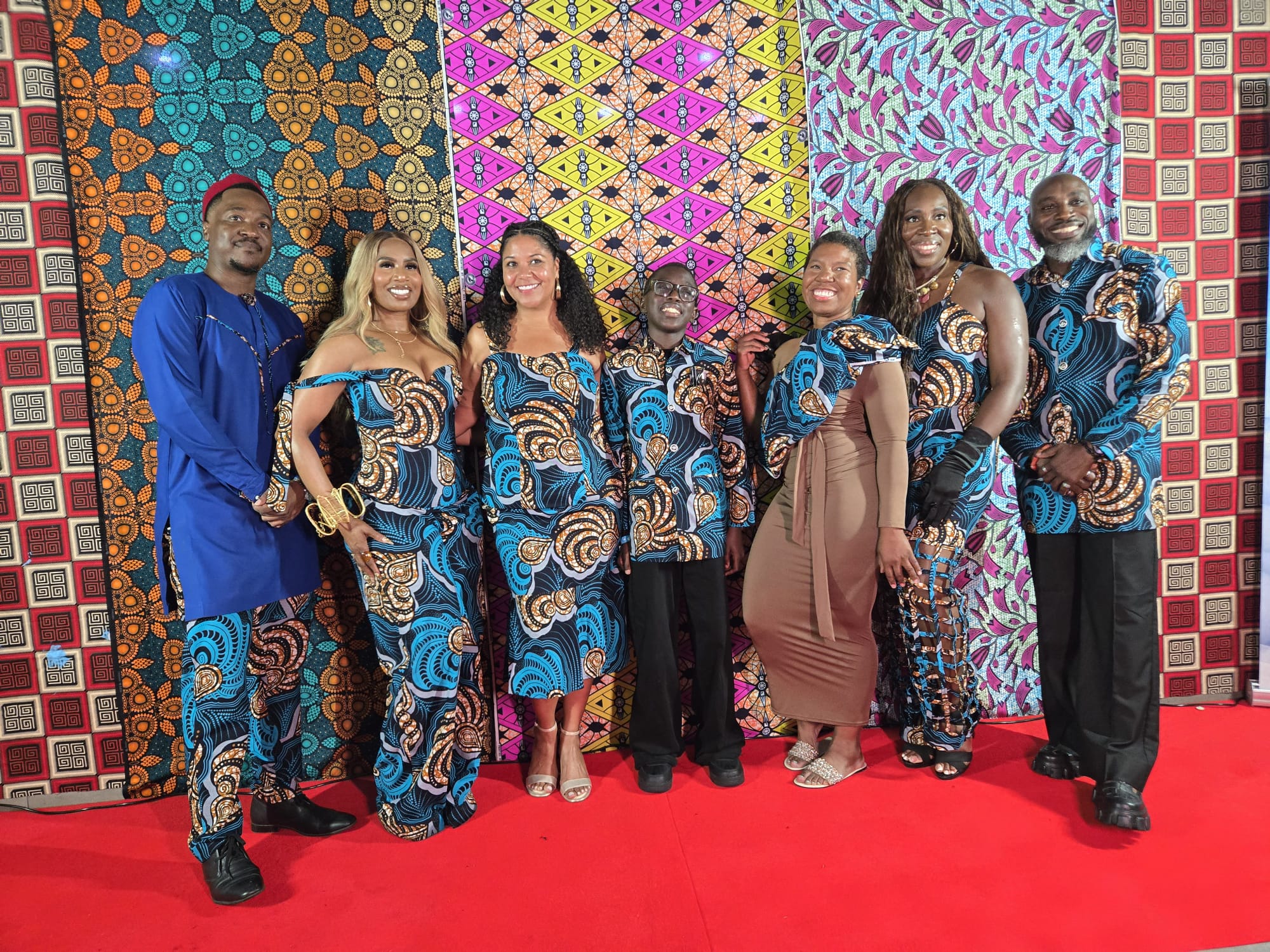
Ankara Festival team, including festival organizer Peter Lentini, seventh from left
Despite the rain, designers, artists, and diaspora communities gathered in Hollywood for a vibrant celebration of African creativity, cultural identity and fashion beyond borders.
The rain came down over Los Angeles, but inside Hollywood’s Sunset Room, Africa was having its moment.
On Sunday, September 6, designers, models, musicians, artists, entrepreneurs, and members of the African diaspora gathered for the 17th Annual Ankara Festival, Los Angeles, carrying into Hollywood the colors, rhythms, and creative confidence of a continent whose cultural influence has long traveled beyond geography.
Outside, the weather was wet and unrelenting. Inside, fabric moved beneath the lights. African silhouettes met contemporary design. Music and fashion shared the same stage. Heritage was not being preserved behind glass or confined to memory.
It was alive, wearable, and evolving.
For immigrant and diaspora communities, cultural celebrations can become much more than entertainment. They are places of recognition—spaces where traditions carried across oceans can be seen, celebrated, and introduced to new generations and new audiences.
Ankara Festival Los Angeles has spent years creating that kind of space.
The 2026 festival unfolded over Labor Day weekend, September 4–6, under the fitting theme “Fashion Beyond Borders.” According to festival organizers, Ankara Festival has brought African designers, artists, and performers to Los Angeles every Labor Day weekend since 2010.
This year’s program extended beyond the runway, with an Afro Met Gala, Pilates and Afrobeats, a cultural marketplace, an East Africa-West Africa celebration, and the headline fashion runway and concert.
Yet beneath the spectacle was a deeper message: African creativity belongs everywhere.
Festival founder Peter Lentini and his creative team have built a platform where African fashion can occupy a major Los Angeles stage not as a cultural curiosity, but as part of a living and increasingly global creative conversation.
Here, clothing becomes storytelling.
A seam can carry memory. A textile can preserve history. A silhouette can travel thousands of miles without surrendering the culture that helped shape it.
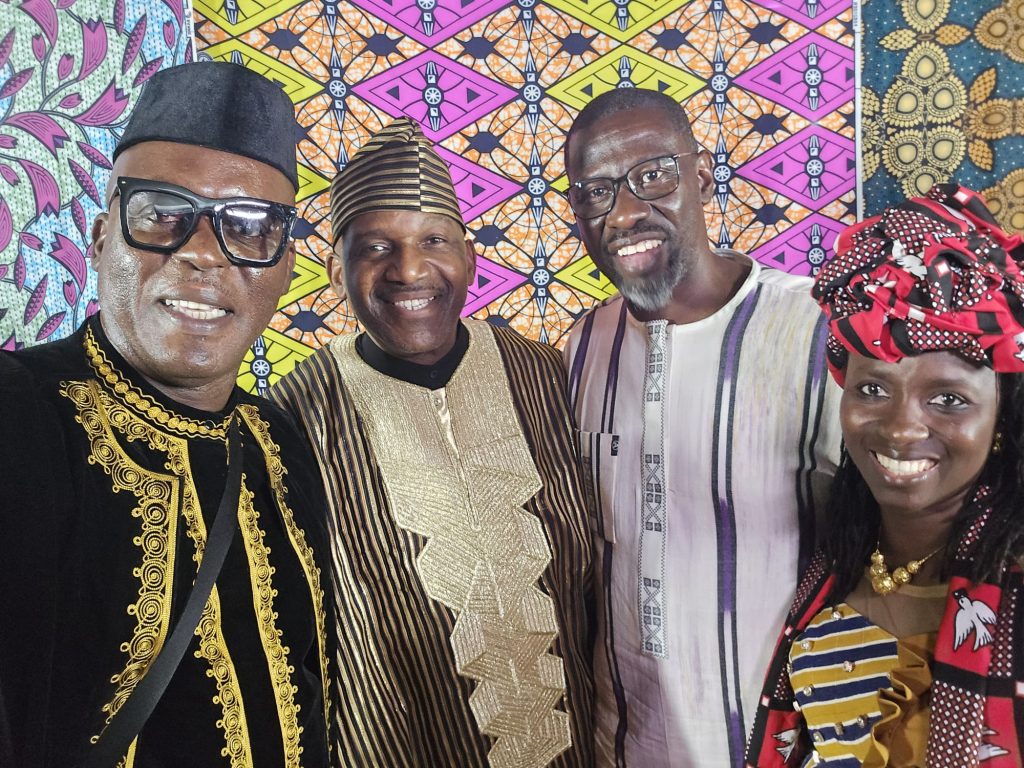
The 2026 runway featured designers representing Burkina Faso, Cameroon, Nigeria, and Senegal, including Soro’Bis, Abiola Beauty Concept, AfricStyle Fashion, Mike Sylla Couture, and Los Angeles-based Nigerian brand Olumay.
Together, the collections offered different interpretations of African fashion and a reminder that there has never been only one way to look African.
Africa is multiplicity.
Its fashion reflects countries, communities, histories, and generations. Its creative traditions are vast, and designers continue to draw from those traditions while creating clothes meant to move through an interconnected world.
For Los Angeles’ Cameroonian community, the presence of AfricStyle Fashion carried particular resonance.
Contemporary Cameroonian design was being presented on a Hollywood stage, demonstrating how cultural identity can travel without becoming invisible.
It is a journey familiar across the immigrant experience.
People leave home, but home often travels with them.
It survives in language and food, music and memory, and ceremonies and celebrations. It can live in the fabric worn to a wedding, in a pattern an elder immediately recognizes, or in a garment transformed by a designer for a generation born thousands of miles from the place where the tradition began.
That conversation between inheritance and reinvention came vividly to life through Soro’Bis of Burkina Faso.
The collection was bold and sophisticated while remaining visibly connected to African textile traditions. Its earthy aesthetic and contemporary silhouettes demonstrated how heritage and modern design can strengthen rather than diminish one another.
The festival’s official designer profile describes Soro’Bis as rooted in Burkinabè heritage, craftsmanship, and African silhouettes.
And therein lies one of the most compelling ideas emerging from the runway:
African fashion does not have to choose between heritage and modernity.
Tradition is not the opposite of innovation.
Designers can take materials, patterns, techniques, and visual languages shaped across generations and allow them to speak in a contemporary vocabulary.
The result does not have to be a rejection of the past.
It can be the past continuing its journey.
Like cloth passing through the hands of a skilled tailor, culture survives not simply by remaining untouched, but by being carried forward with intention.
That is what made the festival’s theme, “Fashion Beyond Borders,” especially resonant.
Borders define countries. They do not easily contain culture.
African fashion moves.
It moves in suitcases packed by immigrants beginning new lives. It moves through designers reimagining familiar forms. It moves through music videos, weddings, festivals, red carpets, and city streets.
And it moves through younger generations who may have been born far from their parents’ or grandparents’ homelands but can still recognize something of themselves in a pattern, a rhythm, or a piece of cloth.
At Ankara Festival Los Angeles, the runway became a bridge.
Designers with roots in Burkina Faso, Cameroon, Nigeria, and Senegal shared a Hollywood platform before an audience witnessing not one definition of African style, but a conversation among cultures.
Hollywood itself gives that moment added meaning.
Few places are as closely associated with the production of images that travel around the world. Representation here carries symbolic weight. Who is visible, whose creativity is celebrated, and which cultures are allowed to define themselves can shape perceptions far beyond a single room.
Against that backdrop, African designers arriving with their own aesthetics, craftsmanship, and cultural references become more than participants in a fashion event.
They become authors of their own image.
And the significance reaches beyond fashion.
Diaspora festivals create ecosystems.
Designers gain visibility. Artists encounter audiences. Entrepreneurs meet customers. Communities reconnect. Younger generations encounter cultural expressions that might otherwise feel distant from their everyday American lives.
Those outside the culture are invited in through beauty, music, craftsmanship, and human connection.
This is how culture becomes a bridge rather than a boundary.
For African immigrants in the United States, such spaces can also illuminate one of migration’s most enduring realities: learning how to belong to more than one place at once.
There is the homeland remembered.
There is the country where a new life is being built.
And somewhere between them is an identity that continues to evolve.
Festivals such as the Ankara Festival make that space visible. They demonstrate that belonging does not have to require erasure. Diaspora identity can be additive—African and American, traditional and contemporary, rooted and global.
That was the story unfolding beneath the lights at the Sunset Room.
Not simply clothes moving down a runway, but cultures moving forward.
Not simply African fashion arriving in Hollywood, but African creatives defining how their cultures are presented, interpreted, and carried into the future.
Outside, Los Angeles was soaked by rain.
Inside, Africa was creating.
Africa was designing.
Africa was celebrating.
And perhaps that is the enduring power of a festival built around fashion beyond borders: culture does not necessarily lose its identity when it travels.
Sometimes, crossing a border simply gives it another stage.
Learn more about Ankara Festival
#AnkaraFestivalLA #AfricanFashion #AfricanDiaspora #FashionBeyondBorders #AfricanDesigners #ImmigrantVoices #AfricanCulture #DiasporaPride #Hollywood #TheImmigrantMagazine