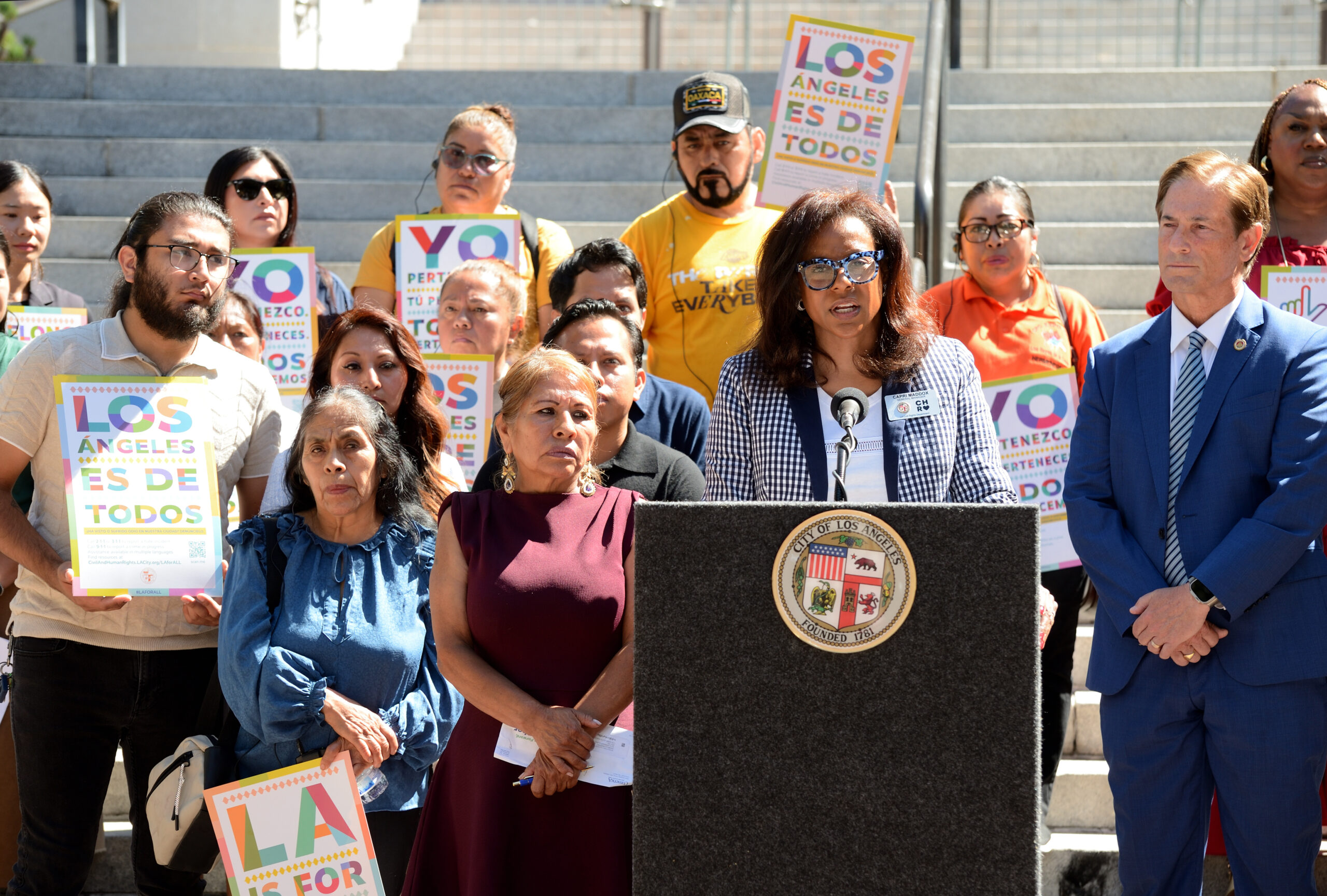
LA Civil Rights Executive Director Capri Maddox joins city leaders, law enforcement officials, and community advocates in standing with longtime street vendor Arabelia Martinez and addressing violence, discrimination, and safety concerns facing immigrant vendors.
Magazine, The Immigrant Experience
City leaders, law enforcement officials, civil rights advocates, and community organizations gathered in Los Angeles to condemn violence against street vendors and stand with Arabelia Martinez, a longtime vendor whose assault in Downtown Los Angeles renewed concerns about the safety of workers whose livelihoods unfold in public spaces.
For more than 30 years, Martinez has earned a living as a street vendor in Los Angeles.
On June 15, 2026, while operating her hot dog cart near the intersection of Figueroa Street and 7th Street, Martinez was violently assaulted.
Video of the confrontation circulated widely on social media and local news broadcasts. The attack left Martinez injured and her vending equipment heavily damaged. According to her family, the suspect made derogatory comments toward her before the assault.
Following an investigation by the Los Angeles Police Department, the suspect was arrested and formally charged.
The attack brought Martinez and her family together with elected officials, prosecutors, law enforcement leaders, civil rights officials, and community advocates at a press conference organized by the Los Angeles Civil + Human Rights and Equity Department on behalf of Mayor Karen Bass.
The coalition included Councilmembers Jurado and Hernandez, Los Angeles County District Attorney Nathan Hochman, Los Angeles Police Department leadership, and community advocacy partners.
The gathering focused on Martinez’s experience and broader concerns about harassment, extortion, discrimination, and violence affecting street vendors across Los Angeles.
It also carried a message directed at workers who may hesitate to seek help: crime victims and people who experience discrimination have rights regardless of citizenship status, permit status, country of origin, or language.
Capri Maddox, Esq., Executive Director of the Los Angeles Civil + Human Rights and Equity Department (LA Civil Rights), issued the following statement:
At LA Civil Rights, our core mission is to protect the vulnerable and fight hate and discrimination on both offense and defense. We want to remind all Angelenos they do not have to ignore discrimination or suffer in silence. Our mission motivated us to organize and activate today’s press conference on behalf of Mayor Karen Bass—to stand shoulder-to-shoulder with Ms. Arabelia Martinez following a horrific act of violence, extortion, harassment, and a possible hate crime. For more than 30 years, Ms. Martinez has been a vital part of our street vending community, and we are here to send a strong message: Hate has no home in Los Angeles. When you come for one of us, you come for all of us.
I am incredibly proud of Ms. Martinez for turning immense trauma and stress into a powerful stand for all street vendors. To ensure her voice was heard, we brought together a broad coalition—including Councilmembers Jurado and Hernandez, District Attorney Nathan Hochman, LAPD leadership, and our vital community advocacy partners—to hear firsthand how this violence impacts hard-working families. Street vendors are part of the very fabric of Los Angeles; they deserve to work safely, be treated with dignity, and know their city stands with them.
We want every Angeleno to understand this: no matter your citizenship status, your permit status, your country of origin, or the language you speak, you have rights! If you experience or witness a crime, call 9-1-1 immediately. If you are a crime victim, think you’re a possible victim, or see someone else mistreated, report it. If you experience discrimination, we urge you to file a civil rights enforcement claim with our department by visiting LAisForEveryone.com. Los Angeles is for everyone, and we will protect our community!
Maddox’s statement placed Martinez’s experience within a wider public safety concern: whether street vendors know their rights and trust public institutions enough to report violence and discrimination.
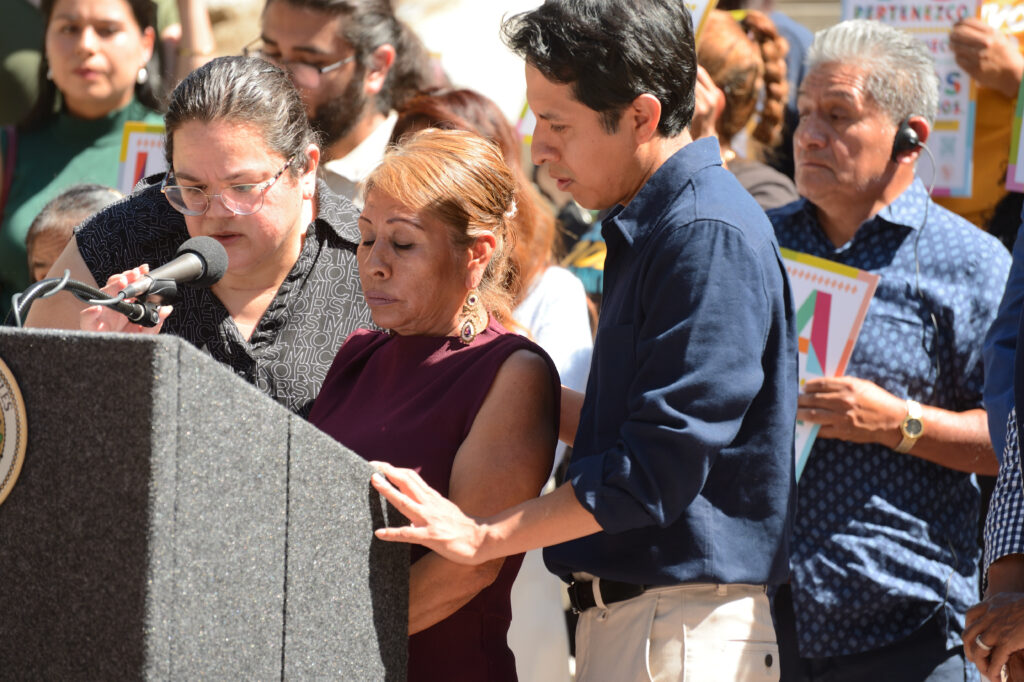
For many vendors, the sidewalk is both workplace and storefront.
They operate in direct contact with the public, often without the physical protections available in traditional workplaces. Their equipment, merchandise, income, and personal safety can be exposed to theft, harassment, threats, extortion, and violence.
Some work alone. Others work alongside relatives. Their hours may begin early in the morning or continue late into the night.
When an incident occurs, vendors may depend on customers, witnesses, nearby residents, community organizations, and law enforcement for assistance.
For immigrant vendors, the decision to report violence can involve additional concerns.
Language barriers, unfamiliarity with government agencies, uncertainty about immigration consequences, and questions about permit status can affect whether victims or witnesses seek help.
When incidents go unreported, law enforcement agencies, civil rights officials, and community organizations have less information about recurring threats or patterns of violence affecting workers and neighborhoods.
That concern was central to the city’s response to Martinez’s case.
The gathering also placed renewed attention on the role street vendors play in the economic and cultural life of Los Angeles.
Across the city, vendors sell food, fruit, flowers, clothing, and other goods in residential neighborhoods, commercial districts, and near entertainment venues.
Many are immigrants who enter street vending as a source of income, a path to self-employment, or the beginning of a family business.
For workers who face barriers to traditional employment or business ownership, vending can provide an entry point into the local economy.
A cart may require less startup capital than a storefront. Family members may work together. Earnings can support rent, food, education, relatives abroad, and other household expenses.
Street vending is also closely tied to the immigrant history of Los Angeles.
Foods, languages, and traditions carried across borders have become part of everyday life on the city’s sidewalks.
The fruit carts serving mango, watermelon, cucumber, lime, and chile.
The hot dog vendors feeding crowds leaving concerts and sporting events.
The flower sellers arranging bouquets along busy intersections.
These businesses are part of the city’s daily economy and reflect the migration stories of the people who operate them.
Martinez has been part of that landscape for more than three decades.
Her case has drawn attention to the vulnerability that can accompany working in public spaces.
According to her family, derogatory comments were made before the physical assault.
Maddox described the incident as involving “violence, extortion, harassment, and a possible hate crime.”
Whether alleged conduct meets the legal standard for a hate crime is determined through investigation and the criminal justice process.
The allegation nevertheless adds another question to the public discussion surrounding the case: whether street vendors can become targets because of race, national origin, language, occupation, or perceived immigration status.
The response to Martinez’s assault brought several public institutions into the same conversation.
LA Civil Rights receives and investigates civil rights complaints involving discrimination.
The Los Angeles Police Department investigates criminal conduct.
The Los Angeles County District Attorney’s Office determines which criminal charges can be supported by evidence and prosecuted.
City Council offices represent communities where vendors live and work.
Community organizations often help vendors navigate permits, legal concerns, language barriers, and interactions with government agencies.
The coalition assembled around Martinez reflected the different roles those institutions play when violence against a street vendor occurs.
It also shifted attention from the widely circulated video of the assault to Martinez herself.
Before the attack brought widespread attention to her name, Martinez had spent more than 30 years earning a living as a street vendor.
Damage to a vending cart can carry consequences beyond the immediate incident.
For a vendor, equipment is both workplace and source of income. Damage can interrupt the ability to work, create repair or replacement costs, and affect a family’s finances.
Physical injuries and emotional trauma can extend those consequences further.
Martinez’s decision to appear publicly alongside her family, city officials, and community advocates placed those realities before a wider audience.
The attack comes within a changing legal landscape for street vendors.
California and Los Angeles have revised laws and policies governing sidewalk vending in recent years, moving away from criminal penalties and toward regulatory and permitting systems.
Those changes addressed the legal status of vending but did not eliminate the risks associated with operating a business in public space.
Martinez’s case has renewed attention to those risks and to the relationship between immigrant vendors and the institutions responsible for public safety and civil rights enforcement.
How often do street vendors experience harassment, threats, extortion, or violence?
How many incidents are never reported?
Do vendors know which agencies and community organizations can assist them?
Are language services and civil rights resources reaching workers who need them?
Do immigrant residents trust that reporting a crime will bring assistance?
The questions extend beyond one criminal case.
They involve public safety, civil rights enforcement, language access, community outreach, and the relationship between immigrant communities and government institutions.
For Martinez, the events began at the place where she had worked for decades: beside her hot dog cart on a Downtown Los Angeles sidewalk.
The assault brought injuries, damage to her equipment, and public attention she did not seek.
Her appearance alongside city leaders and community advocates turned that attention toward other street vendors who work under similar conditions.
The criminal case will continue through the legal system.
City agencies will continue receiving reports of crimes and discrimination.
Community organizations will continue working with vendors who need assistance.
Across Los Angeles, street vendors will continue setting up carts, preparing food, serving customers, and earning a living in public spaces.
The attack on Arabelia Martinez has placed renewed attention on whether those workers know their rights, whether they feel safe reporting crimes, and whether public institutions can reach residents whose livelihoods exist in plain sight.
For more than 30 years, Martinez was part of the street vending community long before the city gathered around her.
Her case has now brought elected officials, law enforcement leaders, prosecutors, civil rights officials, and community advocates together around concerns vendors have raised for years.
What follows will unfold in the criminal justice system, city agencies, community organizations, and the daily interactions between street vendors and the institutions responsible for serving them.
For Martinez and other vendors across Los Angeles, the central question remains immediate: when violence or discrimination occurs, will they know where to turn, and will they feel safe enough to ask for help?
#ArabeliaMartinez #CapriMaddox #AntiVendorViolence #StreetVendorSafety #LACivilRights #ImmigrantVoices #ImmigrantWorkers #LosAngeles #VendorRights #CivilRights