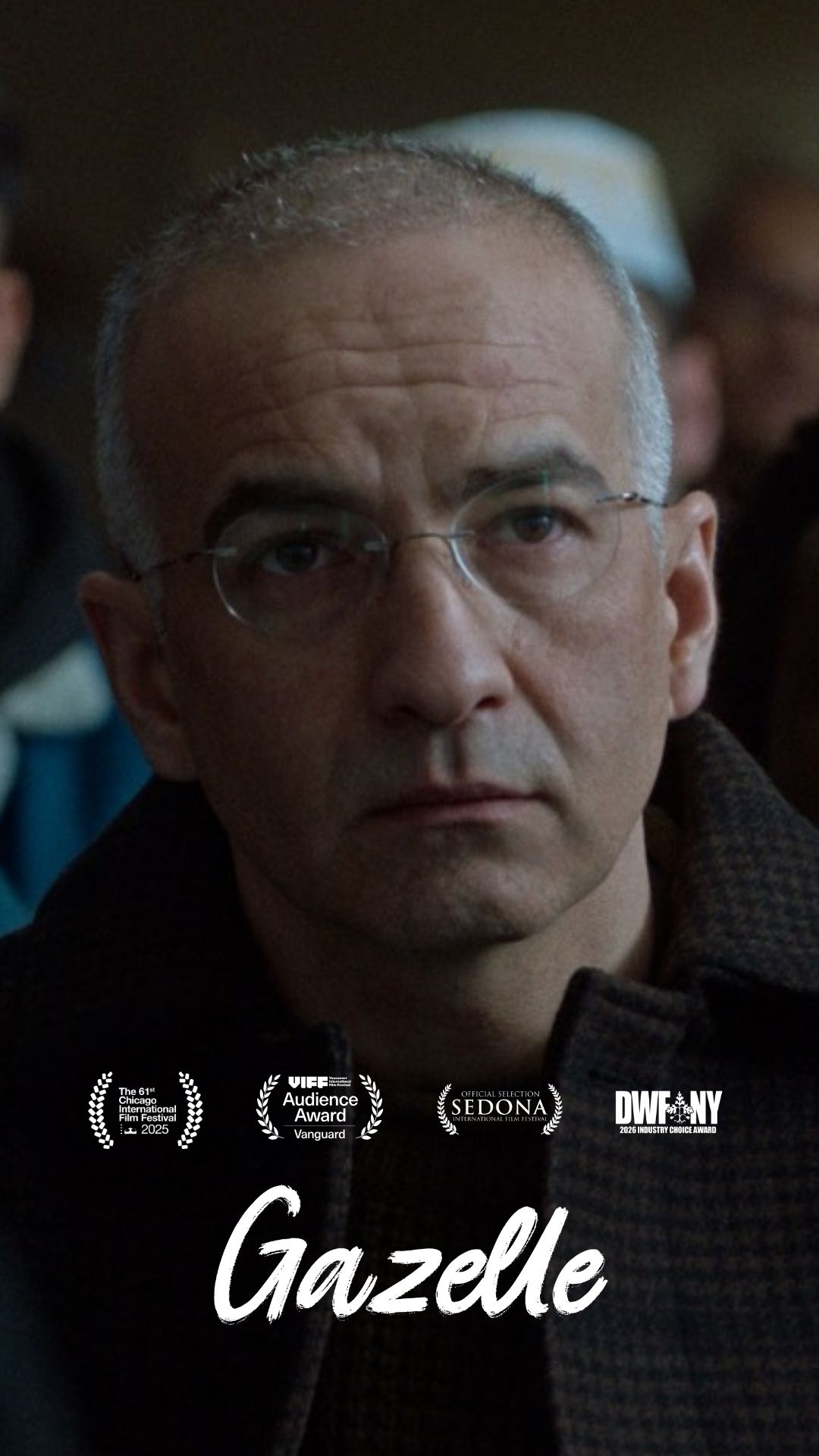
What was supposed to be a family vacation in New York became a life in exile.
For award-winning Turkish actor Nadir Sarıbacak, everything changed in 2016 when political upheaval back home made returning to Turkey impossible.
Once celebrated for his role in the Palme d’Or-winning Winter Sleep and honored with a Best Actor award for Ivy, Sarıbacak suddenly found himself driving Uber and delivering packages to support his family in America.
Imagine building a successful career, only to find yourself starting over in a country you never planned to call home.
Years later, Sarıbacak drew on his experience of displacement to create GAZELLE, a deeply personal film exploring family separation, exile, and the longing for home.
But how do you rebuild your life when going back is no longer an option? And what happens to the dreams, relationships, and sense of belonging you leave behind?
In this conversation with The Immigrant Magazine, Sarıbacak shares the story behind GAZELLE and the immigrant experience that shaped it.
His journey from Turkey to America and the story behind GAZELLE
Before the recognition and acclaimed films, where did your story begin? Tell us about growing up in Turkey and what first drew you to acting.
My love of acting actually goes back to my childhood. I grew up as an only child in a sensitive family, and what drew me to acting was noticing, back in primary school, that I felt freer on stage. In Turkey, after I trained as a Turkish-language teacher, I taught in schools for a few years. Then I quit, went to acting school, and later did a master’s degree in acting. For 10 to 12 years I worked as an actor at a large, important theater in Istanbul. The turning point for me came when my teachers at the school recommended me and I played the lead in the film “Wrong Rosary.” That film won the best film award at the Rotterdam Film Festival. And after I won best actor at the TOFIFEST Film Festival, moving forward step by step as an actor in Turkey had become easier.
What did home mean to you before that trip to New York? What do you remember about the everyday life you and your family had built?
Before the trip to New York, I had been offered the lead role in a TV series. A more comfortable life was about to begin for my family and me. I actually felt more secure financially, and more rooted in Istanbul. I thought I could finally make long-term plans. Home, for me, was the place where I felt safe and could put down roots. I don’t think that anymore.
Ten years ago my children were little. We spent our days with them in Istanbul’s crowded streets and in its parks. When I think back on those days now, with the ferries, the old wooden houses, the street vendors and the bazaars, it feels as if we had lived in a city from another era, then suddenly died, and opened our eyes again in this new country, America.
We understand that your acceptance speech at the Antalya Film Festival was cut from the broadcast. What did you want to say that evening? How did that experience affect you?
A few hours before the ceremony, in my hotel room, I wrote a speech in case I won. Before I wrote it, I listened to Martin Luther King’s “I Have a Dream” speech, and it inspired me. My intention was to give a speech about “getting to know one another, embracing, and understanding each other,” so that the discrimination and divisions that had been growing in my country for years would come to an end.
I didn’t know they had cut the speech. I was so excited anyway. Interestingly, once they cut it, the speech spread across the whole country very quickly. So instead of the 1,000 people in the hall, the whole country ended up hearing it. And do you know what’s even funnier? The channel that cut my speech had “No to censorship” written in the top right corner of the screen.
Take us back to the vacation that changed your family’s life. When did you begin to understand that returning home might no longer be possible?
For the first few weeks, we honestly didn’t realize it. We still thought we could go back. Then, as the money in my pocket started to run out, a close friend called me from Houston. “Come and stay here for a while,” he said, “you can go back to Turkey from here.” Five of us stayed as guests in a single room in his house. As the days went by, it became clearer and clearer that we couldn’t go back. You can guess the rest. Before there was even time to fall into depression, my wife and I quickly learned to drive, and I started packing boxes in a warehouse. I had actually understood within the first month that we could no longer go back. My wife, sadly, understood it fully seven months later, on the day she lost her father and couldn’t go to his funeral.
How did you and your wife navigate that uncertainty as parents? What helped you give your children a sense of stability while you were still figuring out what came next?
My eldest son was nine at the time. The others were younger. Of course, the children sometimes showed a sadness, and sometimes an aggression, that we couldn’t quite put a name to. I even have a photo, and I wish I could show it to you. It’s from the first day of school: they’re holding on to their mother, not wanting to go. That photo really said everything. As much as we could, we spent time with the children and played games with them. We tried not to let them feel what we were going through. Our friends from Turkey tried to support us by taking us on picnics or short nature walks. And when we were setting up our first home, our friends in Houston brought us the extra things they had at home (beds, quilts, clothes, dishes…), which moved us deeply. All of this made us stronger, emotionally and mentally, and we pulled ourselves together quickly and gave our energy to our children. I think we got through those first few years with as little damage as possible.
You went from an established acting career to driving for Uber and delivering for Amazon. What do you remember most about that period? What did it teach you about yourself and the work of starting over?
Looking at my situation from the outside, what I went through was normal. Every immigrant goes through something similar: trying to adapt right away, taking part-time jobs. But inside me, there were earthquakes. When I remember that period, I remember working nonstop, doing physical labor, and never letting anyone see what I was feeling. But inside, I felt an emptiness. A sense of nothingness that I can’t describe. Yes, that’s the word that says it best: “nothingness.”
I don’t think I learned anything from life in those first few years. Then, once I started getting used to life as an immigrant, once I began to accept that I had come down a little in the world, the learning and the experience began for me. It may sound strange, but every day I sit and thank God for letting me live through all of this. In this temporary life, I experienced and understood things I could never have learned from any book. In short, I believe that God created us anew after we migrated. That re-creation gave me new hopes and new dreams. So I think that feeling like “nothing” turned out to be very useful for starting over.
Who helped you find your footing in America? Share a person, community, or moment that made you feel less alone and helped you see a way forward.
The first support came from a very old friend of mine. Then our own community supported us. And they helped not just us, but many people who came from Turkey during that time. I thank them again and again. When Gazelle was screened in Houston seven years later, I was very moved. I watched the film together with all those friends. It meant so much, to me and to them, because we knew how hard those first few years in Houston had been.
What did it take to build a creative career in America, and what led you to direct your first film?
When I moved to New Jersey, I opened a shop where I sold sportswear. At the same time, a friend and I looked for a manager and an agent for my acting. Unfortunately, no one got back to us. Then I acted in a producer’s short film. I won a best actor award at a festival, and we also won best film at the Tribeca Film Festival. But neither that short film nor the awards helped me get back into acting. Then I reached out to Turkish and Kurdish directors living in Europe and told them I could act in their films, but since they traveled back and forth to Turkey, they didn’t want to work with me. All of this pushed me to write my own script, because I didn’t want to wait for someone to call me anymore. I called my friend Ayhan Hulagu and told him we could write a script about what we had been going through. And that’s how Gazelle began. To come back to the first part of your question: it was “persistence and continuity” in my wish to make films that got us to make our first film.
Your family was together when you found yourselves unable to return to Turkey, while Yakup is separated from his wife and daughter. How did your experience and the stories of others in your community come together in GAZELLE?
Ayhan and I had many friends around us who had left their families behind and lived through this. We brought their experiences together, and we also wove our own psychological journeys into the story. Every immigrant went through something different, but our psychological experiences were the same. Before we started the film, we also got hold of an audio recording from Turkey. A real recording. It was a father in prison talking to his daughter. He was trying to convince her that they would be together again, that he would bring her dolls, but his five-year-old daughter just wouldn’t be convinced. That recording affected us deeply. And we decided to build the story around that relationship.
As Yakup waits, his memories and sense of reality begin to blur. How did you bring that experience to the screen, both as an actor and as a first-time director?
There’s a principle in psychology: “How you react to events in a moment of trauma or hardship tells us about your true character.” The moment Yakup realizes he can’t bring his family over right away, his state of mind starts to break down, step by step. He panics and starts making hasty decisions. That makes him see everything more blurrily and leads him to burnout. That “psychological process” is what we focused on. We were curious how he would find his way through it. Some of my friends and I had already lived through similar situations. But while writing and directing, I tried as much as I could to look at the story, and build it, from a healthy place. Otherwise I would have burned out right along with Yakup, and the film would never have been finished.
It’s a long story, but in short: after Ayhan and I finished the script, we put together a wonderful team. It was made up of friends who were living through the same problems we were. I was the one who kept pushing to build that team, but they were the ones who did the good work. If you saw anything good in Gazelle, it’s their work.
Yakup faces a painful choice between waiting for legal reunification and taking a dangerous risk to bring his family together. What do you hope audiences understand about the human cost of that uncertainty?
When I was writing Gazelle, my biggest dream was for it to be understood not only by immigrants, but by other people too. What did I want? When people face a serious hardship in their lives, how should they respond? How can they get through it as maturely as possible, with as little damage as possible? We wanted to make this film so that these questions would be talked about and understood. What we really wanted was for the audience to go home with these feelings.
What does home mean to you now, and what have you learned that might help someone beginning again in an unfamiliar country?
That’s a beautiful question, thank you. Now that I’ve reached 50, home for me is a guesthouse. God created the earth as one big home for us to live in. So I now feel like a guest in this home. My children feel American. But I don’t feel that I belong to any one place.
During this journey as immigrants, my wife and I hosted four different families in our home for months. That was how we tried to repay the kindness that was shown to us. Newcomers should feel that they’re not alone. Everyone goes through similar problems, and somehow they get solved. We should be social and support the other immigrants around us, and even the locals. I believe that’s how we’ll stay healthier.
Find all upcoming screenings across the US here: https://www.gazellefilm.com/screenings/
#NadirSaribacak #GAZELLEFilm #ImmigrantStories #TurkishCinema #Exile #ImmigrantExperience #AwardWinningActor #TheImmigrantMagazine