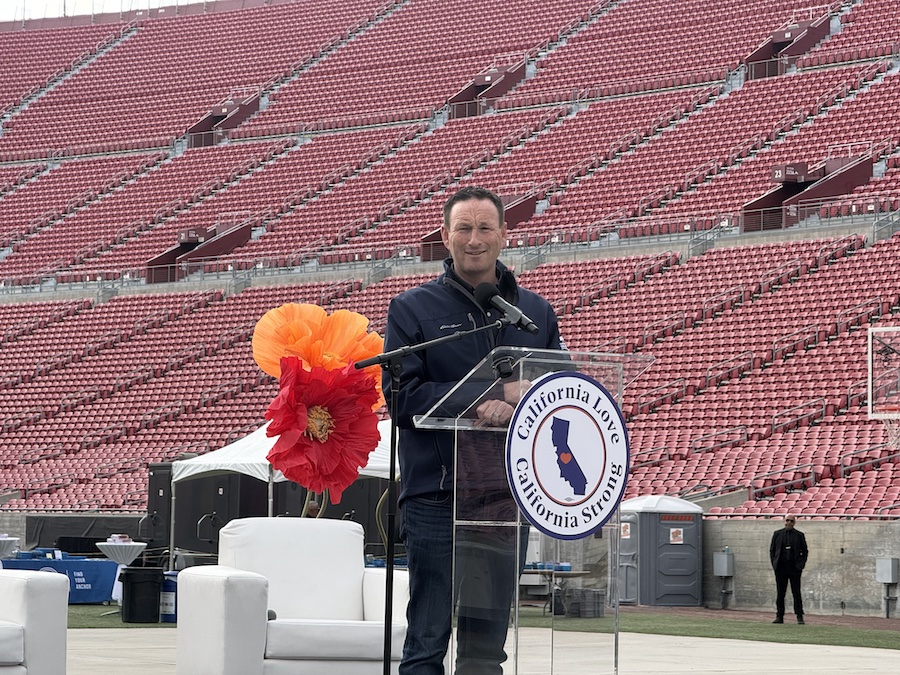
On a warm afternoon at the Los Angeles Memorial Coliseum, the message wasn’t just about mental health—it was about purpose.
As part of California Love, California Strong (CLCS), led in partnership with the Office of Community Partnerships and Strategic Communications (OCPSC), hundreds of young people gathered not only to talk about mental health but also to reimagine how healing begins.
For Josh Fryday, California’s Chief Service Officer, that answer is clear: service.
“My name is Josh. I’m 45 years old, and I want to be like Leo when I grow up,” he began, pointing to a young participant in the crowd—grounding the moment in something simple, human, and generational.
But his message quickly deepened.
He shared the story of a Navy sailor who had served for nearly two decades before asking for help with anxiety and depression—only to face being pushed out of service for it. Fryday helped defend him, and the case became a turning point.
The lesson stayed with him.
“Seeking mental health… is not a sign of weakness. It is the greatest sign of strength.”
That idea—redefining strength—sat at the center of his remarks.
In a time when young people are navigating rising anxiety, isolation, and uncertainty, Fryday pointed to a less discussed solution: giving them something to belong to.
Citing research highlighted in a Harvard report, he explained that one of the most effective ways to address the youth mental health crisis is to give young people a sense of purpose—and a chance to serve others.
Because, as he put it, people don’t just want to be loved.
They want to love.
“They want the opportunity to love others, to love their community, to take care of others… and service is how we manifest that love.”
That philosophy is shaping California’s approach.
Through the California Service Corps—the largest service corps in the country—thousands of young people are stepping into roles that allow them to support their communities while building pathways for their own futures.
The impact is layered.
Young people gain experience, purpose, and financial support. Communities receive critical services. And the state builds a stronger, more representative mental health workforce.
Programs like the Mental Health Career Pathways initiative take that even further—placing young people directly into schools and communities where they provide peer support and non-clinical mental health care.
It’s a model rooted not just in treatment but in participation.
“It’s a win, win, win,” Fryday said, describing a system that supports individuals, strengthens communities, and builds long-term capacity.
But even as he spoke about systems and programs, he returned repeatedly to something more fundamental: partnership.
From philanthropic organizations to local leaders and community spaces like Exposition Park, the work, he emphasized, does not happen in isolation.
It is built collectively.
And that collective effort reflects a broader shift in how mental health is being understood—not just as an individual challenge, but as a shared responsibility.
Across the event, that idea was visible.
Young people weren’t just participants—they were contributors. Volunteers weren’t just helping—they were shaping the experience. Conversations weren’t confined to stages—they were happening across the field, in motion, in real time.
For many, especially those from immigrant and underserved communities, where mental health stigma still lingers, this approach offers something different.
It creates an entry point.
A way to engage without labels.
A way to connect without pressure.
A way to heal through action.
Because sometimes, the first step toward feeling better isn’t talking.
It’s doing.
It’s showing up.
It’s helping someone else—and realizing you’re not alone in the process.
And in that sense, what unfolded at the Coliseum wasn’t just a gathering.
It was a redefinition.
Not just of mental health.
But of what it means to belong.
#MentalHealthMatters #YouthPurpose #CaliforniaStrong #CommunityCare #ServiceLeadership #YouthVoices #HealthEquity #ImmigrantVoices