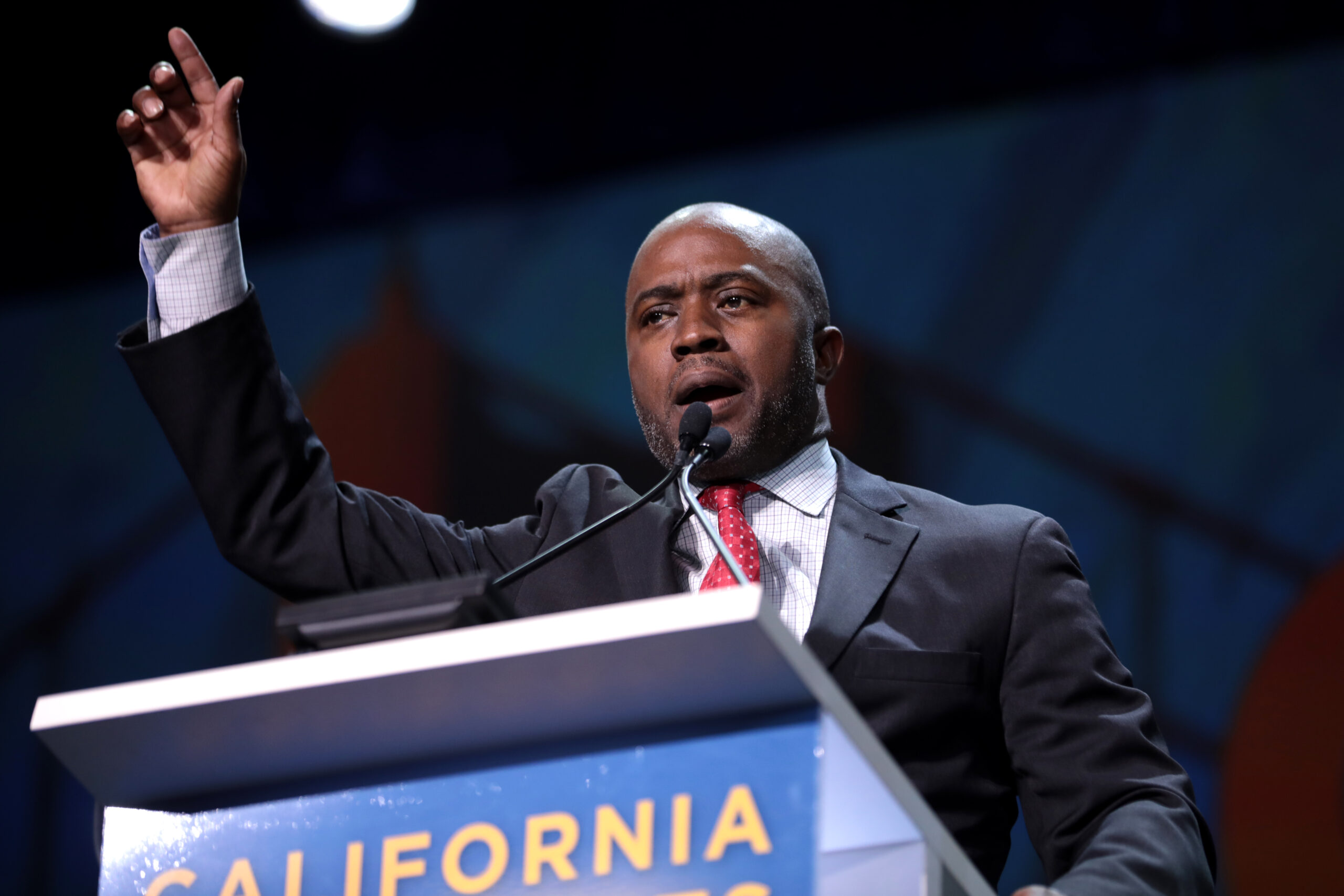
As economic pressure and immigration tensions rise, Thurmond outlines a sweeping vision to rebuild California’s housing, healthcare, and economic systems.
Magazine, The Immigrant Experience
In California, survival is becoming a strategy.
A mother in the Central Valley delays a doctor’s visit because Medi-Cal coverage feels uncertain. In Los Angeles, a rent increase quietly turns a two-bedroom apartment into a shared space for two families. In the fields before sunrise, a farmworker moves through the rows with practiced focus—carrying not just the weight of labor but also the quiet calculation of risk.
This is how pressure lives here—steady, unrelenting, often invisible to those not forced to navigate it.
And it is into this reality that Tony Thurmond is running for governor.
In the middle of California’s high-stakes gubernatorial race, Thurmond joined a recent American Community Media (ACOM) briefing moderated by journalist Pilar Marrero, where ethnic media reporters pressed him directly on the issues shaping their communities. These were not abstract questions. They were rooted in lived experience—where immigration policy, healthcare access, and affordability are daily negotiations.
What followed was not a performance. It was a proposition.
“I believe that a better California is possible,” Thurmond said.
But his version of “better” does not live in incremental change. It calls for something more disruptive: a willingness to rebuild systems that, for many, have stopped working altogether.
Immigration is where that argument sharpens.
“I was the first candidate to call for abolishing ICE,” Thurmond said.
For some, it is a radical line. For others, it names a reality long felt.
In immigrant communities, enforcement is not an abstract policy—it is a presence. It shapes where people work, how they move, what risks they take, and what futures they allow themselves to imagine. It is a system that, like a border drawn through daily life, separates safety from uncertainty in ways both visible and unseen.
Thurmond’s critique is direct: the current model is not just ineffective—it is harmful. He pointed to deportations of essential workers, deaths in detention, and the expansion of private facilities where detention becomes profit.
His response moves on two tracks.
At the federal level, he calls for dismantling ICE and replacing it with a system that prioritizes lawful pathways to citizenship—one that recognizes immigrant labor not as expendable but essential.
At the state level, his approach is immediate. He is backing legislation that would impose a 50% tax on companies operating immigration detention centers in California—an economic strategy designed to push them out.
“We don’t want ICE here,” he said.
The message is clear: if policy cannot yet be rewritten in Washington, it can still be resisted in California.
Healthcare, in Thurmond’s telling, reveals a different kind of failure—quieter, but no less devastating.
His support for single-payer healthcare is anchored in loss. His brother died at 35 after losing access to insurance.
“No person should lose their life simply because they don’t have health insurance,” he said.
For many immigrant families, where access to care is often fragile or delayed, that statement lands with familiarity.
He warned that federal changes are already pushing people off Medi-Cal and raising costs across the board. The result is not dramatic in the moment but cumulative: skipped appointments, untreated conditions, and emergencies that could have been prevented.
His proposal is sweeping—remove profit from healthcare and expand access universally, including to undocumented Californians.
But beneath the policy is a deeper question: what does a system owe the people who rely on it to survive?
If immigration is about belonging, and healthcare about survival, affordability is where both are tested daily.
Housing sits at the center.
For many families, especially immigrants, housing is not just shelter—it is stability, proximity to work, access to schools, and community. When it becomes unaffordable, everything else begins to shift.
“We are experiencing a crisis of supply and demand,” Thurmond said.
His solution is scale: build two million housing units by 2030.
The plan leans on underutilized public land—particularly from school districts—and pairs it with state funding and private development. The goal is not just more units, but accessible ones: housing that keeps teachers, nurses, and working families rooted in the communities they serve.
He also supports expanding rent control, arguing that without immediate protections, long-term solutions arrive too late.
At the same time, he resists offering easy promises.
“The state can’t just make prices go down,” he said.
So his approach reflects a dual reality—relief now, restructuring over time.
That same logic shapes his economic plan.
A proposed billionaire tax—targeting individuals with more than $150 million in assets—would fund direct tax credits for working families. It is both redistribution and relief, aimed at easing the daily costs that have quietly reshaped life across the state.
For small businesses, many of them immigrant-owned, his focus shifts to access.
“Small business is the backbone of our economy,” he said.
He proposed cutting bureaucratic barriers, expanding access to state contracts, and offering financial support to help businesses grow.
In neighborhoods where storefronts carry not just commerce but culture—where a restaurant, a salon, or a market becomes a bridge between worlds—those policies are about more than economics. They are about continuity.
Education brought the conversation back to something foundational.
When asked about efforts in other states to deny undocumented children access to public education, Thurmond’s answer was immediate.
“All children have the right to an education,” he said.
He pointed to California’s protections and committed to strengthening them. He also proposed expanding access across borders—allowing students living near the U.S.-Mexico border to attend California schools and access community college pathways.
It is an idea that reflects a broader philosophy: that opportunity should not be confined by the lines that divide us.
Throughout the exchange, ethnic media did more than host the conversation—it shaped it.
These are platforms rooted in trust, in proximity, in lived understanding. They ask different questions because they see different realities. And in doing so, they create a space where policy must answer to people.
For Thurmond, that meant clarity.
It also meant acknowledging limits. Many of his proposals—abolishing ICE, creating a national wealth tax, and establishing pathways to citizenship—depend on federal action.
But his argument is that states can still lead. They can push, resist, and model something different.
When the conversation turned to his campaign—polling challenges, calls to step aside—Thurmond stayed consistent.
“I don’t think polls elect anyone. People do,” he said.
It is a familiar sentiment, but here, it reads as something more grounded. His campaign is not built on inevitability. It is built on recognition—that voters who are living with these pressures may see themselves in a platform that names them directly.
California does not lack ideas.
What it faces is a deeper question: how much change is it willing to embrace?
What Thurmond offered in this conversation was not moderation. It was a reframing.
A belief that systems should serve people—not strain them. That policy should reflect lived reality—not political convenience. That dignity should not depend on status, income, or access.
For the families already navigating impossible choices, the stakes are not abstract.
They are daily. They are personal. They are real.
And in this race, Thurmond is asking a simple, difficult question:
What would it look like to build a California that actually holds them?
#CaliforniaPolitics #GovernorRace #TonyThurmond #HousingCrisis #HealthcareForAll #ImmigrantRights #CostOfLiving #EconomicJustice #EthnicMedia