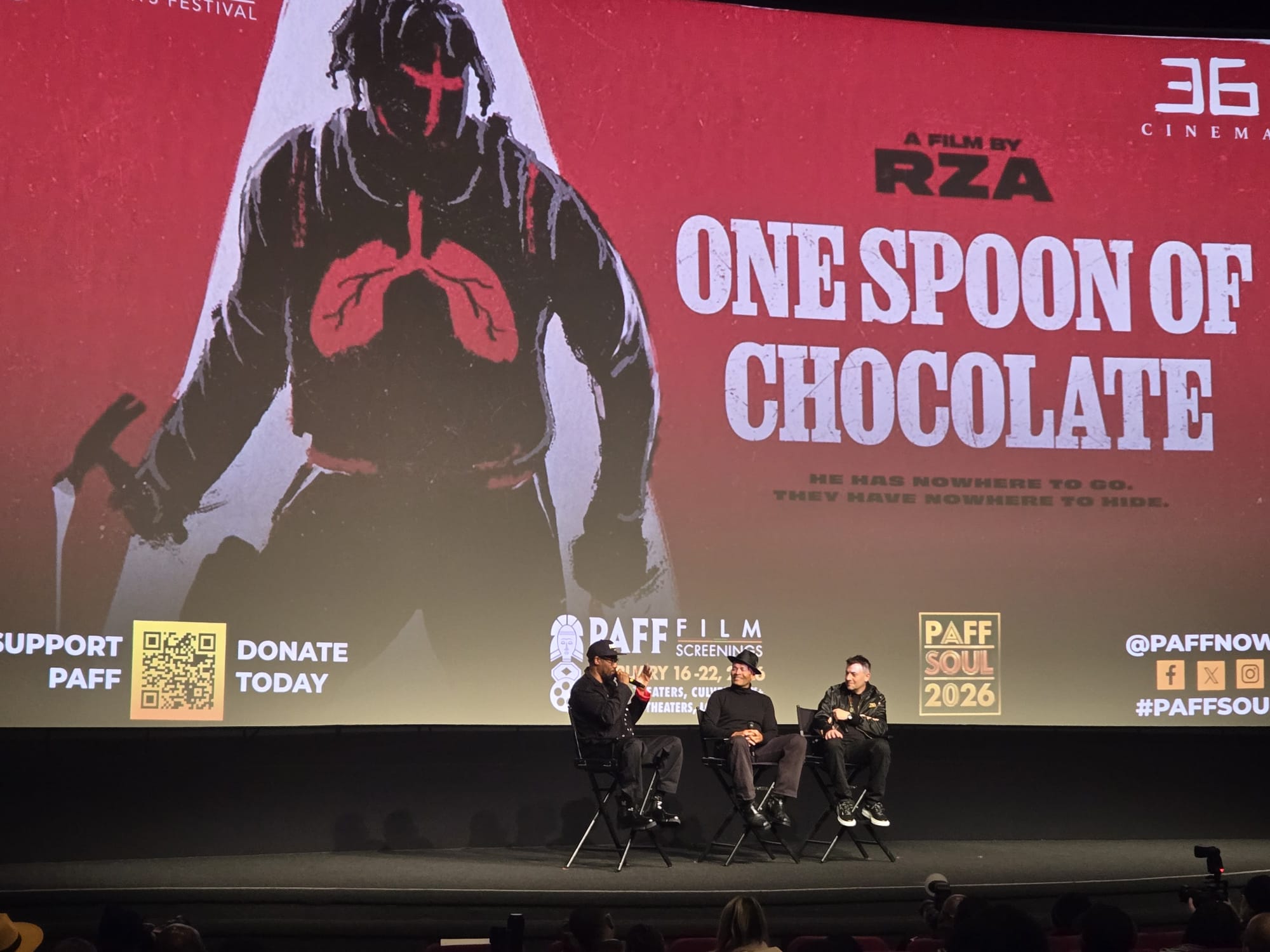
At the 34th Annual Pan African Film Festival in Los Angeles, One Spoon of Chocolate did not quietly arrive.
The West Coast premiere played to a completely sold-out, 600-seat theater — a full house of artists, filmmakers, executives, and community members packed into the Directors Guild of America screening room. The anticipation was palpable long before the lights dimmed. This wasn’t casual attendance. It was expected.
By the time the credits rolled, that expectation had turned into sustained applause.
What followed elevated the night further.
RZA — founder of the Wu-Tang Clan and director of the film — returned to the stage for a live conversation moderated by Mario Van Peebles, joined by the film’s director of photography. What unfolded was not routine festival commentary. It was a serious discussion about authorship, political timing, lineage, and what it means to create art that refuses dilution.
RZA revealed that the story for One Spoon of Chocolate had lived inside him for thirteen years. He began writing it more than a decade ago—long before the current political climate intensified around belonging, power, and systemic neglect. But the script stalled at page forty.
It wouldn’t move.
Then came the writer’s strike. Ironically, during a moment when writing was formally paused, the story returned. On the back of a tour bus, traveling across the country with his wife, RZA began writing again — six to eight pages a day. The film did not feel engineered for the market. It felt released.
He described the process as something passing through him rather than something forced into existence.
That rhythm defines the film.
Coming from hip-hop, RZA builds cinema the way he builds music — in beats. Film, he explained, unfolds like a snake: head to middle to tail. A painting can be absorbed in a glance. A film requires movement. Tempo. Patience. Tension.
He samples cinematically the way he once sampled musically — studying directors like John Woo and Quentin Tarantino, blending genre with intention. Action, silence, confrontation — all arranged with cadence.
The result is a film that resists a fixed time period. It could be the 1980s. The 1990s. Or today. That ambiguity is intentional. Because while One Spoon of Chocolate was not written as a political statement, it now feels urgent.
At its core, the story follows an ex-military convict trying to restart his life in a small town. Instead, he collides with a system that offers little grace and even less support. Veterans returning home unseen. Individuals navigating spaces that were never designed for their restoration.
There is a fictional town in the film — “Karensville, Ohio.” It does not exist geographically. But culturally, it feels familiar.
RZA is not delivering a lecture about the system. He is showing how it operates — quietly, structurally, predictably.
Mario Van Peebles framed the larger issue plainly. We are living in an era of “easy diet stuff.” Sequels. Franchises. Safe narratives that comfort rather than confront.
He referenced his father’s groundbreaking film Sweet Sweetback’s Baadasssss Song — a project that disrupted American cinema not because it was universally embraced, but because it demanded reaction. Debate. Engagement.
That is the lineage RZA steps into.
Not art designed for passive consumption.
Art designed to generate conversation.
The title carries its own thesis: one spoon of chocolate changes an entire glass of milk. A small infusion alters the entire composition.
One uncompromising film can disrupt a complacent industry.
One bold voice can shift cultural temperature.
What happened at PAFF was not a ceremonial Q&A. It was intergenerational affirmation — a filmmaker shaped by Black cinematic rebellion affirming a cultural producer who refuses to dilute his vision.
The room was full. The conversation was pointed. The applause was sustained.
Not for spectacle.
But for intention.
For risk.
For art that refuses to be diet.
If you care about Black cinema, independent filmmaking, and storytelling that resists formula, this conversation is worth your time.
Watch the full interview between Mario Van Peebles and RZA here: