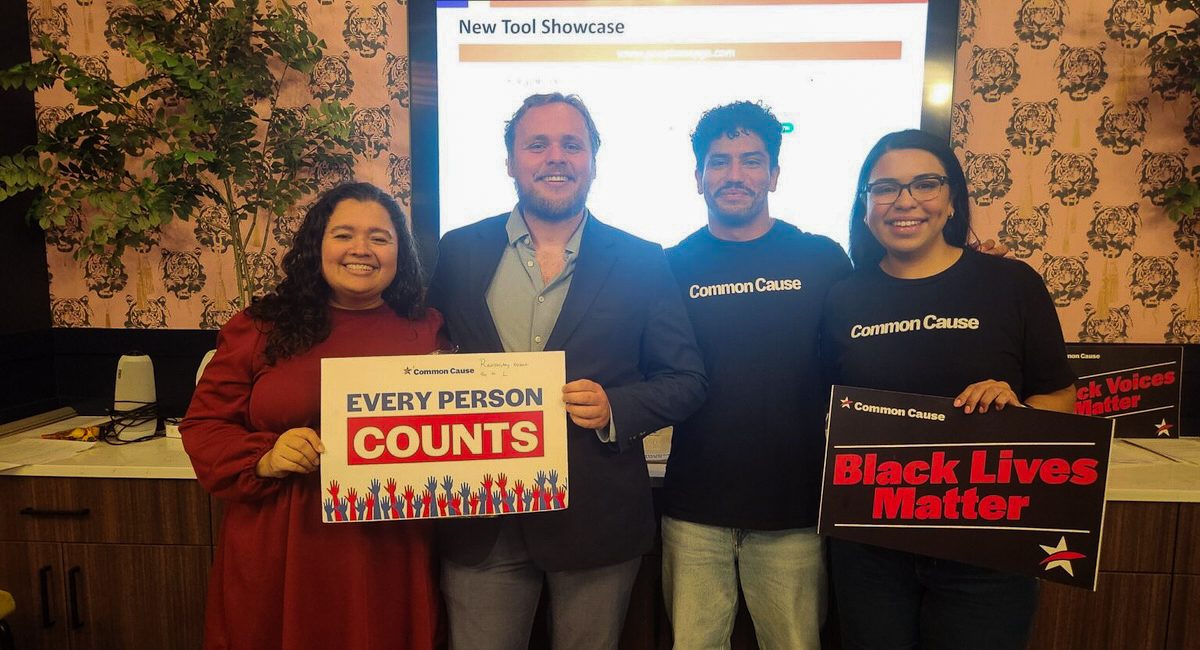
Activists with Common Cause Georgia hold signs calling for fair maps during a redistricting town hall meeting in Duluth, Georgia, on May 23, 2026. (Photo: Jongwon Lee)
A special legislative session to redraw Georgia’s maps is sparking fierce pushback from voting rights advocates and Democratic lawmakers.
Magazine, The Immigrant Experience, By Jongwon Lee, American Community Media
A highly contentious special legislative session to redraw Georgia’s political maps is sparking fierce pushback from voting rights advocates and Democratic lawmakers.
The political maneuvering began on May 1, 2026, when Governor Brian Kemp told local media “voting is already underway for the 2026 elections.”
The comment was widely interpreted by political observers as an official decision to shut the door on any mid-decade redistricting ahead of the 2026 midterms.
At the time, Kemp’s stance positioned Georgia as a notable exception among Republican-led Southern states following the U.S. Supreme Court’s April 2026 decision in Louisiana v. Callais. That ruling weakened Section 2 of the Voting Rights Act — the primary legal mechanism used to challenge discriminatory voting maps — prompting states like Alabama and Tennessee to quickly move toward dismantling majority-Black districts.
However, Kemp reversed course just weeks later on May 13, issuing a proclamation that officially summoned lawmakers back to the state Capitol for a special redistricting session set to convene this June 17.
The timing of the session introduces an unusual layer of political complexity. The regular 2026 legislative session adjourned on April 3, and the state’s primary elections were held on May 19 based on lines drawn during a 2023 special session.
Those 2023 maps had been redrawn to include additional majority-Black districts following a federal court mandate. With primary runoffs scheduled for June 16, the new redistricting battle will begin exactly one day later.
“Georgia has already seen two redistricting cycles in the 2020s, and now a third is coming in 2026,” said Kyle Gomez-Leinweber, political director of Common Cause Georgia.
Gomez-Leinweber predicted that the upcoming session would trigger a comprehensive overhaul, “establishing a brand-new map configuration explicitly engineered for the 2028 elections.”
Asian American Democratic lawmakers are raising alarms over how the redrawn boundaries will impact minority voters. Speaking at a Korean American convening event on May 30, State Representative Sam Park (D-Lawrenceville) warned that the upcoming maps threaten to dilute the growing political influence of diverse communities.
“This redistricting effort will likely knock back the political progress of minority communities by 10 to 20 years,” he said, noting that “the shift comes just as the state’s multibillion-dollar budget could otherwise be leveraged to invest directly back into communities like Korean Americans.”
Park cautioned that communities of color risk being “packed, cracked and ordered” to systematically undermine their legislative voice, urging voters to counter the effort through vigorous civic engagement.
The legislative reality remains an uphill battle for the minority Democratic party. At a redistricting town hall meeting in Duluth on May 23, State Representative Marvin Lim (D-Norcross) acknowledged the structural hurdles.
“While Georgia Democrats intend to propose their own alternative House maps, the bills that ultimately advance are entirely controlled by the Republican majority,” he stated.
He explained that map-makers rely on a mix of internal and external polling data, voter canvassing records and broad neighborhood political “vibes” to draw lines behind closed doors. Consequently, he urged voters to make the most of the brief time remaining before the June 17 session and contact their lawmakers directly.
To effectively capture a legislator’s attention, Lim strongly advocated direct phone calls over digital outreach.
“The vast majority of my colleagues do not check email,” he noted, adding that placing phone calls to legislative offices, attending local town halls or visiting the state Capitol in person remain the most reliable ways to influence representatives before the session opens next week.
#GeorgiaPolitics #Redistricting #KoreanAmericans #VotingRights #AAPI #CivicEngagement #ImmigrantVoices #Democracy #Representation #AsianAmericanPolitics